QUESTION IMAGE
Question
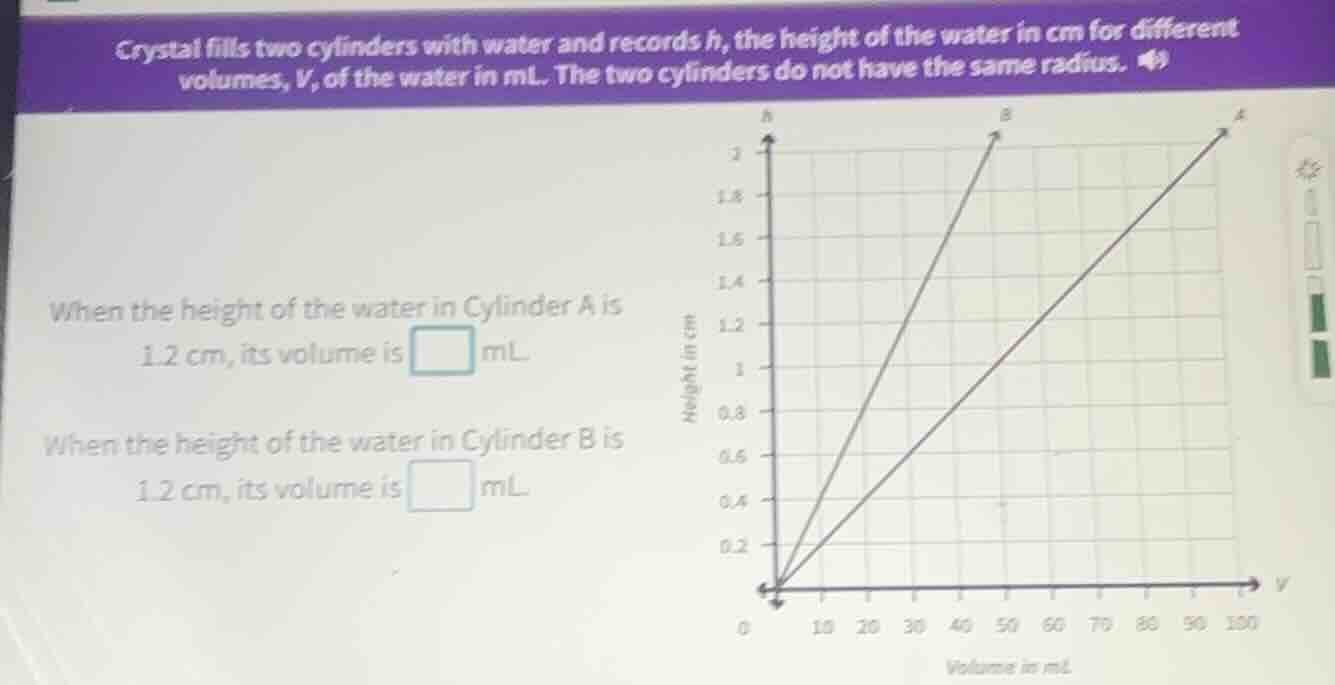
crystal fills two cylinders with water and records h, the height of the water in cm for different volumes, v, of the water in ml. the two cylinders do not have the same radius.
when the height of the water in cylinder a is 1.2 cm, its volume is \boxed{} ml.
when the height of the water in cylinder b is 1.2 cm, its volume is \boxed{} ml.
Step1: Analyze Cylinder A's Graph
First, we need to find the relationship between volume (\(V\)) and height (\(h\)) for Cylinder A. From the graph, we can see that when \(h = 2\) cm (approximate, looking at the line for A), \(V = 100\) mL? Wait, no, let's check the grid. Wait, the x - axis is volume (mL) from 0 to 100, y - axis is height (cm) from 0 to 2. Let's find the slope (rate of change) for Cylinder A. Let's take two points on Cylinder A's line. Let's say when \(V = 100\) mL, \(h = 2\) cm? Wait, no, looking at the graph, the line for A: let's see the coordinates. Wait, maybe better to find the equation of the line for A. Let's assume the line for A passes through (0,0) and (100, 2) (since at \(V = 100\) mL, \(h = 2\) cm? Wait, no, the top of A is at \(V = 100\) mL, \(h = 2\) cm? Wait, the y - axis is height, x - axis is volume. So for Cylinder A, the line goes from (0,0) to (100, 2). So the slope \(m_A=\frac{h}{V}=\frac{2}{100} = 0.02\) cm/mL. So \(h = 0.02V\). We need to find \(V\) when \(h = 1.2\) cm. So \(1.2=0.02V\), then \(V=\frac{1.2}{0.02}=60\) mL. Wait, alternatively, we can use proportionality. Since \(h\) and \(V\) are proportional (cylinder volume formula \(V=\pi r^2h\), so \(V\) is proportional to \(h\) for a fixed cylinder). So if at \(h = 2\) cm, \(V = 100\) mL (from the graph, the end point of A is (100, 2)), then \(\frac{h_1}{V_1}=\frac{h_2}{V_2}\). So \(\frac{2}{100}=\frac{1.2}{V}\), cross - multiply: \(2V = 1.2\times100\), \(2V = 120\), \(V = 60\) mL.
Step2: Analyze Cylinder B's Graph
For Cylinder B, let's find the relationship between \(V\) and \(h\). The line for B passes through (0,0) and (50, 2) (since at \(V = 50\) mL, \(h = 2\) cm? Wait, the top of B is at \(V = 50\) mL, \(h = 2\) cm? Wait, looking at the graph, the line for B: when \(V = 50\) mL, \(h = 2\) cm. So the slope \(m_B=\frac{h}{V}=\frac{2}{50}=0.04\) cm/mL. So \(h = 0.04V\). We need to find \(V\) when \(h = 1.2\) cm. So \(1.2 = 0.04V\), then \(V=\frac{1.2}{0.04}=30\) mL. Alternatively, using proportionality. If at \(h = 2\) cm, \(V = 50\) mL, then \(\frac{h_1}{V_1}=\frac{h_2}{V_2}\). So \(\frac{2}{50}=\frac{1.2}{V}\), cross - multiply: \(2V=1.2\times50\), \(2V = 60\), \(V = 30\) mL.

Snap & solve any problem in the app
Get step-by-step solutions on Sovi AI
Photo-based solutions with guided steps
Explore more problems and detailed explanations
For Cylinder A: \(\boxed{60}\) mL.
For Cylinder B: \(\boxed{30}\) mL.