QUESTION IMAGE
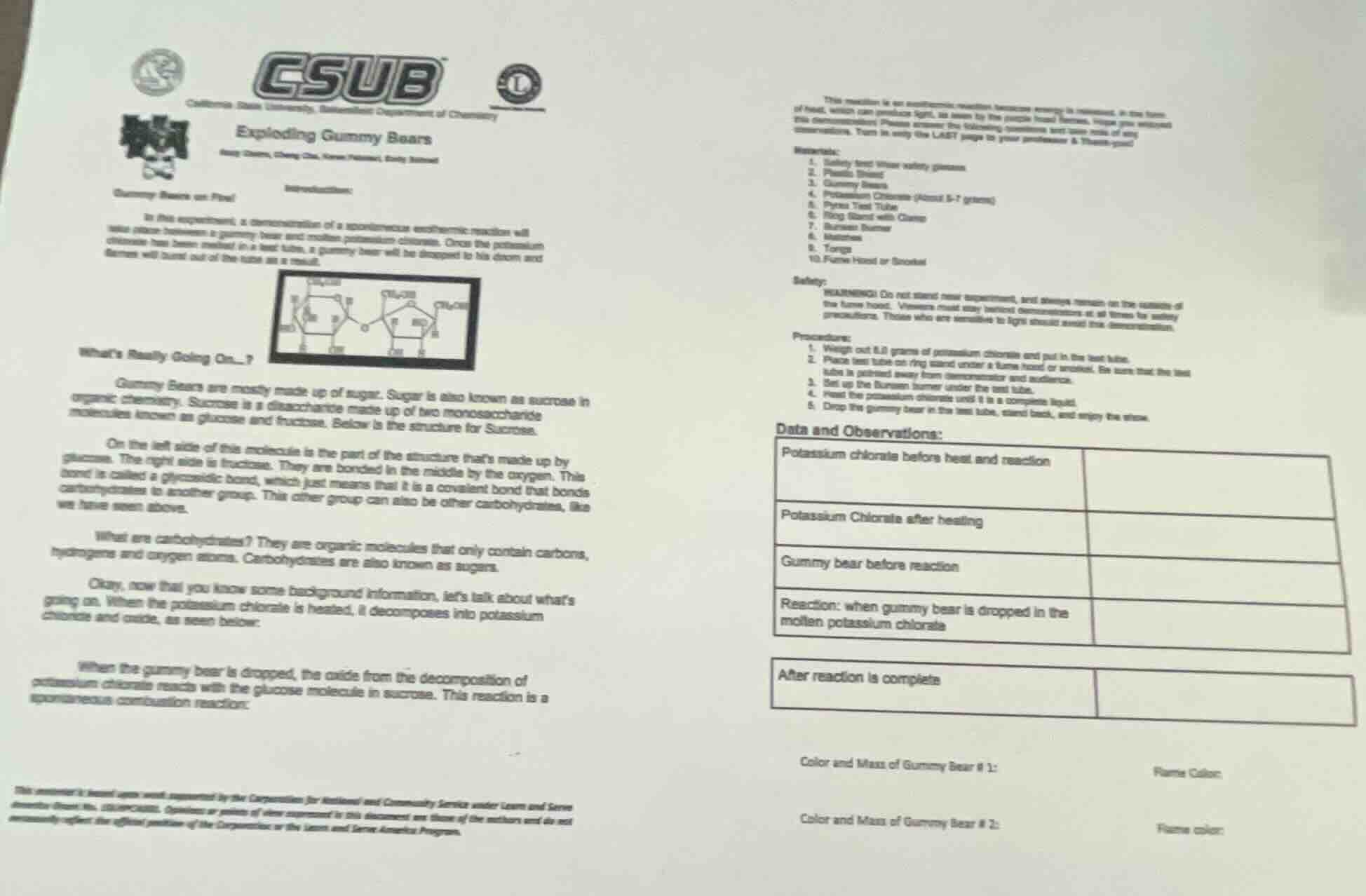
Question
csub
california state university, bakersfield department of chemistry
exploding gummy bears
amy ooms, cheng chu, karen plamer, emily ramey
introduction:
gummy bears on fire!
in this experiment, a demonstration of a spontaneous exothermic reaction will take place between a gummy bear and molten potassium chlorate. once the potassium chlorate has been melted in a test tube, a gummy bear will be dropped to its doom and flames will burst out of the tube as a result.
what’s really going on...?
gummy bears are mostly made up of sugar. sugar is also known as sucrose in organic chemistry. sucrose is a disaccharide made up of two monosaccharide molecules known as glucose and fructose. below is the structure for sucrose.
on the left side of this molecule is the part of the structure that’s made up by glucose. the right side is fructose. they are bonded in the middle by the oxygen. this bond is called a glycosidic bond, which just means that it is a covalent bond that bonds carbohydrates to another group. this other group can also be other carbohydrates, like we have seen above.
what are carbohydrates? they are organic molecules that only contain carbons, hydrogens and oxygen atoms. carbohydrates are also known as sugars.
okay, now that you know some background information, let’s talk about what’s going on. when the potassium chlorate is heated, it decomposes into potassium chloride and oxide, as seen below:
when the gummy bear is dropped, the oxide from the decomposition of potassium chlorate reacts with the glucose molecule in sucrose. this reaction is a spontaneous combustion reaction.
this summer’s beaut camp was supported by the corporation for national and community service under learn and serve america grant no. ul084c08016. opinions or points of view expressed in this document are those of the authors and do not necessarily reflect the official position of the corporation or the learn and serve america program.
this reaction is an exothermic reaction because energy is released, in the form of heat, which can produce light, as seen by the purple flame below. hope you enjoyed the demonstration! please answer the following questions and take note of any observations. turn in only the last page to your professor & thank you!
materials:
- safety goggles (wear safety goggles)
- plastic tongs
- gummy bears
- potassium chlorate (about 5 - 7 grams)
- pyrex test tube
- ring stand with clamp
- bunsen burner
- matches
- tongs
- fume hood or bucket
safety:
warning! do not attempt near experiment, and always remain on the outside of the fume hood. viewers must stay behind demonstrators at all times for safety precautions. those who are sensitive to light should avoid demonstrations.
procedure:
- weigh out 5.0 grams of potassium chlorate and put in the test tube.
- place test tube on ring stand under a fume hood or bucket. be sure that the test tube is pointed away from demonstrators and bystanders.
- set up the bunsen burner under the test tube.
- heat the potassium chlorate until it is a complete liquid.
- drop the gummy bear in the test tube, stand back, and enjoy the show.
data and observations:
| potassium chlorate before heat and reaction | |
|---|---|
| gummy bear before reaction | |
| reaction: when gummy bear is dropped in the molten potassium chlorate | |
| after reaction is complete |
color and mass of gummy bear # 1: flame color:
color and mass of gummy bear # 2: flame color:
Since the problem here is about filling out the data and observations for the "Exploding Gummy Bears" experiment (a chemistry - related experiment), we can describe what is typically observed in each stage:
For "Potassium chlorate before heat and reaction":
- Appearance: It is a white, crystalline solid. It has a powdery or granular texture.
- State: Solid at room temperature.
For "Potassium Chlorate after heating":
- Appearance: When heated until it is molten, it becomes a clear, colorless liquid. If heating is uneven or there are impurities, there might be some slight discoloration, but generally, it is a liquid.
- State: Liquid (molten) after sufficient heating.
For "Gummy bear before reaction":
- Appearance: It has a characteristic gummy - bear shape, is usually colorful (depending on the flavor/type, e.g., red for cherry, yellow for lemon etc.), and has a soft, chewy texture.
- Composition: Mostly made of sugar (sucrose), along with other ingredients like gelatin, flavorings, and colorings.
For "Reaction: when gummy bear is dropped in the molten potassium chlorate":
- Observation: As soon as the gummy bear is dropped into the molten potassium chlorate, a vigorous reaction occurs. There is a rapid combustion - like process. The gummy bear burns very quickly, often with a bright flame. The flame color can vary depending on the elements present in the gummy bear (for example, if there are sodium - based colorings, the flame might be yellow; if there are potassium - based colorings, it might be lilac, but in a typical gummy bear with sucrose, the flame is often yellow - orange due to the carbon - hydrogen - oxygen combustion and possible sodium impurities from the manufacturing process). There is also a lot of heat released, and the gummy bear is quickly consumed, with sparks or a very intense burning visible.
For "After reaction is complete":
- Potassium Chlorate Residue: The molten potassium chlorate that was involved in the reaction will have reacted with the gummy bear. The residue left will likely be a mixture of potassium chloride (from the decomposition of potassium chlorate and subsequent reactions) and other reaction products. It will be a solid again as it cools down, and its appearance will be different from the original molten potassium chlorate, possibly with a more heterogeneous look due to the reaction by - products.
- Gummy Bear Residue: There is little to no gummy bear left in its original form. Most of it has been consumed in the reaction, and any residue will be part of the overall reaction by - products, which are likely to be carbon - based (soot, if incomplete combustion occurs) and other oxidized compounds.
If we were to fill in a table with these observations (assuming a simple text - based table for each row):
| Category | Observation |
|---|---|
| Potassium Chlorate after heating | Clear (or slightly discolored) molten liquid |
| Gummy bear before reaction | Colorful, soft, chewy, sugar - based gummy - bear shape |
| Reaction: when gummy bear is dropped in the molten potassium chlorate | Vigorous, rapid burning with a bright flame, quick consumption of the gummy bear |
| After reaction is complete | Potassium chlorate residue: solid, heterogeneous mixture; Gummy bear: mostly consumed, with reaction by - products |
For the "Color and Mass of Gummy Bear # 1" and "Color and Mass of Gummy Bear # 2" sections, if we assume a typical gummy bear:
- Gummy Bear # 1:
- Color…

Snap & solve any problem in the app
Get step-by-step solutions on Sovi AI
Photo-based solutions with guided steps
Explore more problems and detailed explanations
Since the problem here is about filling out the data and observations for the "Exploding Gummy Bears" experiment (a chemistry - related experiment), we can describe what is typically observed in each stage:
For "Potassium chlorate before heat and reaction":
- Appearance: It is a white, crystalline solid. It has a powdery or granular texture.
- State: Solid at room temperature.
For "Potassium Chlorate after heating":
- Appearance: When heated until it is molten, it becomes a clear, colorless liquid. If heating is uneven or there are impurities, there might be some slight discoloration, but generally, it is a liquid.
- State: Liquid (molten) after sufficient heating.
For "Gummy bear before reaction":
- Appearance: It has a characteristic gummy - bear shape, is usually colorful (depending on the flavor/type, e.g., red for cherry, yellow for lemon etc.), and has a soft, chewy texture.
- Composition: Mostly made of sugar (sucrose), along with other ingredients like gelatin, flavorings, and colorings.
For "Reaction: when gummy bear is dropped in the molten potassium chlorate":
- Observation: As soon as the gummy bear is dropped into the molten potassium chlorate, a vigorous reaction occurs. There is a rapid combustion - like process. The gummy bear burns very quickly, often with a bright flame. The flame color can vary depending on the elements present in the gummy bear (for example, if there are sodium - based colorings, the flame might be yellow; if there are potassium - based colorings, it might be lilac, but in a typical gummy bear with sucrose, the flame is often yellow - orange due to the carbon - hydrogen - oxygen combustion and possible sodium impurities from the manufacturing process). There is also a lot of heat released, and the gummy bear is quickly consumed, with sparks or a very intense burning visible.
For "After reaction is complete":
- Potassium Chlorate Residue: The molten potassium chlorate that was involved in the reaction will have reacted with the gummy bear. The residue left will likely be a mixture of potassium chloride (from the decomposition of potassium chlorate and subsequent reactions) and other reaction products. It will be a solid again as it cools down, and its appearance will be different from the original molten potassium chlorate, possibly with a more heterogeneous look due to the reaction by - products.
- Gummy Bear Residue: There is little to no gummy bear left in its original form. Most of it has been consumed in the reaction, and any residue will be part of the overall reaction by - products, which are likely to be carbon - based (soot, if incomplete combustion occurs) and other oxidized compounds.
If we were to fill in a table with these observations (assuming a simple text - based table for each row):
| Category | Observation |
|---|---|
| Potassium Chlorate after heating | Clear (or slightly discolored) molten liquid |
| Gummy bear before reaction | Colorful, soft, chewy, sugar - based gummy - bear shape |
| Reaction: when gummy bear is dropped in the molten potassium chlorate | Vigorous, rapid burning with a bright flame, quick consumption of the gummy bear |
| After reaction is complete | Potassium chlorate residue: solid, heterogeneous mixture; Gummy bear: mostly consumed, with reaction by - products |
For the "Color and Mass of Gummy Bear # 1" and "Color and Mass of Gummy Bear # 2" sections, if we assume a typical gummy bear:
- Gummy Bear # 1:
- Color: Red (for example, cherry - flavored)
- Mass: Approximately 2 - 3 grams (typical gummy bear mass)
- Flame Color: Yellow - orange (due to sucrose combustion and possible sodium impurities)
- Gummy Bear # 2:
- Color: Yellow (for example, lemon - flavored)
- Mass: Approximately 2 - 3 grams (typical gummy bear mass)
- Flame Color: Yellow - orange (similar to the first, as the main component is sucrose with similar impurity profiles in manufacturing)
These are the typical observations for this well - known "Exploding Gummy Bears" chemistry demonstration.