QUESTION IMAGE
Question
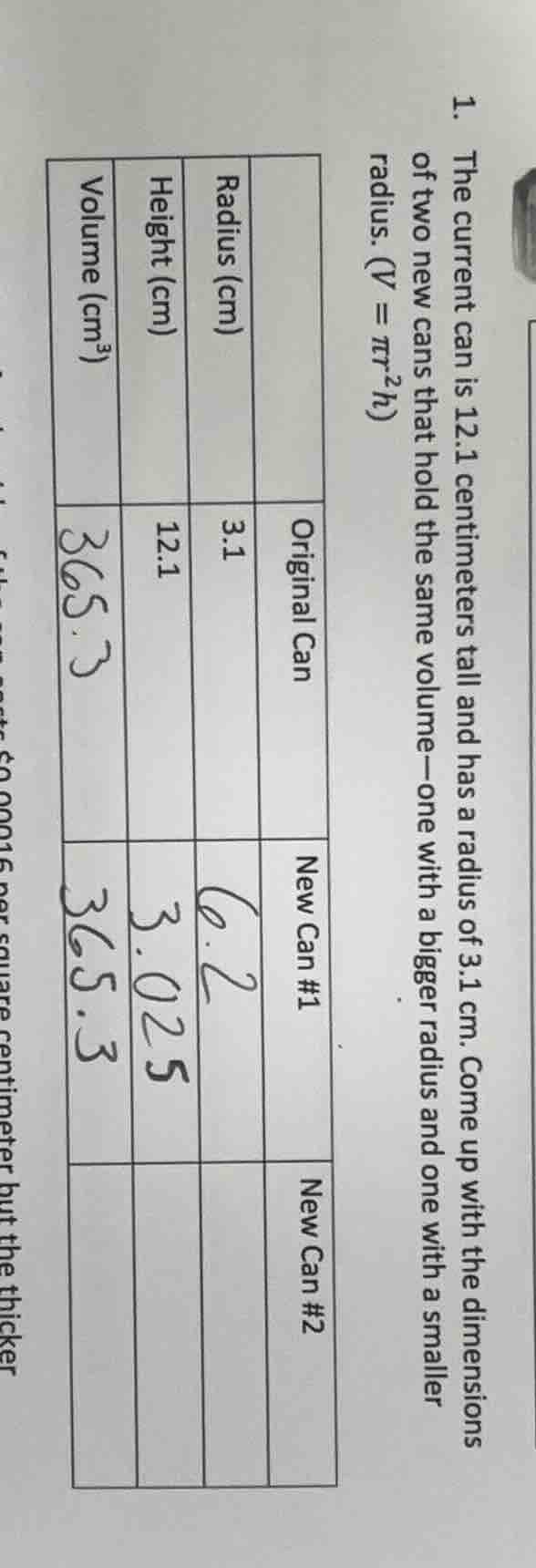
- the current can is 12.1 centimeters tall and has a radius of 3.1 cm. come up with the dimensions of two new cans that hold the same volume—one with a bigger radius and one with a smaller radius. ($v = pi r^2 h$)
| original can | new can #1 | new can #2 | |
|---|---|---|---|
| height (cm) | 12.1 | 3.025 | |
| volume ($mathrm{cm}^3$) | 365.3 | 365.3 |
The volume of a cylinder is given by \( V=\pi r^{2}h \). The original can has \( V = \pi\times(3.1)^{2}\times12.1\approx365.3\space cm^{3}\). We need to find new radii (bigger and smaller) such that the volume remains the same.
Step 1: For New Can with bigger radius (let's take radius \( r_1 = 6.2\space cm \) (double the original radius))
We know \( V=\pi r^{2}h \), so \( h=\frac{V}{\pi r^{2}} \)
Substitute \( V = 365.3\space cm^{3} \) and \( r = 6.2\space cm \)
\( h=\frac{365.3}{\pi\times(6.2)^{2}}=\frac{365.3}{\pi\times 38.44}\approx\frac{365.3}{120.76}\approx3.025\space cm \) (matches the given height for New Can #1)
Step 2: For New Can with smaller radius (let's take radius \( r_2 = 1.55\space cm \) (half the original radius))
Using \( h=\frac{V}{\pi r^{2}} \)
Substitute \( V = 365.3\space cm^{3} \) and \( r = 1.55\space cm \)
\( h=\frac{365.3}{\pi\times(1.55)^{2}}=\frac{365.3}{\pi\times 2.4025}\approx\frac{365.3}{7.547}\approx48.4\space cm \)
So for New Can #2, if we take radius \( r = 1.55\space cm \), then height \( h=\frac{365.3}{\pi\times(1.55)^{2}}\approx48.4\space cm \) (or we can choose other smaller radii, but this is a valid example)

Snap & solve any problem in the app
Get step-by-step solutions on Sovi AI
Photo-based solutions with guided steps
Explore more problems and detailed explanations
For New Can #2, if we choose a smaller radius, say \( r = 1.55\space cm \), then the height \( h=\frac{365.3}{\pi\times(1.55)^{2}}\approx48.4\space cm \) (or any other valid combination where \( V=\pi r^{2}h = 365.3\space cm^{3} \) with \( r<3.1\space cm \))