QUESTION IMAGE
Question
current attempt in progress
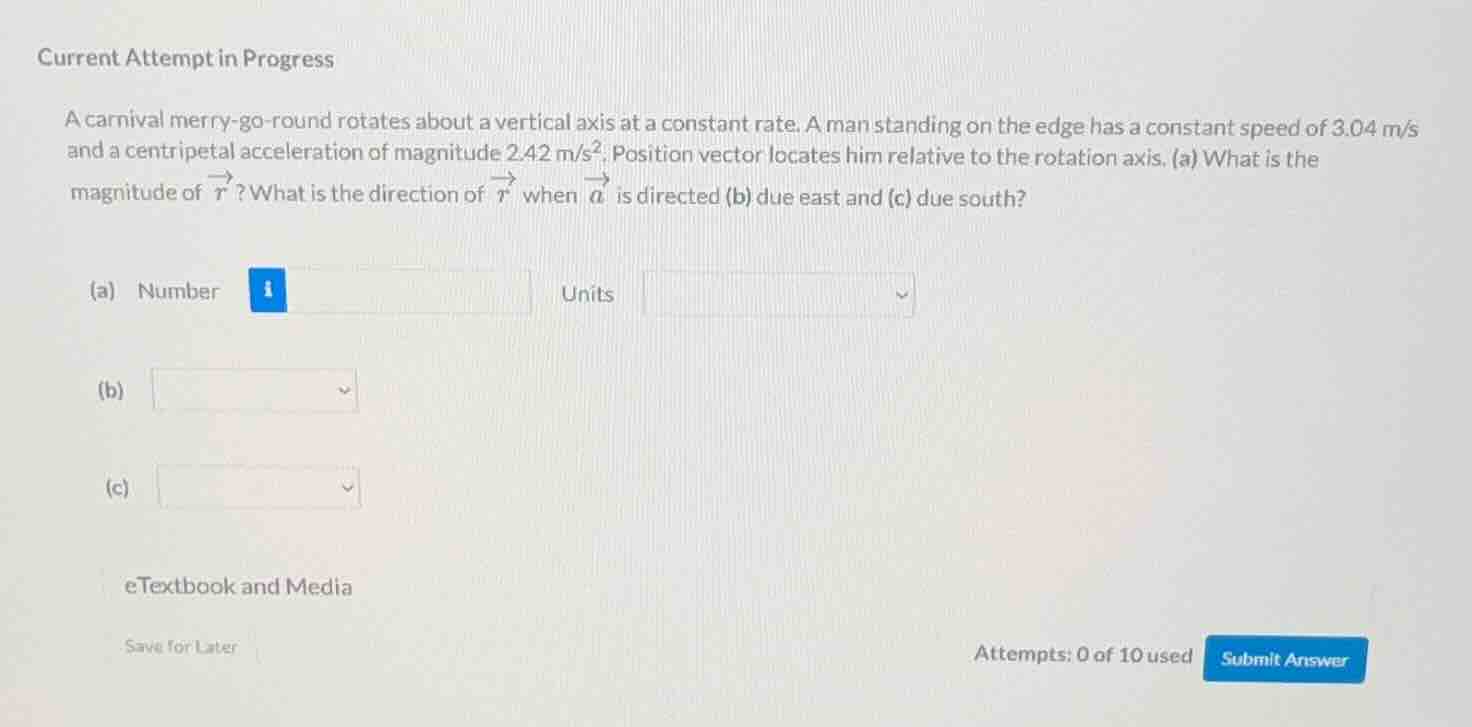
a carnival merry-go-round rotates about a vertical axis at a constant rate. a man standing on the edge has a constant speed of 3.04 m/s and a centripetal acceleration of magnitude 2.42 m/s². position vector locates him relative to the rotation axis. (a) what is the magnitude of $vec{r}$? what is the direction of $vec{r}$ when $vec{a}$ is directed (b) due east and (c) due south?
(a) number units
(b)
(c)
Step1: Recall centripetal acceleration formula
The centripetal acceleration is given by $a_c = \frac{v^2}{r}$, where $v$ is the speed and $r$ is the magnitude of the position vector $\vec{r}$.
Step2: Solve for $r$
Rearrange the formula to isolate $r$: $r = \frac{v^2}{a_c}$
Substitute $v=3.04\ \text{m/s}$ and $a_c=2.42\ \text{m/s}^2$:
$r = \frac{(3.04)^2}{2.42} = \frac{9.2416}{2.42} \approx 3.82$
Step3: Analyze direction of $\vec{r}$ (part b)
Centripetal acceleration $\vec{a}$ points toward the axis of rotation, so $\vec{r}$ points opposite to $\vec{a}$. If $\vec{a}$ is east, $\vec{r}$ is west.
Step4: Analyze direction of $\vec{r}$ (part c)
If $\vec{a}$ is south, $\vec{r}$ points opposite, so $\vec{r}$ is north.

Snap & solve any problem in the app
Get step-by-step solutions on Sovi AI
Photo-based solutions with guided steps
Explore more problems and detailed explanations
(a) 3.82, Units: meters
(b) due west
(c) due north