QUESTION IMAGE
Question
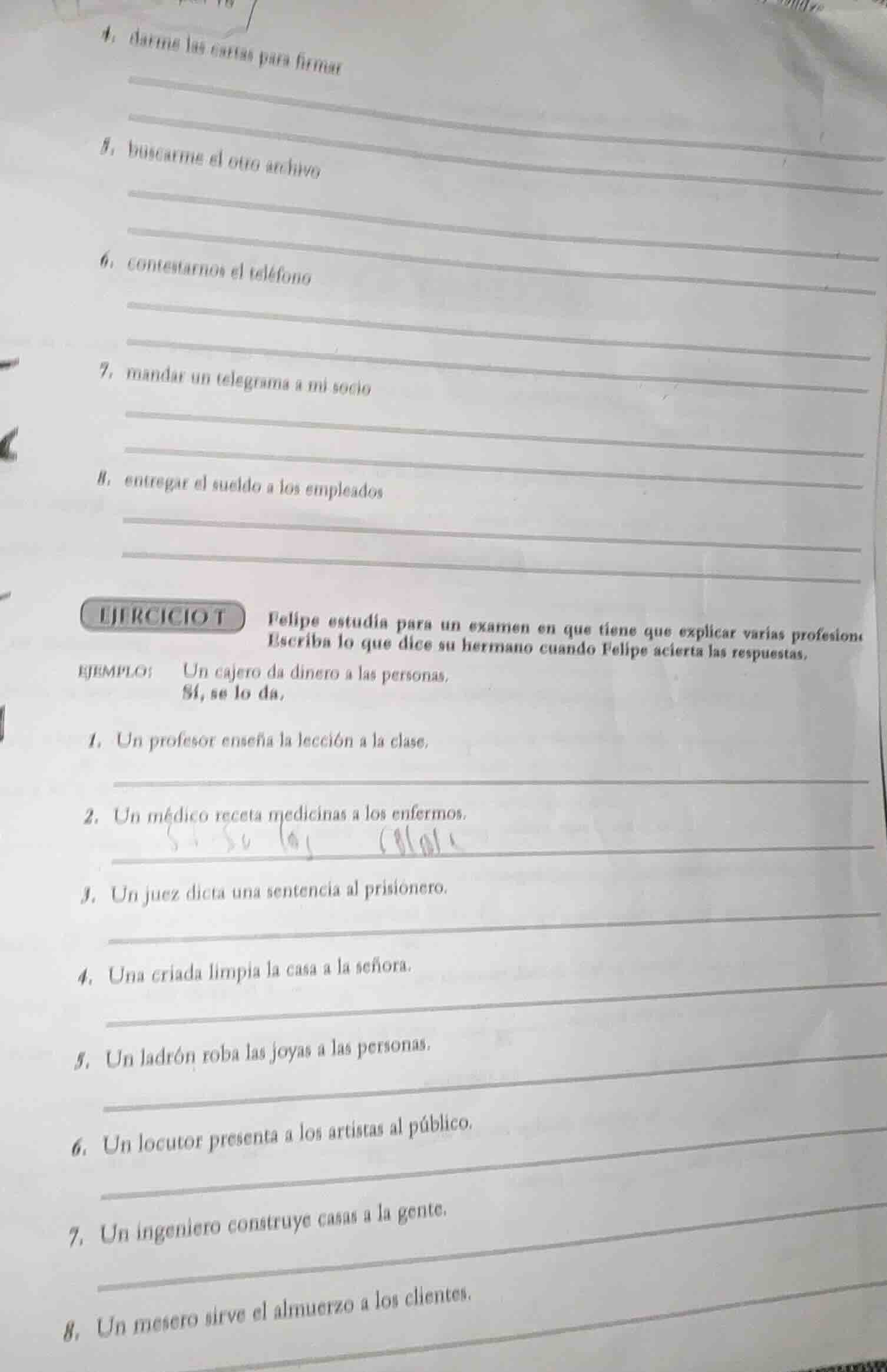
- darme las cartas para firmar
- buscarme el otro archivo
- contestarnos el teléfono
- mandar un telegrama a mi socio
- entregar el sueldo a los empleados
ejercicio t
felipe estudia para un examen en que tiene que explicar varias profesiones. escriba lo que dice su hermano cuando felipe acierta las respuestas.
ejemplo: un cajero da dinero a las personas.
sí, se lo da.
- un profesor enseña la lección a la clase.
- un médico receta medicinas a los enfermos.
- un juez dicta una sentencia al prisionero.
- una criada limpia la casa a la señora.
- un ladrón roba las joyas a las personas.
- un locutor presenta a los artistas al público.
- un ingeniero construye casas a la gente.
- un mesero sirve el almuerzo a los clientes.
To solve these problems, we follow the example given. The example shows that we need to rephrase the sentence using the appropriate indirect object pronoun and the structure "sí, se lo da" (or similar depending on the verb and object). Let's solve each one:
1. Un profesor enseña la lección a la clase.
Step 1: Identify the verb and the indirect object.
The verb is "enseñar" (to teach), and the indirect object is "la clase" (the class). The indirect object pronoun for "la clase" (third person plural, but in this case, we use "se" for the indirect object and "la" for the direct object "la lección".
Step 2: Form the sentence.
Following the example, we say "Sí, se la enseña." (Yes, he teaches it to them.)
2. Un médico receta medicinas a los enfermos.
Step 1: Identify the verb and the indirect object.
The verb is "recetar" (to prescribe), indirect object is "los enfermos" (the patients), direct object is "medicinas" (medicines).
Step 2: Form the sentence.
Using the structure, we get "Sí, se las receta." (Yes, he prescribes them to them.)
3. Un juez dicta una sentencia al prisionero.
Step 1: Identify the verb and the indirect object.
Verb: "dictar" (to dictate), indirect object: "el prisionero" (the prisoner), direct object: "una sentencia" (a sentence).
Step 2: Form the sentence.
So, "Sí, se la dicta." (Yes, he dictates it to him.)
4. Una criada limpia la casa a la señora.
Step 1: Identify the verb and the indirect object.
Verb: "limpiar" (to clean), indirect object: "la señora" (the lady), direct object: "la casa" (the house).
Step 2: Form the sentence.
Thus, "Sí, se la limpia." (Yes, she cleans it for her.)
5. Un ladrón roba las joyas a las personas.
Step 1: Identify the verb and the indirect object.
Verb: "robar" (to steal), indirect object: "las personas" (the people), direct object: "las joyas" (the jewels).
Step 2: Form the sentence.
So, "Sí, se las roba." (Yes, he steals them from them.)
6. Un locutor presenta a los artistas al público.
Step 1: Identify the verb and the indirect object.
Verb: "presentar" (to present), indirect object: "el público" (the public), direct object: "los artistas" (the artists).
Step 2: Form the sentence.
Hence, "Sí, se los presenta." (Yes, he presents them to them.)
7. Un ingeniero construye casas a la gente.
Step 1: Identify the verb and the indirect object.
Verb: "construir" (to build), indirect object: "la gente" (the people), direct object: "casas" (houses).
Step 2: Form the sentence.
So, "Sí, se las construye." (Yes, he builds them for them.)
8. Un mesero sirve el almuerzo a los clientes.
Step 1: Identify the verb and the indirect object.
Verb: "servir" (to serve), indirect object: "los clientes" (the clients), direct object: "el almuerzo" (the lunch).
Step 2: Form the sentence.
Thus, "Sí, se lo sirve." (Yes, he serves it to them.)

Snap & solve any problem in the app
Get step-by-step solutions on Sovi AI
Photo-based solutions with guided steps
Explore more problems and detailed explanations
s:
- Sí, se la enseña.
- Sí, se las receta.
- Sí, se la dicta.
- Sí, se la limpia.
- Sí, se las roba.
- Sí, se los presenta.
- Sí, se las construye.
- Sí, se lo sirve.