QUESTION IMAGE
Question
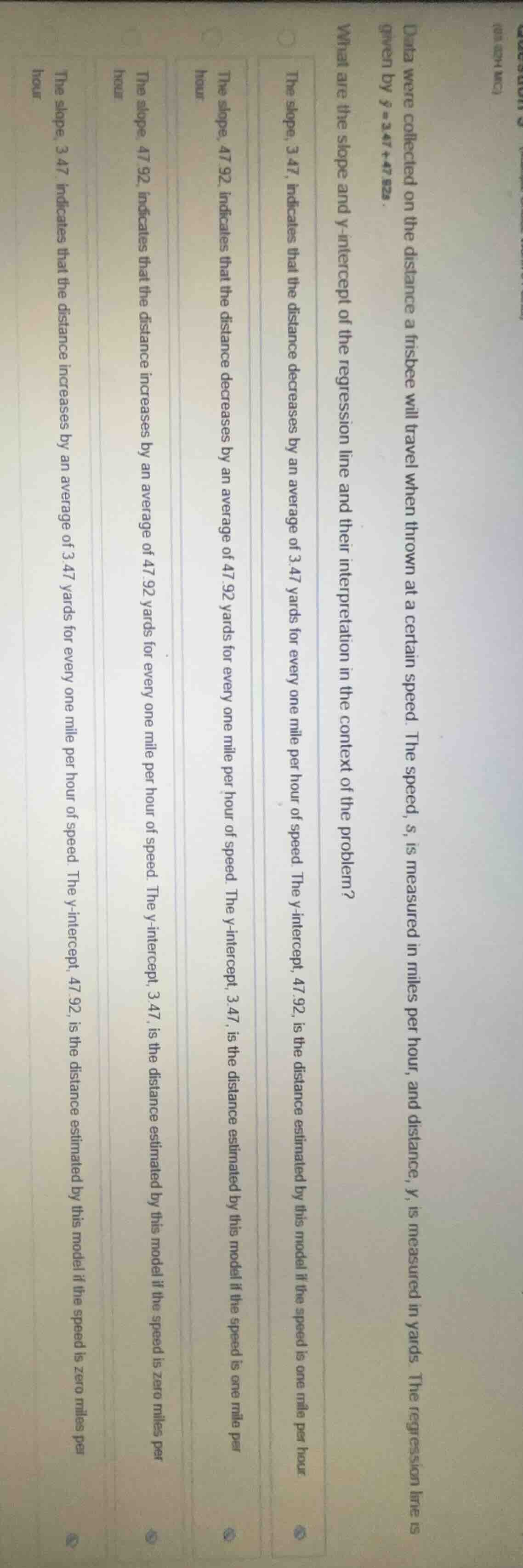
data were collected on the distance a frisbee will travel when thrown at a certain speed. the speed, s, is measured in miles per hour, and distance, y, is measured in yards. the regression line is given by y = 3.47 + 47.92s.
what are the slope and y-intercept of the regression line and their interpretation in the context of the problem?
the slope, 3.47, indicates that the distance decreases by an average of 3.47 yards for every one mile per hour of speed. the y-intercept, 47.92, is the distance estimated by this model if the speed is one mile per hour.
the slope, 47.92, indicates that the distance decreases by an average of 47.92 yards for every one mile per hour of speed. the y-intercept, 3.47, is the distance estimated by this model if the speed is one mile per hour.
the slope, 47.92, indicates that the distance increases by an average of 47.92 yards for every one mile per hour of speed. the y-intercept, 3.47, is the distance estimated by this model if the speed is zero miles per hour.
the slope, 3.47, indicates that the distance increases by an average of 3.47 yards for every one mile per hour of speed. the y-intercept, 47.92, is the distance estimated by this model if the speed is zero miles per hour.
The regression line follows the form $\hat{y} = b_0 + b_1x$, where $b_1$ (slope) is the change in $\hat{y}$ per unit $x$, and $b_0$ (y-intercept) is $\hat{y}$ when $x=0$. Here, $\hat{y}=3.47s + 47.92$, so slope = 3.47 (distance increases by 3.47 yards per 1 mph speed increase) and y-intercept = 47.92 (estimated distance at 0 mph speed).

Snap & solve any problem in the app
Get step-by-step solutions on Sovi AI
Photo-based solutions with guided steps
Explore more problems and detailed explanations
The slope, 3.47, indicates that the distance increases by an average of 3.47 yards for every one mile per hour of speed. The y-intercept, 47.92, is the distance estimated by this model if the speed is zero miles per hour.