QUESTION IMAGE
Question
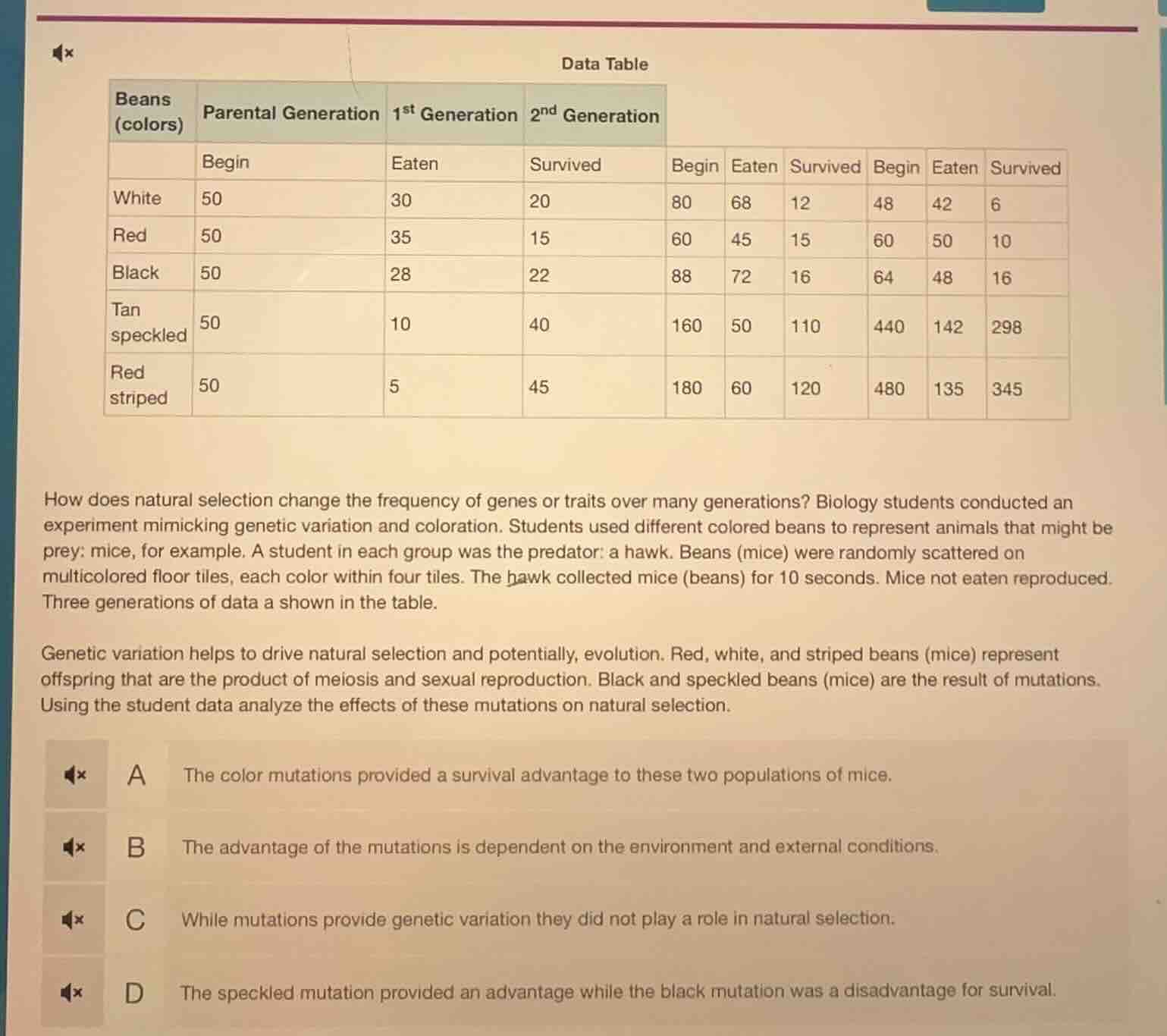
data table
beans (colors) | parental generation | 1st generation | 2nd generation
--- | --- | --- | ---
| begin | eaten | survived | begin | eaten | survived | begin | eaten | survived |
white | 50 | 30 | 20 | 80 | 68 | 12 | 48 | 42 | 6
red | 50 | 35 | 15 | 60 | 45 | 15 | 60 | 50 | 10
black | 50 | 28 | 22 | 88 | 72 | 16 | 64 | 48 | 16
tan speckled | 50 | 10 | 40 | 160 | 50 | 110 | 440 | 142 | 298
red striped | 50 | 5 | 45 | 180 | 60 | 120 | 480 | 135 | 345
how does natural selection change the frequency of genes or traits over many generations? biology students conducted an experiment mimicking genetic variation and coloration. students used different colored beans to represent animals that might be prey: mice, for example. a student in each group was the predator: a hawk. beans (mice) were randomly scattered on multicolored floor tiles, each color within four tiles. the hawk collected mice (beans) for 10 seconds. mice not eaten reproduced. three generations of data a shown in the table.
genetic variation helps to drive natural selection and potentially, evolution. red, white, and striped beans (mice) represent offspring that are the product of meiosis and sexual reproduction. black and speckled beans (mice) are the result of mutations. using the student data analyze the effects of these mutations on natural selection.
a the color mutations provided a survival advantage to these two populations of mice.
b the advantage of the mutations is dependent on the environment and external conditions.
c while mutations provide genetic variation they did not play a role in natural selection.
d the speckled mutation provided an advantage while the black mutation was a disadvantage for survival.
To solve this, we analyze the data for black and tan - speckled (mutation - related) beans across generations. For tan - speckled: Parental begin = 50, 1st gen begin = 160, 2nd gen begin = 440 (shows growth). For black: Parental begin = 50, 1st gen begin = 88, 2nd gen begin = 64 (decrease). But looking at survival: Tan - speckled has high survival (40, 110, 298), black has moderate (22, 16, 16). However, the key is that the mutation's advantage (tan - speckled is better, black less so) shows that mutation advantage depends on environment (like the multicolored tiles, predator's selection). Option A: Black mutation doesn't show a strong survival advantage, so A is wrong. Option C: Mutations do play a role (tan - speckled survives more, so natural selection acts on it), so C is wrong. Option D: Black mutation's survival (22, 16, 16) is not a clear disadvantage compared to white/red, and tan - speckled is an advantage, but the main point is environmental dependence. Option B: The advantage of mutations (tan - speckled does well, black less) depends on the environment (tile colors, predator's ability to find them), so B is correct.

Snap & solve any problem in the app
Get step-by-step solutions on Sovi AI
Photo-based solutions with guided steps
Explore more problems and detailed explanations
A. The color mutations provided a survival advantage to these two populations of mice. - Incorrect (Black mutation does not show a consistent strong survival advantage)
B. The advantage of the mutations is dependent on the environment and external conditions. - Correct (The success of tan - speckled and relative less success of black shows that the advantage of the mutation (a source of genetic variation) depends on the environment like the multicolored floor tiles and the predator's foraging)
C. While mutations provide genetic variation they did not play a role in natural selection. - Incorrect (Mutations like tan - speckled do play a role as they are selected for due to higher survival)
D. The speckled mutation provided an advantage while the black mutation was a disadvantage for survival. - Incorrect (Black mutation's survival is not a clear disadvantage when compared to non - mutation (white/red) in all generations)
So the correct option is B. The advantage of the mutations is dependent on the environment and external conditions.