QUESTION IMAGE
Question
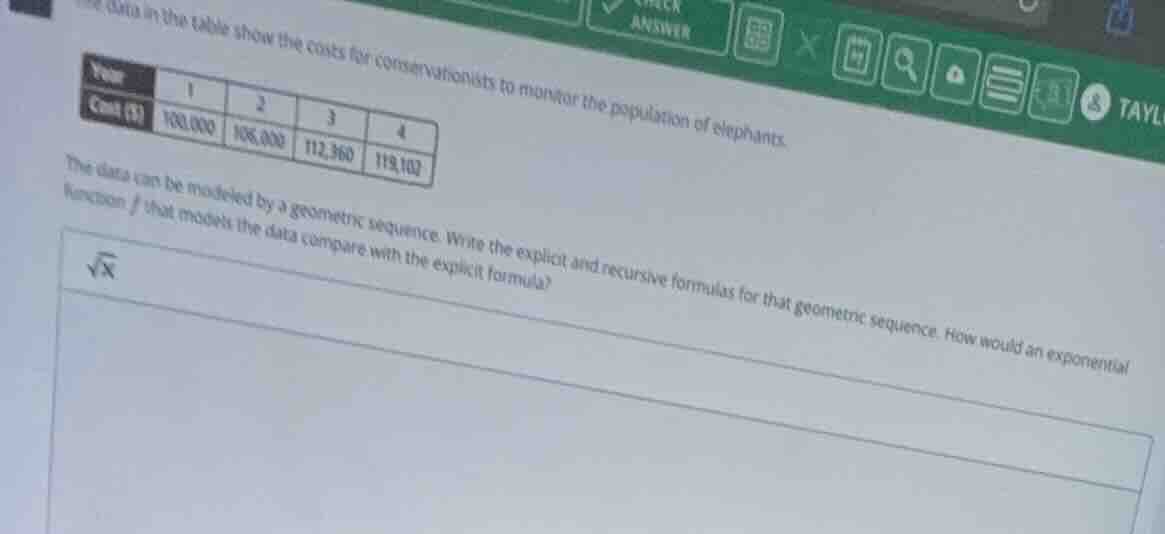
the data in the table show the costs for conservationists to monitor the population of elephants.
year 1 2 3 4
cost ($) 100,000 106,000 112,360 119,101
the data can be modeled by a geometric sequence. write the explicit and recursive formulas for that geometric sequence. how would an exponential function that models the data compare with the explicit formula?
Step1: Find common ratio $r$
Divide term 2 by term 1:
$r = \frac{106000}{100000} = 1.06$
Verify with term 3/term 2: $\frac{112360}{106000}=1.06$, term 4/term 3: $\frac{119102}{112360}=1.06$
Step2: Write explicit formula
For geometric sequence: $a_n = a_1 r^{n-1}$, where $a_1=100000$, $r=1.06$
$a_n = 100000(1.06)^{n-1}$
Step3: Write recursive formula
Recursive form: $a_n = r \cdot a_{n-1}$, with $a_1=100000$
$a_1 = 100000,\ a_n = 1.06a_{n-1}$ for $n\geq2$
Step4: Compare to exponential function
Rewrite explicit formula: $a_n = 100000(1.06)^{n-1} = \frac{100000}{1.06}(1.06)^n \approx 94339.62(1.06)^n$
Standard exponential function: $f(n)=ab^n$, so this matches with $a\approx94339.62$, $b=1.06$. The explicit sequence formula is a shifted/scaled version of the standard exponential function.

Snap & solve any problem in the app
Get step-by-step solutions on Sovi AI
Photo-based solutions with guided steps
Explore more problems and detailed explanations
Explicit Formula:
$a_n = 100000(1.06)^{n-1}$ where $n$ is the year number
Recursive Formula:
$a_1 = 100000$, and $a_n = 1.06a_{n-1}$ for $n \geq 2$
Comparison to Exponential Function:
The explicit sequence formula can be rewritten as an exponential function $f(n) = 94339.62(1.06)^n$, which follows the standard exponential form $f(n)=ab^n$. The sequence formula is equivalent to this exponential function, just adjusted to start at $n=1$ with the initial value of 100,000 instead of the exponential function's starting value at $n=0$.