QUESTION IMAGE
Question
- deep dive analysis
read the passage below. pay attention to how the author moves from the present to the past and back again.
the dusty trophy
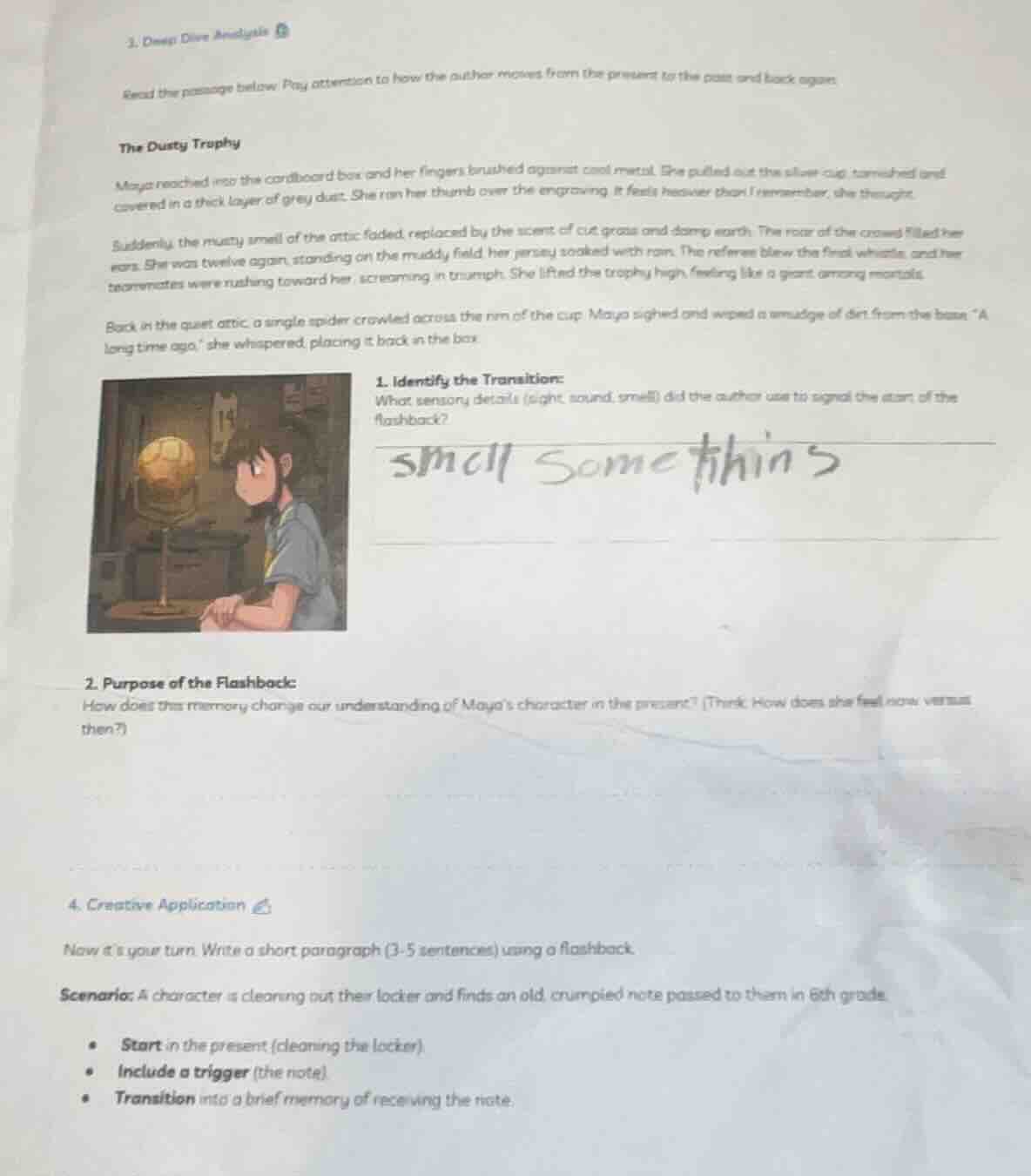
maya reached into the cardboard box and her fingers brushed against cool metal. she pulled out the silver cup, tarnished and covered in a thick layer of grey dust. she ran her thumb over the engraving. it feels heavier than i remember, she thought.
suddenly, the musty smell of the attic faded, replaced by the scent of cut grass and damp earth. the roar of the crowd filled her ears. she was twelve again, standing on the muddy field, her jersey soaked with rain. the referee blew the final whistle, and her teammates were rushing toward her, screaming in triumph. she lifted the trophy high, feeling like a giant among mortals.
back in the quiet attic, a single spider crawled across the rim of the cup. maya sighed and wiped a smudge of dirt from the base. “a long time ago,” she whispered, placing it back in the box.
- identify the transition:
what sensory details (sight, sound, smell) did the author use to signal the start of the flashback?
- purpose of the flashback:
how does this memory change our understanding of maya’s character in the present? (think: how does she feel now versus then?)
- creative application
now it’s your turn. write a short paragraph (3 - 5 sentences) using a flashback.
scenario: a character is cleaning out their locker and finds an old, crumpled note passed to them in 6th grade.
- start in the present (cleaning the locker).
- include a trigger (the note).
- transition into a brief memory of receiving the note.
Question 1: Identify the Transition
To determine the sensory detail signaling the flashback start, we analyze the passage. The sentence "Suddenly, the musty smell of the attic faded, replaced by the scent of cut grass and damp earth" uses the sense of smell (scent of cut grass and damp earth) to transition from the present (attic) to the past (her twelve - year - old self on the muddy field). The musty smell of the attic (present) fades, and the new smell of cut grass and damp earth triggers the flashback to the past event.
In the present, Maya is in a quiet attic, handling the dusty trophy with a sigh, seeming a bit nostalgic or reflective. In the flashback, when she was twelve, she was triumphant - her teammates rushed toward her screaming in triumph, and she felt like a giant among mortals while lifting the trophy. This memory shows that Maya had a moment of great pride and success in the past (as a young athlete). Now, in the present, her sigh and the way she handles the trophy suggest a sense of nostalgia for that past glory. The flashback helps us understand that Maya was once a confident, successful young athlete, and now she looks back on that time with a mix of nostalgia (as seen from her actions in the present like sighing and carefully handling the trophy) and perhaps a sense of how time has passed (the trophy is now dusty and in a box in the attic). It enriches her character by showing her past achievements and how they contrast with her more subdued present state.
We need to follow the scenario: start in the present (cleaning the locker), include a trigger (the old, crumpled note), and transition into a brief memory of receiving the note. First, set the present scene of cleaning the locker. Then, introduce the trigger (finding the note). Finally, transition to the memory of receiving the note in 6th grade.
Step - by - Step Explanation:
Step 1: Start in the present
Write a sentence about the character cleaning the locker. For example, "Jake scrubbed at the grime on his locker door, his hands full of old papers and forgotten trinkets, when his fingers brushed against something crumpled."
Step 2: Include the trigger
Introduce the note as the trigger. For example, "He pulled out an old, crumpled note, the edges frayed and the ink faded, a note he remembered receiving in 6th grade."
Step 3: Transition into the memory
Write a sentence that transitions to the memory of receiving the note. For example, "Suddenly, the harsh fluorescent lights of the school hallway dimmed in his mind, and he was back in Mrs. Thompson’s 6th - grade classroom, heart racing as Lisa slipped the note into his hand during math class, a nervous smile on her face."
Step 4: Conclude the paragraph (optional, but to meet the 3 - 5 sentence requirement)
Bring it back to the present a bit. For example, "Jake blinked, the present - day locker room sounds flooding back, and he unfolded the note, a small smile tugging at his lips as he remembered that moment."
Putting it all together:
Jake scrubbed at the grime on his locker door, his hands full of old papers and forgotten trinkets, when his fingers brushed against something crumpled. He pulled out an old, crumpled note, the edges frayed and the ink faded, a note he remembered receiving in 6th grade. Suddenly, the harsh fluorescent lights of the school hallway dimmed in his mind, and he was back in Mrs. Thompson’s 6th - grade classroom, heart racing as Lisa slipped the note into his hand during math class, a nervous smile on her face. Jake blinked, the present - day locker room sounds flooding back, and he unfolded the note, a small smile tugging at his lips as he remembered that moment.

Snap & solve any problem in the app
Get step-by-step solutions on Sovi AI
Photo-based solutions with guided steps
Explore more problems and detailed explanations
The author used the sense of smell (sensory detail) to signal the start of the flashback. Specifically, the transition is signaled by the change in smell: the musty smell of the attic fades and is replaced by the scent of cut grass and damp earth.