QUESTION IMAGE
Question
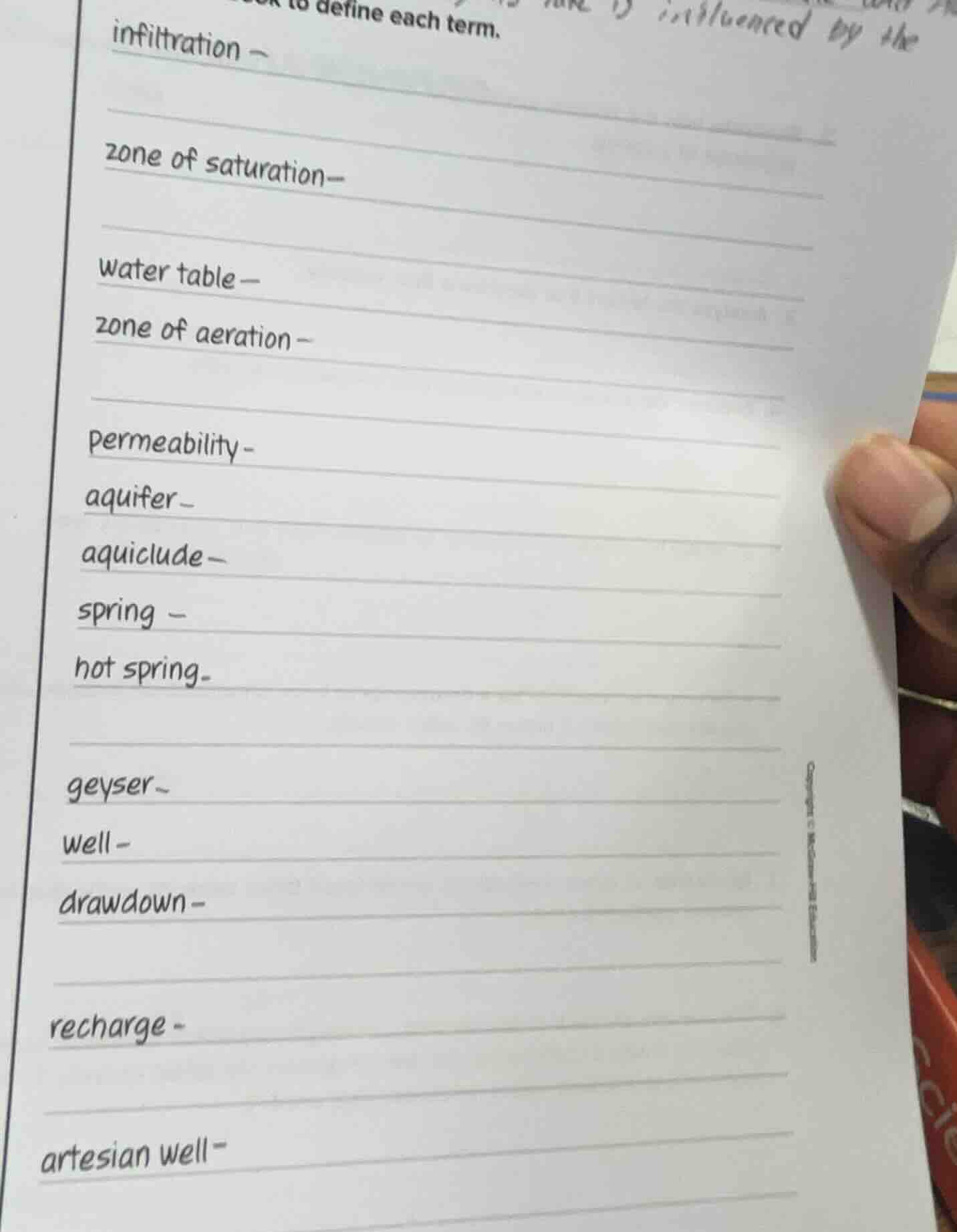
to define each term.
infiltration –
zone of saturation–
water table –
zone of aeration –
permeability -
aquifer –
aquiclude –
spring –
hot spring -
geyser –
well –
drawdown –
recharge -
artesian well –
Brief Explanations
These terms are related to hydrology and geology, which fall under the subfield of Geography (within Natural Science). Here are the definitions:
- infiltration: The process by which water on the ground surface enters the soil.
- zone of saturation: The area of soil or rock where all the pores and fractures are filled with water (also called the phreatic zone).
- water table: The upper surface of the zone of saturation, below which the soil or rock is saturated with water.
- zone of aeration: The area of soil or rock above the water table where pores contain air and some water (also called the vadose zone).
- permeability: The ability of a material (like soil or rock) to allow fluids (such as water) to pass through it.
- aquifer: A body of rock or sediment that can store and transmit groundwater in sufficient quantities to supply wells or springs.
- aquiclude: A layer of impermeable material that restricts the flow of groundwater (e.g., clay layers).
- spring: A natural outflow of groundwater onto the Earth’s surface, occurring where the water table intersects the ground surface.
- hot spring: A spring whose water temperature is significantly higher than the surrounding air temperature, often heated by geothermal energy.
- geyser: A type of hot spring that periodically erupts, sending a column of hot water and steam into the air, caused by the heating of groundwater and subsequent pressure build - up.
- well: A man - made hole drilled or dug into the ground to reach and extract groundwater from an aquifer.
- drawdown: The lowering of the water table or the level of water in a well due to pumping or extraction of groundwater.
- recharge: The process by which water is added to an aquifer, usually through infiltration of precipitation or surface water.
- artesian well: A well in which water rises to the surface under natural pressure, because the aquifer is confined between two impermeable layers (aquicludes) and the water is under hydrostatic pressure.

Snap & solve any problem in the app
Get step-by-step solutions on Sovi AI
Photo-based solutions with guided steps
Explore more problems and detailed explanations
- infiltration: The process by which water on the ground surface enters the soil.
- zone of saturation: The area of soil or rock where all the pores and fractures are filled with water.
- water table: The upper surface of the zone of saturation, below which the soil or rock is saturated with water.
- zone of aeration: The area of soil or rock above the water table where pores contain air and some water.
- permeability: The ability of a material (like soil or rock) to allow fluids (such as water) to pass through it.
- aquifer: A body of rock or sediment that can store and transmit groundwater in sufficient quantities to supply wells or springs.
- aquiclude: A layer of impermeable material that restricts the flow of groundwater.
- spring: A natural outflow of groundwater onto the Earth’s surface, occurring where the water table intersects the ground surface.
- hot spring: A spring whose water temperature is significantly higher than the surrounding air temperature, often heated by geothermal energy.
- geyser: A type of hot spring that periodically erupts, sending a column of hot water and steam into the air.
- well: A man - made hole drilled or dug into the ground to reach and extract groundwater from an aquifer.
- drawdown: The lowering of the water table or the level of water in a well due to pumping or extraction of groundwater.
- recharge: The process by which water is added to an aquifer, usually through infiltration of precipitation or surface water.
- artesian well: A well in which water rises to the surface under natural pressure, because the aquifer is confined between two impermeable layers and the water is under hydrostatic pressure.