QUESTION IMAGE
Question
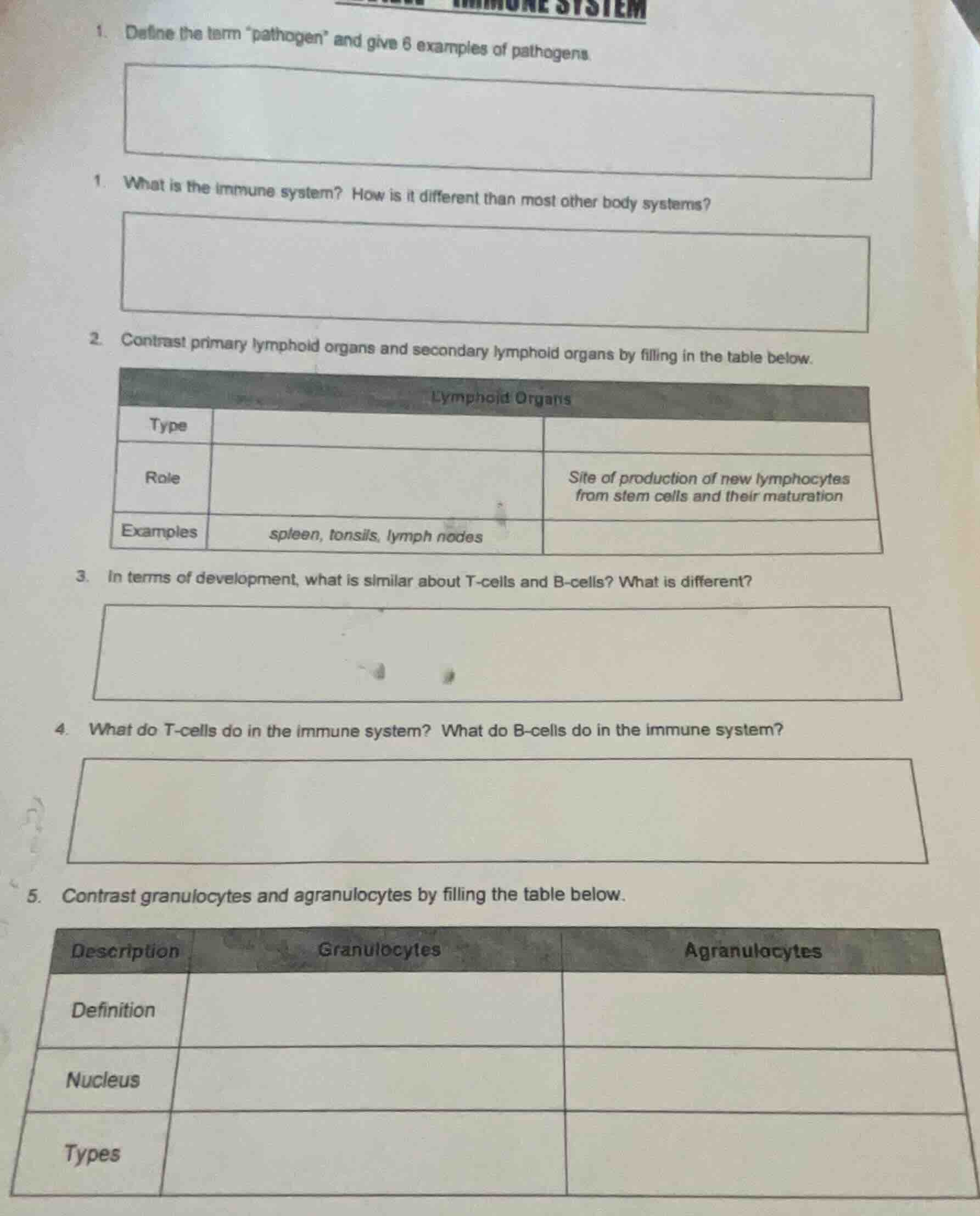
- define the term pathogen and give 6 examples of pathogens
- what is the immune system? how is it different than most other body systems?
- contrast primary lymphoid organs and secondary lymphoid organs by filling in the table below.
lymphoid organs
type
role
site of production of new lymphocytes from stem cells and their maturation
examples
spleen, tonsils, lymph nodes
- in terms of development, what is similar about t - cells and b - cells? what is different?
- what do t - cells do in the immune system? what do b - cells do in the immune system?
- contrast granulocytes and agranulocytes by filling the table below.
description
granulocytes
agranulocytes
definition
nucleus
types
- Pathogen Definition & Examples: A pathogen is an organism/agent that causes disease in its host. Common examples include various infectious agents.
- Immune System Overview: The immune system is a network of cells, tissues, and organs that defends the body from pathogens. It is unique as it targets specific foreign invaders rather than performing a fixed physiological function.
- Lymphoid Organs Contrast: Primary lymphoid organs are where lymphocytes develop/mature, while secondary ones are where immune responses are initiated.
- T-cell & B-cell Development: Both originate from bone marrow stem cells, but they mature in different locations.
- T-cell & B-cell Functions: T-cells handle cell-mediated immunity, while B-cells produce antibodies for humoral immunity.
- Granulocytes vs Agranulocytes: These are white blood cell types distinguished by the presence of granules, nucleus shape, and specific subtypes.

Snap & solve any problem in the app
Get step-by-step solutions on Sovi AI
Photo-based solutions with guided steps
Explore more problems and detailed explanations
- Define "pathogen" + 6 examples:
A pathogen is a disease-causing biological agent (microorganism or virus) that infects a host and disrupts normal bodily functions.
Examples: Influenza virus, Escherichia coli (E. coli), Salmonella enterica, Candida albicans, Mycobacterium tuberculosis, Rhinovirus
- Immune system definition & difference:
The immune system is a network of cells, tissues, and organs that identifies, attacks, and eliminates foreign pathogens, abnormal cells, and other harmful substances to protect the body from disease.
Unlike most body systems (which perform specialized physiological tasks like digestion or circulation), the immune system is dispersed throughout the body (not a single organ system) and targets specific foreign invaders, adapting over time to recognize and fight new threats.
- Contrast primary/secondary lymphoid organs:
| Type | Secondary Lymphoid Organs | Primary Lymphoid Organs |
|---|---|---|
| Examples | spleen, tonsils, lymph nodes | bone marrow, thymus |
- T-cell & B-cell development (similarities/differences):
Similarity: Both T-cells and B-cells originate from hematopoietic stem cells in the bone marrow.
Difference: T-cells migrate to the thymus gland to mature, while B-cells mature in the bone marrow itself.
- T-cell & B-cell immune system functions:
- T-cells: Mediate cell-mediated immunity; they directly kill infected or abnormal cells (cytotoxic T-cells), help activate B-cells and other immune cells (helper T-cells), and regulate immune responses (regulatory T-cells).
- B-cells: Mediate humoral immunity; when activated, they differentiate into plasma cells that produce and secrete antibodies, which bind to pathogens to neutralize them, mark them for destruction, or trigger other immune responses.
- Contrast granulocytes and agranulocytes:
| Description | Granulocytes | Agranulocytes |
|---|---|---|
| Nucleus | Irregular, lobed nucleus (multi-lobed) | Round, oval, or indented single nucleus |
| Types | Neutrophils, eosinophils, basophils | Lymphocytes (T-cells, B-cells, NK cells), monocytes |