QUESTION IMAGE
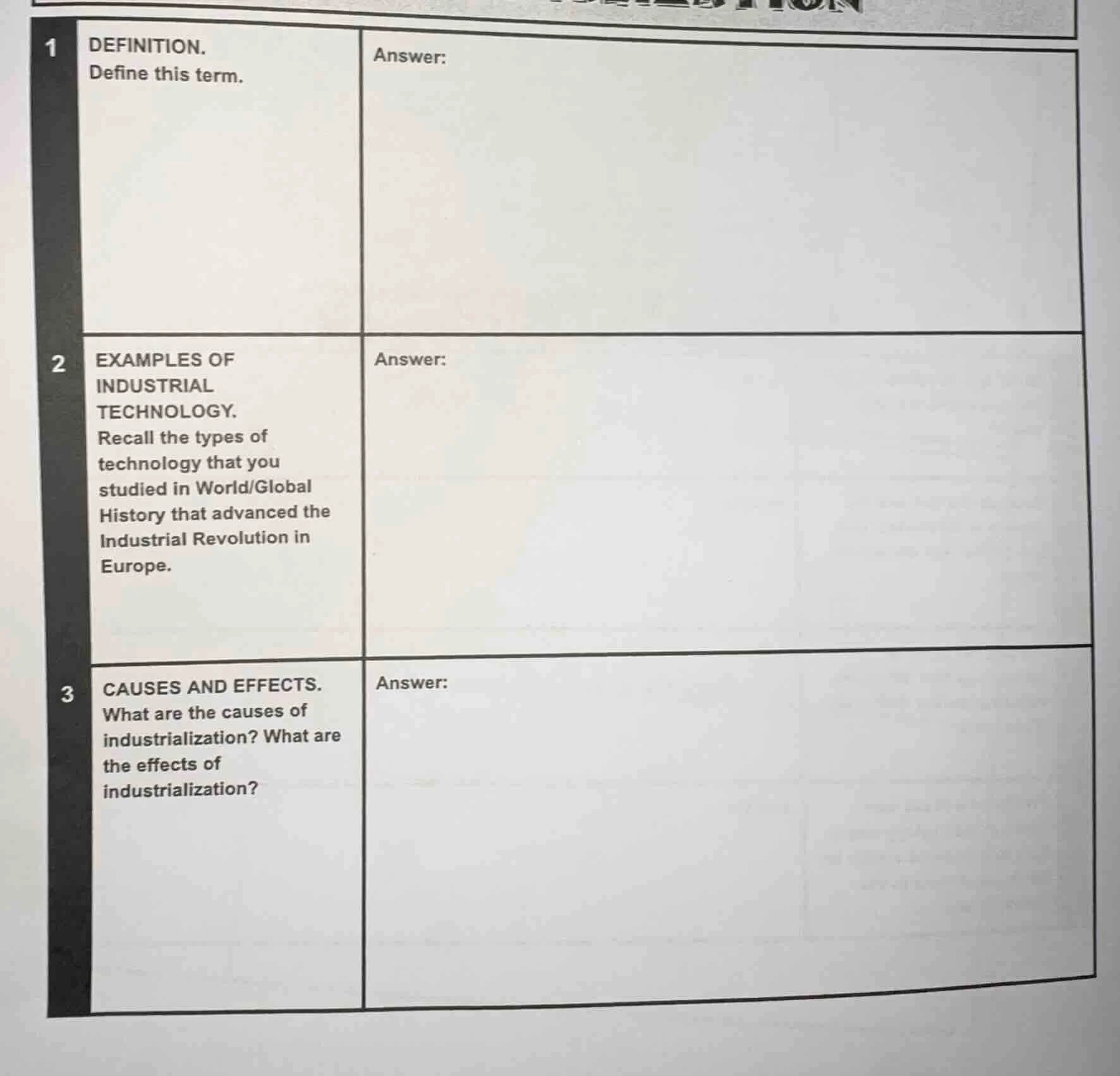
Question
1
definition.
define this term.
answer:
2
examples of industrial technology.
recall the types of technology that you studied in world/global history that advanced the industrial revolution in europe.
answer:
3
causes and effects.
what are the causes of industrialization? what are the effects of industrialization?
answer:
Sub - Question 1 (Definition)
Since the term to define is not given, we assume it's related to industrialization (given the context of the other sub - questions). Industrialization is the process by which an economy is transformed from an agrarian (agriculture - based) one to one dominated by industrial (manufacturing - based) production. It involves the growth of factories, the use of machinery, and a shift from manual labor to mechanized production, along with changes in social and economic structures.
In the context of the Industrial Revolution in Europe, we recall the key technologies. The steam engine (e.g., James Watt's improved steam engine) was crucial as it powered factories, trains, and ships. The spinning jenny (invented by James Hargreaves) and the power loom (Edmund Cartwright) revolutionized textile production. The Bessemer process (Henry Bessemer) for mass - producing steel made the construction of skyscrapers, railways, and machinery more feasible.
Causes of Industrialization:
- Technological Innovations: As seen in sub - question 2, new technologies like the steam engine and spinning jenny made large - scale production possible.
- Availability of Resources: Europe had access to coal (for fueling steam engines) and iron ore (for making machinery and later steel).
- Capital and Investment: The growth of trade and commerce in Europe led to the accumulation of capital, which was then invested in new industries.
- Labor Force: The enclosure movement in Britain (and other parts of Europe) pushed peasants off the land, creating a large urban labor force available for factories.
- Market Demand: The growth of European colonies created a large market for manufactured goods, encouraging production.
Effects of Industrialization:
- Economic Effects: A shift from agrarian to industrial economy, with the growth of factories and the service sector. Increased productivity and economic growth, but also the emergence of economic inequalities between the industrialized and non - industrialized regions.
- Social Effects: Urbanization (growth of cities) as people moved to work in factories. The rise of the working class and the bourgeoisie (middle class). Poor working conditions in factories led to the growth of labor movements.
- Technological and Infrastructure Effects: Development of better transportation (railways, steamships) and communication systems. Advancements in other technologies like electricity (in the later stages of industrialization).
- Environmental Effects: Increased pollution due to the burning of coal and industrial waste. Deforestation for fuel and construction materials.

Snap & solve any problem in the app
Get step-by-step solutions on Sovi AI
Photo-based solutions with guided steps
Explore more problems and detailed explanations
If the term is industrialization: Industrialization is the process of economic transformation from an agrarian - based economy to one dominated by industrial (manufacturing) production, involving the growth of factories, mechanization of labor, and significant social and economic structural changes.