QUESTION IMAGE
Question
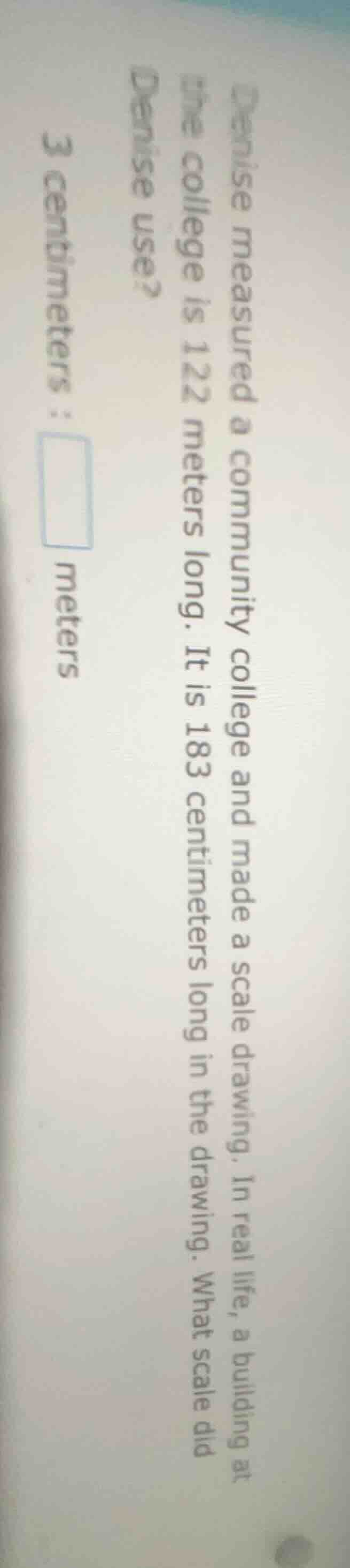
denise measured a community college and made a scale drawing. in real life, a building at the college is 122 meters long. it is 183 centimeters long in the drawing. what scale did denise use? 3 centimeters : square meters
Step1: Convert real length to centimeters
Real length is 122 meters. Since 1 meter = 100 centimeters, so 122 meters = \(122\times100 = 12200\) centimeters.
Step2: Find the scale
Scale is drawing length : real length. Drawing length is 183 centimeters, real length is 12200 centimeters. Wait, maybe I misread. Wait, the other part: "3 centimeters : \(\square\) meters". Wait, no, the problem is: Denise measured a community college and made a scale drawing. In real life, a building at the college is 122 meters long. It is 183 centimeters long in the drawing. Wait, no, the left side: "3 centimeters : \(\square\) meters" – maybe the problem is to find the scale where 3 cm in drawing corresponds to how many meters in real? Wait, no, let's re-express.
Wait, real length \(L_{real}=122\) meters \( = 12200\) cm. Drawing length \(L_{drawing}=183\) cm? No, the left side is "3 centimeters : \(\square\) meters" – maybe the problem is that in the drawing, a certain length is 3 cm, and real is? Wait, no, let's parse the text again.
"Denise measured a community college and made a scale drawing. In real life, a building at the college is 122 meters long. It is 183 centimeters long in the drawing. What scale did Denise use? 3 centimeters : \(\square\) meters"
Wait, maybe the problem is to find the scale factor, then apply to 3 cm.
First, find the scale: drawing length : real length.
\(L_{drawing}=183\) cm, \(L_{real}=122\) m \( = 12200\) cm.
Scale is \(183:12200\)? No, that can't be. Wait, maybe I made a mistake. Wait, 122 meters is 12200 centimeters. The drawing is 183 centimeters? That seems off. Wait, maybe the real length is 122 meters, drawing length is 18.3 centimeters? Or maybe the numbers are 122 meters and 183 centimeters – no, 183 cm is 1.83 meters, which is too small for a building. Wait, maybe the real length is 122 meters, drawing length is 183 millimeters? No, the text says 183 centimeters.
Wait, perhaps the problem is: In the drawing, a building is 3 centimeters, and in real life it's \(x\) meters, given that the scale is such that 183 cm drawing = 122 m real.
So first, find the scale: 183 cm drawing = 122 m real.
We need to find how many meters correspond to 3 cm drawing.
Set up a proportion: \(\frac{183\ \text{cm drawing}}{122\ \text{m real}}=\frac{3\ \text{cm drawing}}{x\ \text{m real}}\)
Cross - multiply: \(183x = 122\times3\)
\(183x = 366\)
\(x=\frac{366}{183}=2\)
Wait, that makes sense. So the scale is 3 cm drawing : 2 m real.
Let's check: If 183 cm drawing is 122 m real, then 1 cm drawing is \(\frac{122}{183}\) m real. Then 3 cm drawing is \(3\times\frac{122}{183}=\frac{366}{183}=2\) m real. Yes, that works.
So the steps:
Step1: Set up proportion
Let \(x\) be the real length (in meters) corresponding to 3 cm drawing. The proportion is \(\frac{183\ \text{cm (drawing)}}{122\ \text{m (real)}}=\frac{3\ \text{cm (drawing)}}{x\ \text{m (real)}}\)
Step2: Cross - multiply and solve for \(x\)
\(183x = 122\times3\)
\(183x = 366\)
\(x=\frac{366}{183}=2\)

Snap & solve any problem in the app
Get step-by-step solutions on Sovi AI
Photo-based solutions with guided steps
Explore more problems and detailed explanations
2