QUESTION IMAGE
Question
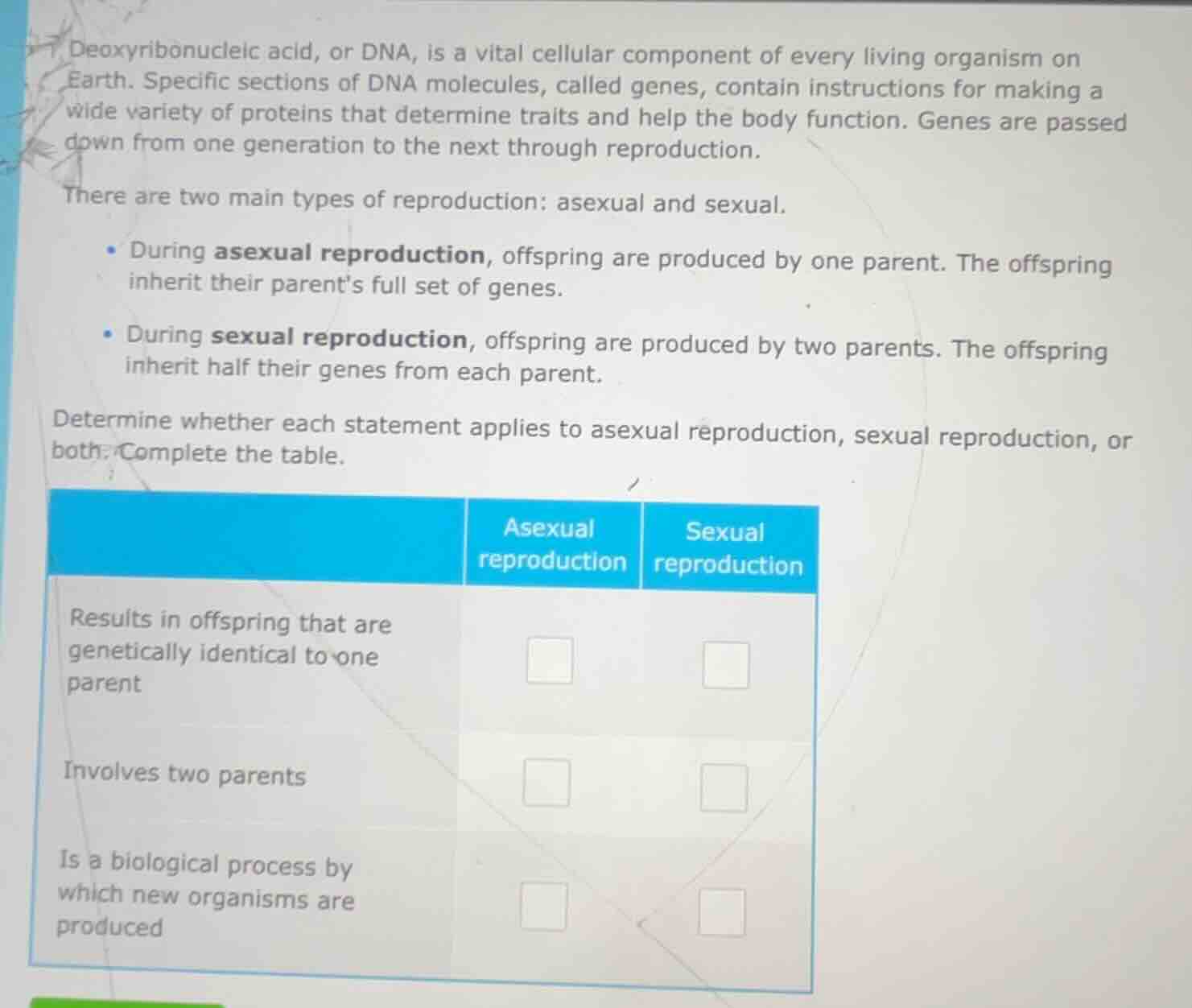
deoxyribonucleic acid, or dna, is a vital cellular component of every living organism on earth. specific sections of dna molecules, called genes, contain instructions for making a wide variety of proteins that determine traits and help the body function. genes are passed down from one generation to the next through reproduction.
there are two main types of reproduction: asexual and sexual.
- during asexual reproduction, offspring are produced by one parent. the offspring inherit their parent’s full set of genes.
- during sexual reproduction, offspring are produced by two parents. the offspring inherit half their genes from each parent.
determine whether each statement applies to asexual reproduction, sexual reproduction, or both. complete the table.
| asexual reproduction | sexual reproduction | |
|---|---|---|
| involves two parents | ||
| is a biological process by which new organisms are produced |
Brief Explanations
- For genetically identical offspring: Asexual reproduction passes the full set of one parent's genes, creating genetically identical offspring; sexual reproduction combines genes from two parents, resulting in unique offspring.
- For number of parents: Asexual reproduction only requires one parent, while sexual reproduction requires two.
- For new organism production: Both asexual and sexual reproduction are defined as biological processes that generate new living organisms.

Snap & solve any problem in the app
Get step-by-step solutions on Sovi AI
Photo-based solutions with guided steps
Explore more problems and detailed explanations
| Statement | Asexual reproduction | Sexual reproduction |
|---|---|---|
| Involves two parents | ❌ | ✅ |
| Is a biological process by which new organisms are produced | ✅ | ✅ |