QUESTION IMAGE
Question
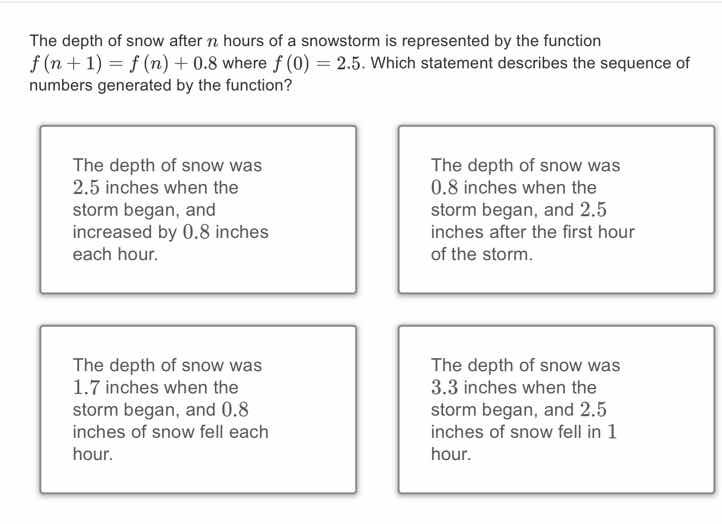
the depth of snow after ( n ) hours of a snowstorm is represented by the function ( f(n + 1) = f(n) + 0.8 ) where ( f(0) = 2.5 ). which statement describes the sequence of numbers generated by the function?
- the depth of snow was 2.5 inches when the storm began, and increased by 0.8 inches each hour.
- the depth of snow was 0.8 inches when the storm began, and 2.5 inches after the first hour of the storm.
- the depth of snow was 1.7 inches when the storm began, and 0.8 inches of snow fell each hour.
- the depth of snow was 3.3 inches when the storm began, and 2.5 inches of snow fell in 1 hour.
Step1: Analyze the initial condition
The function is given with \( f(0) = 2.5 \). In the context of the snowstorm, \( n = 0 \) represents the start of the storm. So, the depth of snow at the beginning (when the storm started) is \( f(0)=2.5 \) inches.
Step2: Analyze the recursive relation
The recursive formula is \( f(n + 1)=f(n)+0.8 \). This means that for each increase of 1 in \( n \) (i.e., for each hour that passes), the depth of snow \( f(n) \) increases by 0.8 inches. For example, when \( n = 0 \), \( f(1)=f(0)+0.8=2.5 + 0.8 \), which is the depth after 1 hour, and it's 0.8 inches more than the depth at \( n = 0 \).
Now let's analyze each option:
- Option 1: "The depth of snow was 2.5 inches when the storm began, and increased by 0.8 inches each hour." This matches our analysis of \( f(0) = 2.5 \) (start depth) and the recursive relation showing a 0.8 - inch increase per hour.
- Option 2: Claims the start depth is 0.8 inches, but \( f(0)=2.5 \), so this is wrong.
- Option 3: Claims the start depth is 1.7 inches, but \( f(0)=2.5 \), so this is wrong.
- Option 4: Claims the start depth is 3.3 inches, but \( f(0)=2.5 \), and also misrepresents the rate, so this is wrong.

Snap & solve any problem in the app
Get step-by-step solutions on Sovi AI
Photo-based solutions with guided steps
Explore more problems and detailed explanations
The depth of snow was 2.5 inches when the storm began, and increased by 0.8 inches each hour.