QUESTION IMAGE
Question
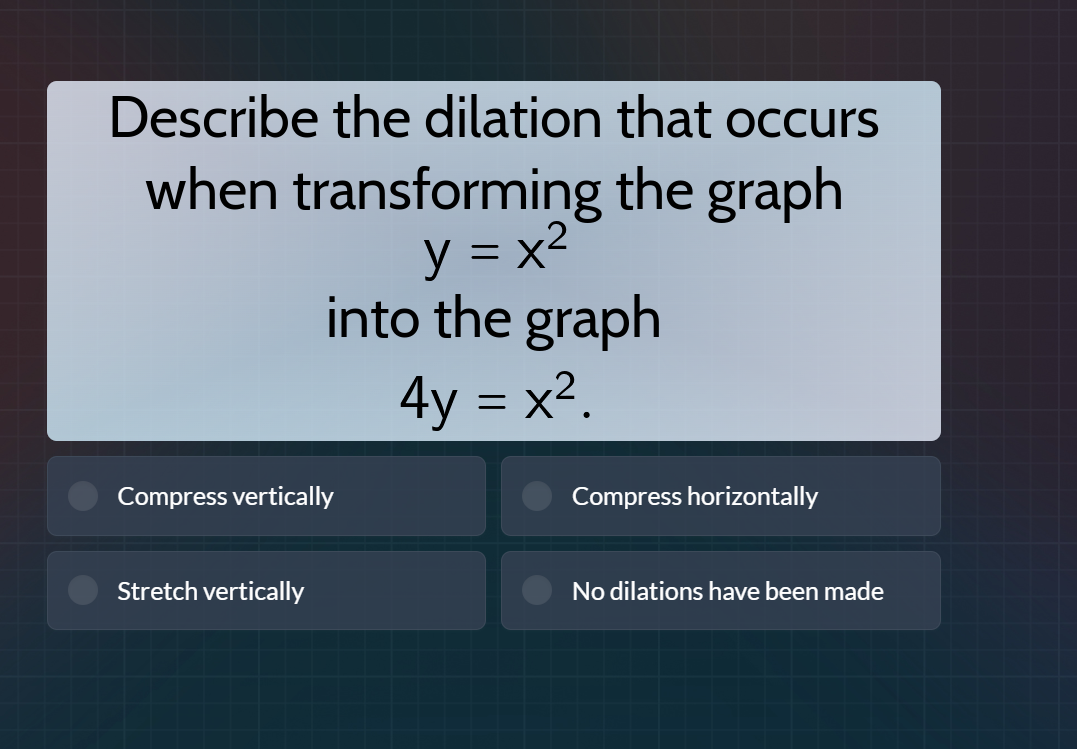
describe the dilation that occurs when transforming the graph $y = x^2$ into the graph $4y = x^2$. options: compress vertically, compress horizontally, stretch vertically, no dilations have been made
Step1: Rewrite the transformed equation
We start with the equation \(4y = x^{2}\). To express \(y\) in terms of \(x\), we divide both sides of the equation by \(4\). So we get \(y=\frac{1}{4}x^{2}\).
Step2: Recall the rule for vertical dilation
For a function \(y = a f(x)\), if \(|a|> 1\), the graph of \(y = f(x)\) is stretched vertically by a factor of \(|a|\), and if \(0 <|a|<1\), the graph of \(y = f(x)\) is compressed vertically by a factor of \(\frac{1}{|a|}\). In our case, the original function is \(y = x^{2}\) (so \(f(x)=x^{2}\)) and the transformed function is \(y=\frac{1}{4}x^{2}\), where \(a = \frac{1}{4}\) and \(0<\frac{1}{4}< 1\). This means the graph of \(y = x^{2}\) is compressed vertically by a factor of \(4\) (since the reciprocal of \(\frac{1}{4}\) is \(4\)) to get the graph of \(y=\frac{1}{4}x^{2}\) (which is equivalent to \(4y=x^{2}\)).

Snap & solve any problem in the app
Get step-by-step solutions on Sovi AI
Photo-based solutions with guided steps
Explore more problems and detailed explanations
Compress vertically