QUESTION IMAGE
Question
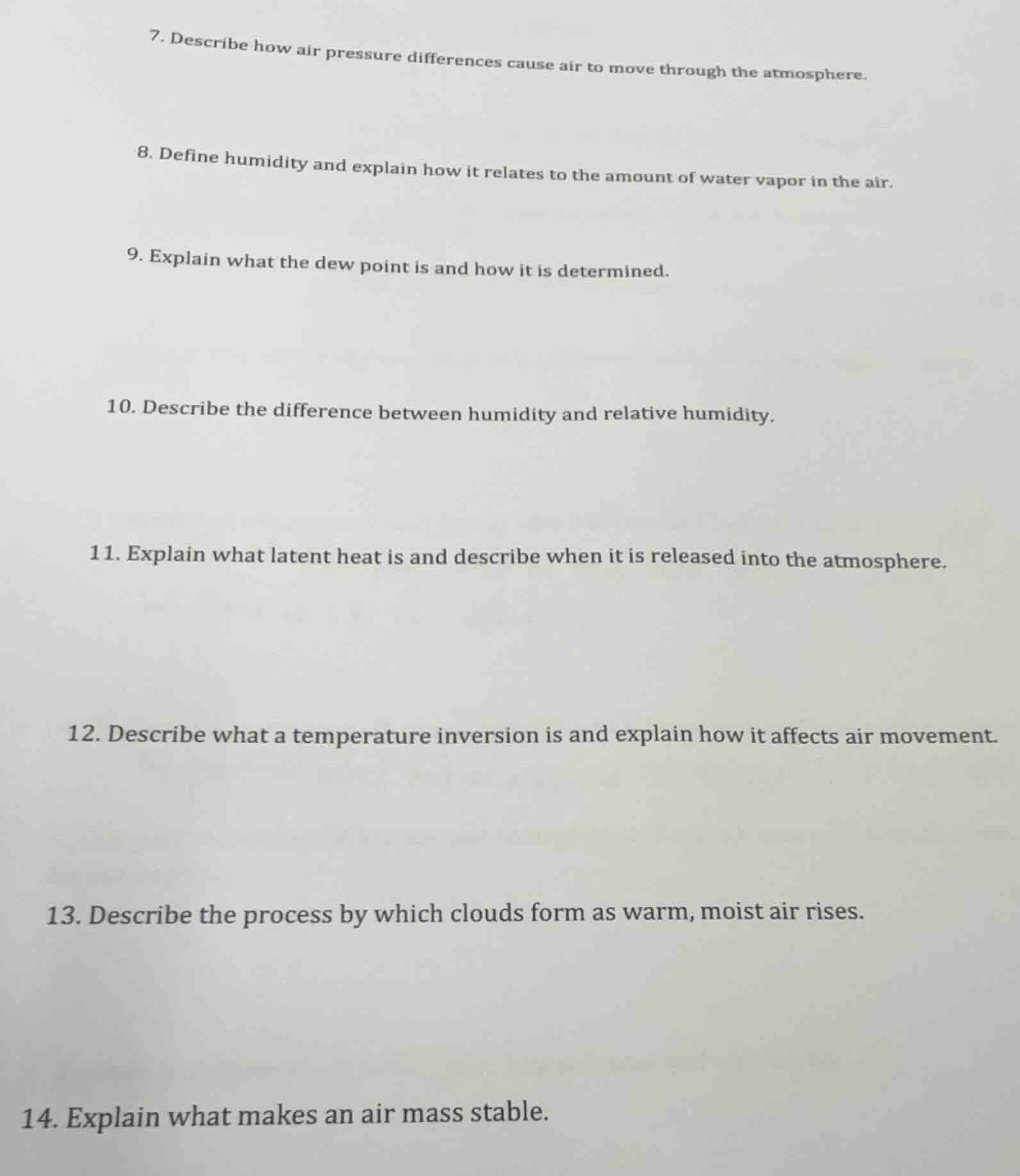
- describe how air pressure differences cause air to move through the atmosphere.
- define humidity and explain how it relates to the amount of water vapor in the air.
- explain what the dew point is and how it is determined.
- describe the difference between humidity and relative humidity.
- explain what latent heat is and describe when it is released into the atmosphere.
- describe what a temperature inversion is and explain how it affects air movement.
- describe the process by which clouds form as warm, moist air rises.
- explain what makes an air mass stable.
Question 7:
Air flows from high to low pressure areas due to pressure gradients; the Coriolis effect deflects this flow (except at the equator), creating global wind patterns that move air through the atmosphere.
Question 8:
Humidity is a general term for the amount of water vapor in air. It directly correlates: higher water vapor content means higher humidity, with specific metrics like absolute humidity quantifying this amount.
Question 9:
The dew point is the temperature at which air becomes saturated with water vapor, causing dew to form. It is determined using a hygrometer to measure relative humidity and air temperature, then using a dew point chart or formula to calculate it.
Question 10:
Humidity (often absolute humidity) is the actual amount of water vapor in a given volume of air. Relative humidity is the ratio of the actual water vapor amount to the maximum amount the air can hold at a given temperature, expressed as a percentage.
Question 11:
Latent heat is the energy absorbed or released when a substance changes phase (e.g., liquid to gas) without changing temperature. It is released into the atmosphere when water vapor condenses into liquid water (like cloud formation) or freezes into ice.
Question 12:
A temperature inversion is a layer in the atmosphere where temperature increases with altitude, reversing the normal cooling with height. It traps cooler, denser air below, preventing upward air movement and trapping pollutants near the surface.
Question 13:
As warm, moist air rises, it expands and cools due to decreasing atmospheric pressure. When it cools to its dew point, water vapor condenses onto tiny airborne particles (condensation nuclei) to form tiny liquid droplets or ice crystals, which cluster together to form clouds.
Question 14:
An air mass is stable when it is cooler and denser than the surrounding air at the same altitude. If lifted, it will be cooler than the environment, so it will sink back to its original position. This often occurs when a temperature inversion is present or when the air mass is dry.

Snap & solve any problem in the app
Get step-by-step solutions on Sovi AI
Photo-based solutions with guided steps
Explore more problems and detailed explanations
- Air moves from high-pressure regions to low-pressure regions along pressure gradients; the Coriolis effect deflects this movement, creating organized wind systems that circulate air through the atmosphere.
- Humidity is a measure of water vapor in air; it directly corresponds to the amount of water vapor present—more water vapor equals higher humidity (measured via metrics like absolute humidity).
- The dew point is the temperature at which air becomes saturated, causing water vapor to condense into dew. It is determined by measuring air temperature and relative humidity, then using a dew point calculator or chart to find the corresponding temperature.
- Humidity refers to the actual quantity of water vapor in air (e.g., absolute humidity). Relative humidity is the percentage of the maximum water vapor the air can hold at a given temperature, dependent on both vapor amount and air temperature.
- Latent heat is phase-change energy without temperature change. It is released into the atmosphere when water vapor condenses into liquid water or freezes into solid ice (e.g., during cloud formation or precipitation).
- A temperature inversion is a layer where atmospheric temperature rises with altitude (opposing normal cooling). It traps cool, dense air below, halting upward air movement and confining pollutants near the ground.
- Warm, moist air rises, expands, and cools as atmospheric pressure drops. When cooled to its dew point, water vapor condenses on condensation nuclei (tiny particles) to form small liquid/ice droplets, which aggregate into clouds.
- An air mass is stable if it is denser (cooler) than surrounding air at the same altitude. If displaced upward, it will be cooler than the environment, so it will sink back to its original position; inversions or dry air can create this stability.