QUESTION IMAGE
Question
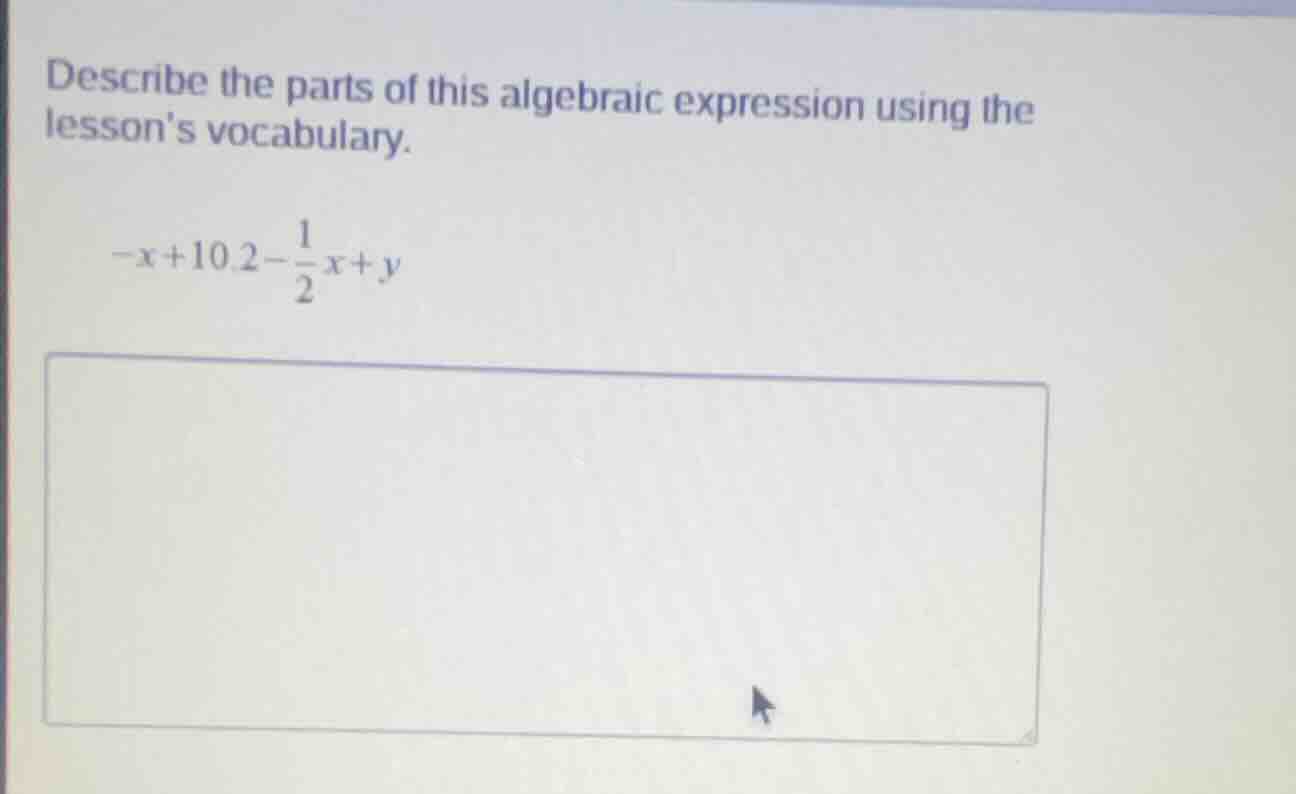
describe the parts of this algebraic expression using the lessons vocabulary.
$-x + 10.2 - \frac{1}{2}x + y$
Brief Explanations
First, recall the vocabulary related to algebraic expressions: terms (each part separated by + or -), coefficients (the numerical factor of a term with a variable), constants (terms without variables), like terms (terms with the same variable or constants).
- Terms: The expression \(-x + 10.2 - \frac{1}{2}x + y\) has four terms: \(-x\), \(10.2\), \(-\frac{1}{2}x\), and \(y\).
- Coefficients: For the term \(-x\), the coefficient is \(-1\) (since \(-x = -1 \cdot x\)); for \(-\frac{1}{2}x\), the coefficient is \(-\frac{1}{2}\); for \(y\), the coefficient is \(1\) (since \(y = 1 \cdot y\)).
- Constant Term: The term \(10.2\) is a constant (no variable).
- Like Terms: The terms \(-x\) and \(-\frac{1}{2}x\) are like terms (both have the variable \(x\)); \(10.2\) is a constant term (no like terms with variables), and \(y\) is a separate term (no like terms here).

Snap & solve any problem in the app
Get step-by-step solutions on Sovi AI
Photo-based solutions with guided steps
Explore more problems and detailed explanations
The algebraic expression \(\boldsymbol{-x + 10.2 - \frac{1}{2}x + y}\) has:
- Four terms: \(-x\), \(10.2\), \(-\frac{1}{2}x\), and \(y\).
- Coefficients: \(-1\) (for \(-x\)), \(-\frac{1}{2}\) (for \(-\frac{1}{2}x\)), and \(1\) (for \(y\)).
- Constant term: \(10.2\) (no variable).
- Like terms: \(-x\) and \(-\frac{1}{2}x\) (both contain \(x\)).