QUESTION IMAGE
Question
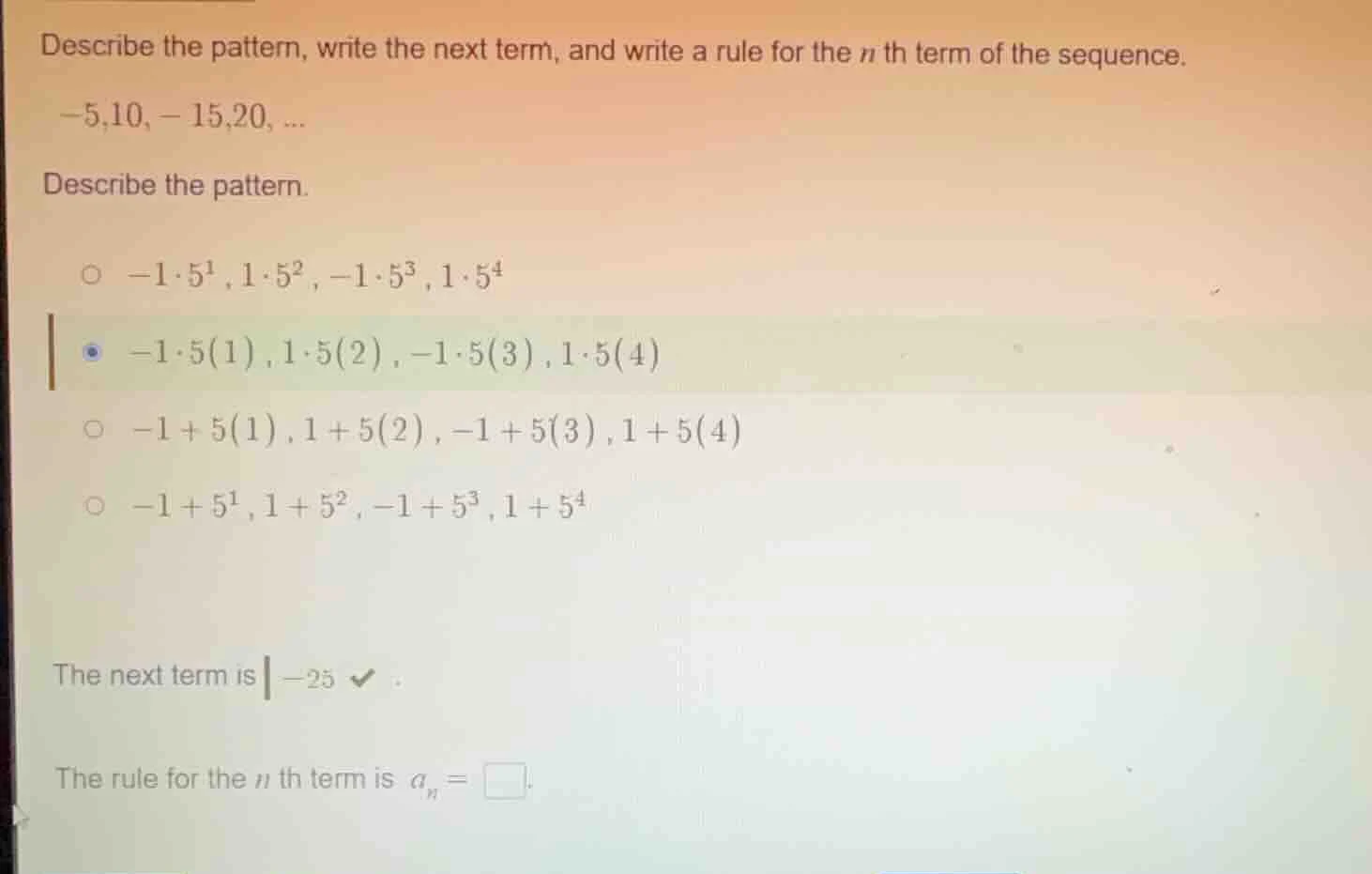
describe the pattern, write the next term, and write a rule for the n th term of the sequence.
-5,10, - 15,20, ...
describe the pattern.
-1·5¹,1·5², -1·5³,1·5⁴
-1·5(1),1·5(2), -1·5(3),1·5(4)
-1 + 5(1),1 + 5(2), -1 + 5(3),1 + 5(4)
-1 + 5¹,1 + 5², -1 + 5³,1 + 5⁴
the next term is -25
the rule for the n th term is aₙ = .
Step1: Analyze the sign pattern
The sequence alternates between negative and positive. For \(n = 1\), the sign is negative; for \(n = 2\), positive; \(n = 3\), negative, etc. This can be represented by \((- 1)^{n}\) since when \(n\) is odd, \((-1)^{n}=-1\) and when \(n\) is even, \((-1)^{n}=1\).
Step2: Analyze the magnitude pattern
The magnitudes of the terms are \(5,10,15,20,\cdots\) which is \(5\times1,5\times2,5\times3,5\times4,\cdots\) or in general \(5n\) where \(n\) is the term number.
Step3: Combine sign and magnitude
Combining the sign pattern \((-1)^{n}\) and the magnitude pattern \(5n\), the \(n\)-th term \(a_{n}\) is given by \(a_{n}=(-1)^{n}\times5n\). We can also write it as \(a_{n}=- 1^{n}\times5n\) (since \((-1)^{n}=-1^{n}\) for integer \(n\)) or in the form similar to the pattern description as \(a_{n}=(-1)\cdot5(n)\) with the sign alternating based on \(n\), which can be written as \(a_{n}=(-1)^{n}\cdot5n\).

Snap & solve any problem in the app
Get step-by-step solutions on Sovi AI
Photo-based solutions with guided steps
Explore more problems and detailed explanations
\(a_{n}=(-1)^{n}\cdot5n\) (or equivalent forms like \(a_{n}=-5n(-1)^{n + 1}\) or \(a_{n}=5n(-1)^{n+1}\) reversed sign, but the standard is \(a_{n}=(-1)^{n}\cdot5n\))