QUESTION IMAGE
Question
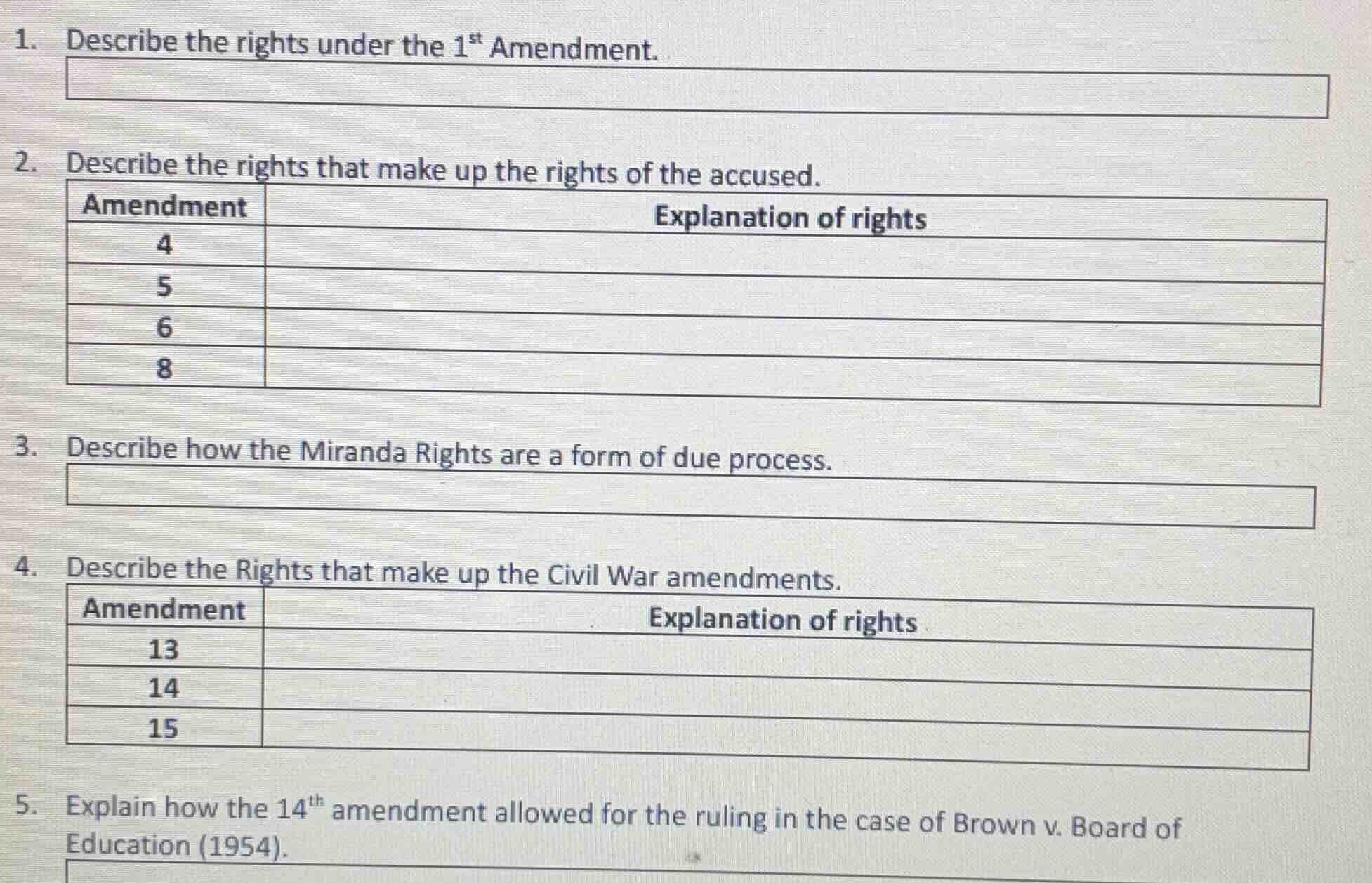
- describe the rights under the 1st amendment.
- describe the rights that make up the rights of the accused.
amendment | explanation of rights
4 |
5 |
6 |
8 |
- describe how the miranda rights are a form of due process.
- describe the rights that make up the civil war amendments.
amendment | explanation of rights
13 |
14 |
15 |
- explain how the 14th amendment allowed for the ruling in the case of brown v. board of education (1954).
Question 1
The 1st Amendment to the US Constitution protects several key rights. It includes the freedom of religion (both the establishment of religion and the free exercise thereof), freedom of speech, freedom of the press, the right to assemble peacefully, and the right to petition the government for a redress of grievances. These rights are fundamental to the democratic process and individual liberties in the United States.
Due process of law requires that the government follow fair procedures when depriving a person of life, liberty, or property. Miranda Rights (informing suspects of their right to remain silent and right to an attorney) are a form of due process because they ensure that suspects are aware of their constitutional rights (from the 5th and 6th Amendments) during police interrogation. This prevents law enforcement from coercing or tricking suspects into self - incrimination and ensures that the suspect's right to counsel (for a fair defense) and right against self - incrimination are protected. Without being informed of these rights, a suspect might unknowingly waive their rights, and the resulting confession or statements could be used against them in a way that violates the fair procedures required by due process.
The 14th Amendment's Equal Protection Clause states that no state shall deny to any person within its jurisdiction the equal protection of the laws. In Brown v. Board of Education (1954), the Supreme Court ruled that racial segregation in public schools was unconstitutional. The "separate but equal" doctrine (from Plessy v. Ferguson) was rejected. The Court held that segregated schools were inherently unequal because the very fact of segregation based on race sent a message of inferiority to African - American students. The 14th Amendment's Equal Protection Clause required that states provide equal educational opportunities, and segregated schools did not meet this standard as they violated the principle of equal protection.

Snap & solve any problem in the app
Get step-by-step solutions on Sovi AI
Photo-based solutions with guided steps
Explore more problems and detailed explanations
The 1st Amendment rights are: Freedom of religion (prohibits establishment of religion & protects free exercise), freedom of speech, freedom of the press, right to peacefully assemble, and right to petition the government for redress of grievances.
Question 2
| Amendment | Explanation of rights |
|---|---|
| 5 | Provides rights to the accused: protection against self - incrimination (right to remain silent), protection against double jeopardy (can't be tried twice for the same crime), right to due process of law, and the government must compensate for taking private property for public use (eminent domain). Also, a grand jury indictment is required for serious federal crimes. |
| 6 | Grants the right to a speedy and public trial by an impartial jury (in the state and district where the crime was committed), the right to be informed of the nature and cause of the accusation, the right to confront witnesses against oneself, the right to have compulsory process for obtaining witnesses in one's favor, and the right to the assistance of counsel (a lawyer) for defense. |
| 8 | Prohibits excessive bail, excessive fines, and cruel and unusual punishments. This ensures that the punishment for a crime is proportionate and that the pretrial detention (if bail is set) is not overly burdensome. |