QUESTION IMAGE
Question
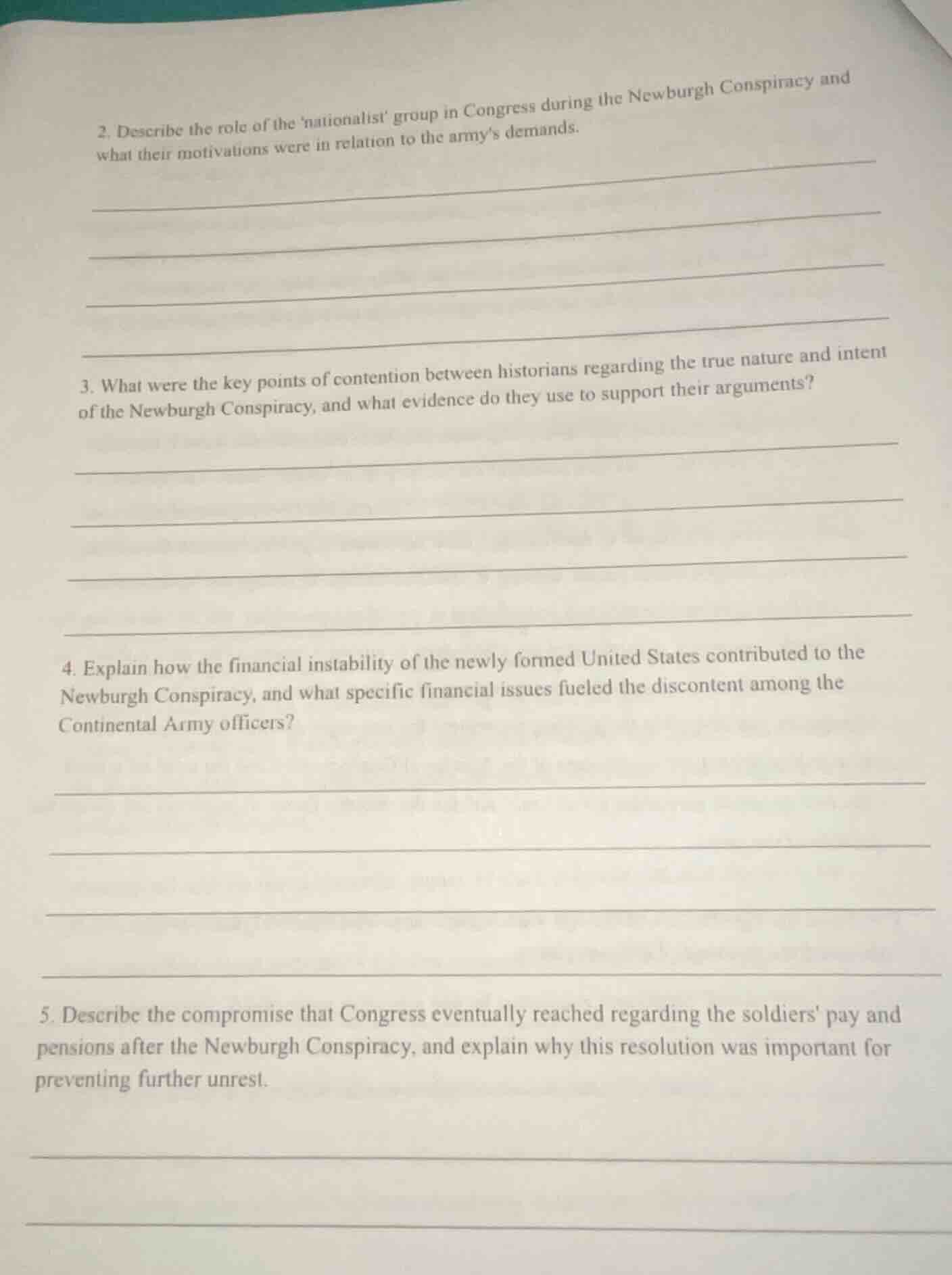
- describe the role of the nationalist group in congress during the newburgh conspiracy and what their motivations were in relation to the armys demands.
- what were the key points of contention between historians regarding the true nature and intent of the newburgh conspiracy, and what evidence do they use to support their arguments?
- explain how the financial instability of the newly formed united states contributed to the newburgh conspiracy, and what specific financial issues fueled the discontent among the continental army officers?
- describe the compromise that congress eventually reached regarding the soldiers pay and pensions after the newburgh conspiracy, and explain why this resolution was important for preventing further unrest.
These questions are related to the Newburgh Conspiracy, which is a historical event. So the discipline is Social Science and the subfield is History. Here are the answers for each sub - question:
Question 2
The 'nationalist' group in Congress (like Alexander Hamilton) played a role in mediating between the army and Congress. Their motivation was to strengthen the national government, as they saw the army's discontent as an opportunity to push for a more centralized authority, and also to prevent a military coup that could destabilize the new nation.
- Key points of contention: Historians debate whether the Newburgh Conspiracy was a genuine plot to overthrow the civilian government (a military coup - like attempt) or just a political maneuver by officers to pressure Congress for pay and pensions.
- Evidence for different sides:
- For it being a genuine coup plot: Some point to the secretive meetings, the inflammatory address (the "First Address" to the army) that seemed to incite against Congress, and the fact that some officers were ready to use force.
- For it being a pressure tactic: Others note that George Washington's intervention (with the "Second Address") defused the situation, and that the officers' main goal was to get their rightful pay and pensions, not to overthrow the government. Also, the fact that the army disbanded peacefully after Congress made concessions supports this view.
- Contribution of financial instability: The newly formed US under the Articles of Confederation had no power to tax, so it couldn't raise enough revenue to pay the army. This financial instability led to the army's discontent as they were owed back pay, and there was no system to provide pensions.
- Specific financial issues:
- The Continental Congress had no authority to levy taxes, so it relied on states' contributions (which were often insufficient or not provided at all).
- Army officers and soldiers were owed years of back pay.
- There was no provision for pensions, and many officers who had served for years feared poverty after the war with no financial security.

Snap & solve any problem in the app
Get step-by-step solutions on Sovi AI
Photo-based solutions with guided steps
Explore more problems and detailed explanations
The 'nationalist' group in Congress, led by figures like Alexander Hamilton, worked to mediate between the Continental Army (which was discontented over pay and pensions) and the weak Confederation Congress. Their motivations were to strengthen the national government (as they believed the Articles of Confederation - era government was too weak), prevent a military uprising that could destroy the new nation, and use the army's demands as leverage to push for a more centralized political structure that could address issues like national finance and authority.