QUESTION IMAGE
Question
describing conditional probabilities
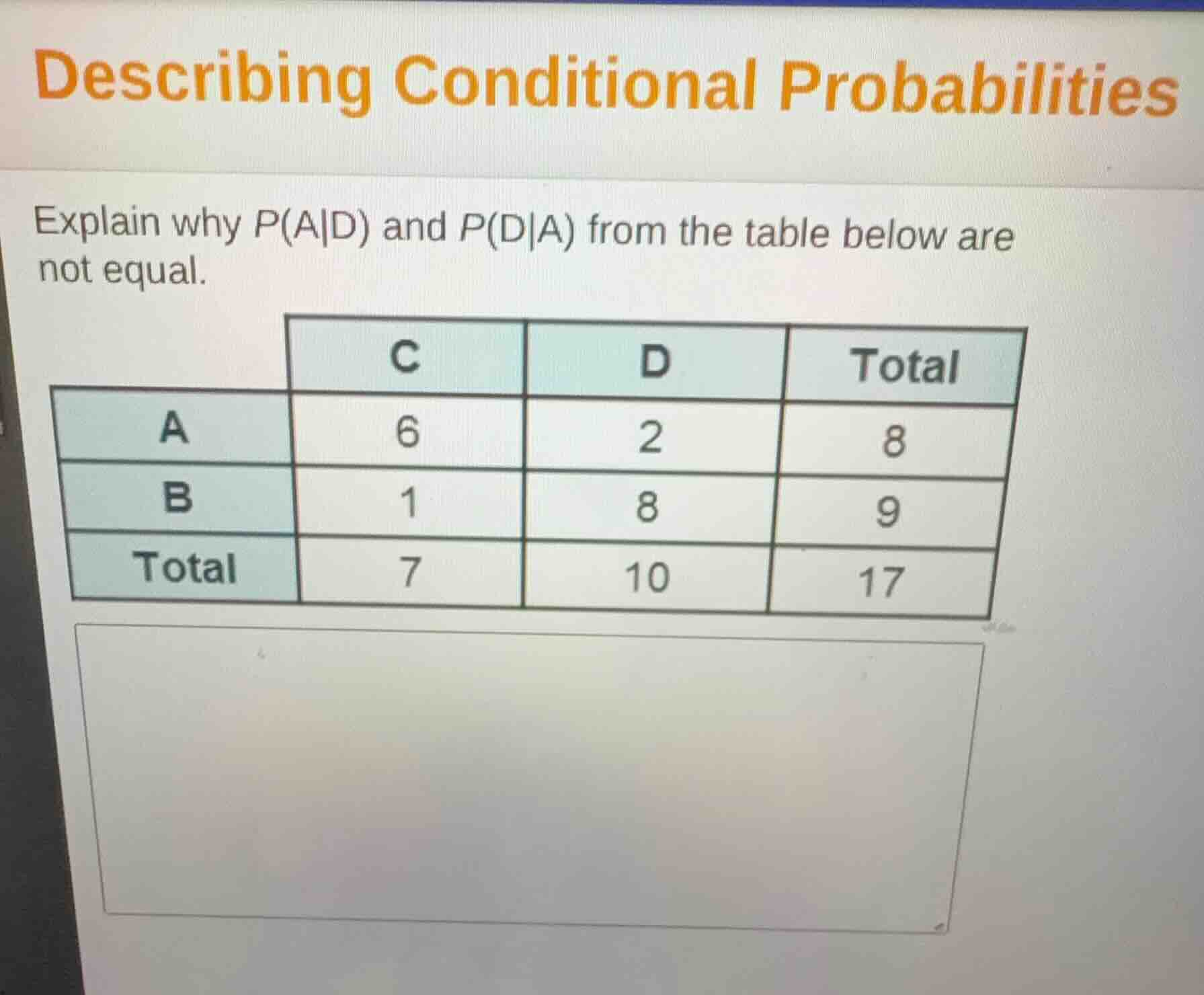
explain why p(a|d) and p(d|a) from the table below are not equal.
| c | d | total | |
|---|---|---|---|
| b | 1 | 8 | 9 |
| total | 7 | 10 | 17 |
Step1: Recall Conditional Probability Formula
The formula for conditional probability is \( P(X|Y) = \frac{P(X \cap Y)}{P(Y)} \), or using counts from a table, \( P(X|Y) = \frac{\text{Number of cases where } X \text{ and } Y \text{ occur}}{\text{Number of cases where } Y \text{ occurs}} \).
Step2: Calculate \( P(A|D) \)
For \( P(A|D) \), the number of cases where \( A \) and \( D \) occur is 2 (from the table, cell A-D), and the number of cases where \( D \) occurs is 10 (total for column D). So \( P(A|D) = \frac{2}{10} = \frac{1}{5} \).
Step3: Calculate \( P(D|A) \)
For \( P(D|A) \), the number of cases where \( D \) and \( A \) occur is 2 (same cell A-D), and the number of cases where \( A \) occurs is 8 (total for row A). So \( P(D|A) = \frac{2}{8} = \frac{1}{4} \).
Step4: Compare the Two Probabilities
Since \( \frac{1}{5}
eq \frac{1}{4} \), the denominators (the total number of cases for the condition) are different (10 for \( D \), 8 for \( A \)), leading to different probabilities.

Snap & solve any problem in the app
Get step-by-step solutions on Sovi AI
Photo-based solutions with guided steps
Explore more problems and detailed explanations
\( P(A|D) = \frac{2}{10} = \frac{1}{5} \) and \( P(D|A) = \frac{2}{8} = \frac{1}{4} \). They differ because \( P(A|D) \) conditions on \( D \) (denominator 10) and \( P(D|A) \) conditions on \( A \) (denominator 8), so their denominators (total cases for the condition) are different, resulting in unequal probabilities.