QUESTION IMAGE
Question
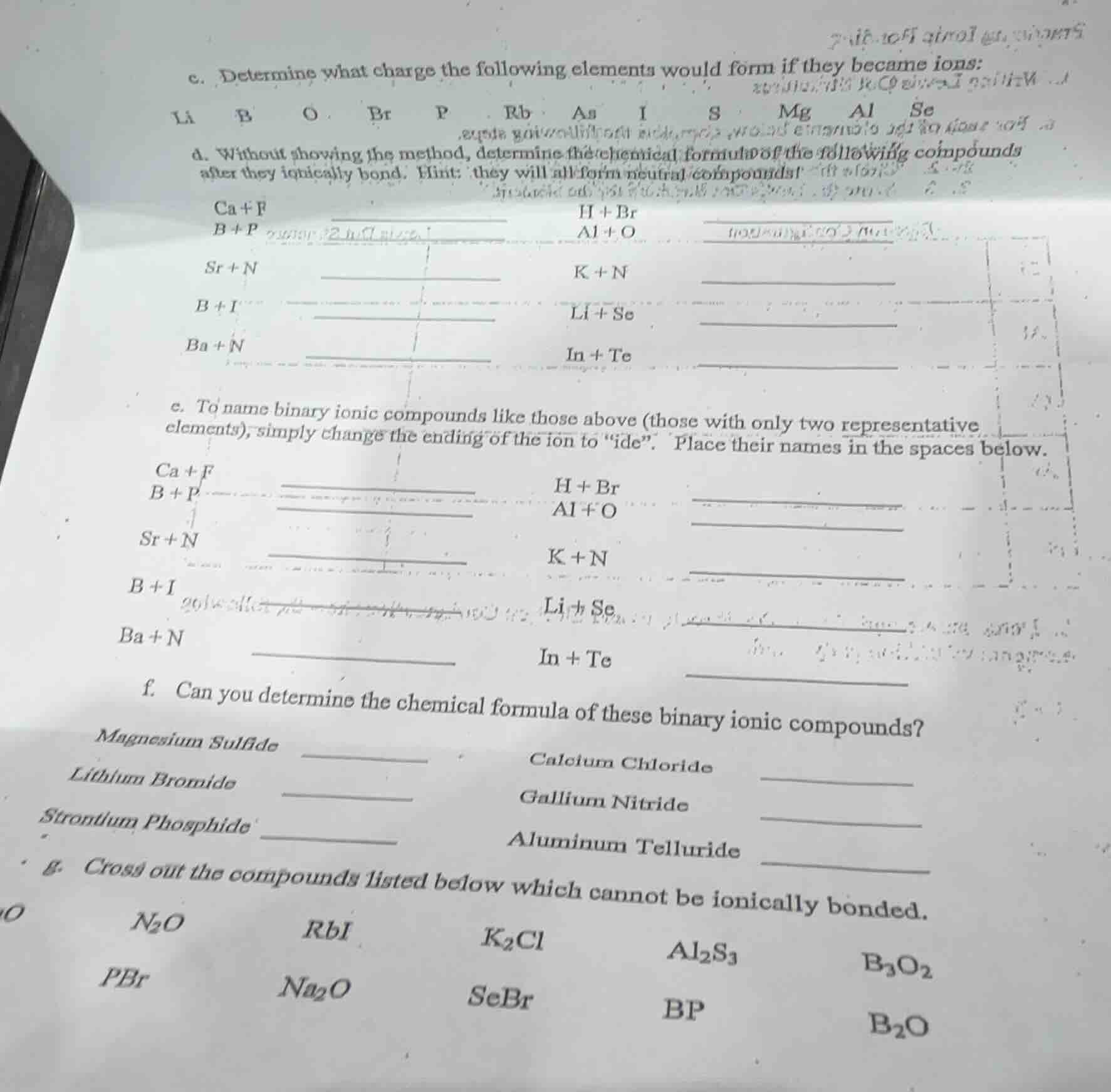
c. determine what charge the following elements would form if they became ions: li b o br p rb as i s mg al se d. without showing the method, determine the chemical formula of the following compounds after they ionically bond. hint: they will all form neutral compounds! ca+f h+br b+p al+o sr+n k+n b+i li+se ba+n in+te e. to name binary ionic compounds like those above (those with only two representative elements), simply change the ending of the ion to \ide\. place their names in the spaces below. ca+f h+br b+p al+o sr+n k+n b+i li+se ba+n in+te f. can you determine the chemical formula of these binary ionic compounds? magnesium sulfide calcium chloride lithium bromide gallium nitride strontium phosphide aluminum telluride g. cross out the compounds listed below which cannot be ionically bonded. n₂o rbi k₂cl al₂s₃ b₃o₂ pbr na₂o sebr bp b₂o
Part c: Determine Ion Charges
To determine the charge of each element when forming ions, we use their group number (for main - group elements) or common oxidation states:
- Li: Lithium is in Group 1. Group 1 metals lose 1 electron to form a cation with a charge of \(+ 1\). So, \(\text{Li}^{+}\)
- B: Boron is in Group 13. It commonly loses 3 electrons to form \(\text{B}^{3+}\)
- O: Oxygen is in Group 16. It gains 2 electrons to form \(\text{O}^{2 -}\)
- Br: Bromine is in Group 17. It gains 1 electron to form \(\text{Br}^{-}\)
- P: Phosphorus is in Group 15. It gains 3 electrons to form \(\text{P}^{3 -}\)
- Rb: Rubidium is in Group 1. It loses 1 electron to form \(\text{Rb}^{+}\)
- As: Arsenic is in Group 15. It gains 3 electrons to form \(\text{As}^{3 -}\)
- I: Iodine is in Group 17. It gains 1 electron to form \(\text{I}^{-}\)
- S: Sulfur is in Group 16. It gains 2 electrons to form \(\text{S}^{2 -}\)
- Mg: Magnesium is in Group 2. It loses 2 electrons to form \(\text{Mg}^{2+}\)
- Al: Aluminum is in Group 13. It loses 3 electrons to form \(\text{Al}^{3+}\)
- Se: Selenium is in Group 16. It gains 2 electrons to form \(\text{Se}^{2 -}\)
Part d: Chemical Formulas of Ionic Compounds
For ionic compounds, the total positive charge must equal the total negative charge (the compound is neutral). We use the charges of the ions (from part c) and the criss - cross method (swap the absolute values of the charges to get the subscripts).
- \(\text{Ca}+\text{F}\): \(\text{Ca}\) has a charge of \(+ 2\), \(\text{F}\) has a charge of \(-1\). Using criss - cross, the formula is \(\text{CaF}_2\)
- \(\text{H}+\text{Br}\): \(\text{H}\) has a charge of \(+ 1\), \(\text{Br}\) has a charge of \(-1\). The formula is \(\text{HBr}\)
- \(\text{B}+\text{P}\): \(\text{B}\) has a charge of \(+ 3\), \(\text{P}\) has a charge of \(-3\). The formula is \(\text{BP}\)
- \(\text{Al}+\text{O}\): \(\text{Al}\) has a charge of \(+ 3\), \(\text{O}\) has a charge of \(-2\). Criss - cross gives \(\text{Al}_2\text{O}_3\)
- \(\text{Sr}+\text{N}\): \(\text{Sr}\) has a charge of \(+ 2\), \(\text{N}\) has a charge of \(-3\). The formula is \(\text{Sr}_3\text{N}_2\)
- \(\text{K}+\text{N}\): \(\text{K}\) has a charge of \(+ 1\), \(\text{N}\) has a charge of \(-3\). The formula is \(\text{K}_3\text{N}\)
- \(\text{B}+\text{I}\): \(\text{B}\) has a charge of \(+ 3\), \(\text{I}\) has a charge of \(-1\). The formula is \(\text{BI}_3\)
- \(\text{Li}+\text{Se}\): \(\text{Li}\) has a charge of \(+ 1\), \(\text{Se}\) has a charge of \(-2\). The formula is \(\text{Li}_2\text{Se}\)
- \(\text{Ba}+\text{N}\): \(\text{Ba}\) has a charge of \(+ 2\), \(\text{N}\) has a charge of \(-3\). The formula is \(\text{Ba}_3\text{N}_2\)
- \(\text{In}+\text{Te}\): Indium (\(\text{In}\)) commonly has a charge of \(+ 3\), Tellurium (\(\text{Te}\)) has a charge of \(-2\). The formula is \(\text{In}_2\text{Te}_3\)
Part e: Naming Binary Ionic Compounds
For binary ionic compounds, we name the cation first (using the element name) and then the anion, changing the anion's ending to - ide.
- \(\text{CaF}_2\): Calcium fluoride
- \(\text{HBr}\): Hydrogen bromide
- \(\text{BP}\): Boron phosphide
- \(\text{Al}_2\text{O}_3\): Aluminum oxide
- \(\text{Sr}_3\text{N}_2\): Strontium nitride
- \(\text{K}_3\text{N}\): Potassium nitride
- \(\text{BI}_3\): Boron iodide
- \(\text{Li}_2\text{Se}\): Lithium selenide
- \(\text{Ba}_3\text{N}_2\): Barium nitride
- \(\text{In}_2\text{Te}_3\): Indiu…

Snap & solve any problem in the app
Get step-by-step solutions on Sovi AI
Photo-based solutions with guided steps
Explore more problems and detailed explanations
Part c: Determine Ion Charges
To determine the charge of each element when forming ions, we use their group number (for main - group elements) or common oxidation states:
- Li: Lithium is in Group 1. Group 1 metals lose 1 electron to form a cation with a charge of \(+ 1\). So, \(\text{Li}^{+}\)
- B: Boron is in Group 13. It commonly loses 3 electrons to form \(\text{B}^{3+}\)
- O: Oxygen is in Group 16. It gains 2 electrons to form \(\text{O}^{2 -}\)
- Br: Bromine is in Group 17. It gains 1 electron to form \(\text{Br}^{-}\)
- P: Phosphorus is in Group 15. It gains 3 electrons to form \(\text{P}^{3 -}\)
- Rb: Rubidium is in Group 1. It loses 1 electron to form \(\text{Rb}^{+}\)
- As: Arsenic is in Group 15. It gains 3 electrons to form \(\text{As}^{3 -}\)
- I: Iodine is in Group 17. It gains 1 electron to form \(\text{I}^{-}\)
- S: Sulfur is in Group 16. It gains 2 electrons to form \(\text{S}^{2 -}\)
- Mg: Magnesium is in Group 2. It loses 2 electrons to form \(\text{Mg}^{2+}\)
- Al: Aluminum is in Group 13. It loses 3 electrons to form \(\text{Al}^{3+}\)
- Se: Selenium is in Group 16. It gains 2 electrons to form \(\text{Se}^{2 -}\)
Part d: Chemical Formulas of Ionic Compounds
For ionic compounds, the total positive charge must equal the total negative charge (the compound is neutral). We use the charges of the ions (from part c) and the criss - cross method (swap the absolute values of the charges to get the subscripts).
- \(\text{Ca}+\text{F}\): \(\text{Ca}\) has a charge of \(+ 2\), \(\text{F}\) has a charge of \(-1\). Using criss - cross, the formula is \(\text{CaF}_2\)
- \(\text{H}+\text{Br}\): \(\text{H}\) has a charge of \(+ 1\), \(\text{Br}\) has a charge of \(-1\). The formula is \(\text{HBr}\)
- \(\text{B}+\text{P}\): \(\text{B}\) has a charge of \(+ 3\), \(\text{P}\) has a charge of \(-3\). The formula is \(\text{BP}\)
- \(\text{Al}+\text{O}\): \(\text{Al}\) has a charge of \(+ 3\), \(\text{O}\) has a charge of \(-2\). Criss - cross gives \(\text{Al}_2\text{O}_3\)
- \(\text{Sr}+\text{N}\): \(\text{Sr}\) has a charge of \(+ 2\), \(\text{N}\) has a charge of \(-3\). The formula is \(\text{Sr}_3\text{N}_2\)
- \(\text{K}+\text{N}\): \(\text{K}\) has a charge of \(+ 1\), \(\text{N}\) has a charge of \(-3\). The formula is \(\text{K}_3\text{N}\)
- \(\text{B}+\text{I}\): \(\text{B}\) has a charge of \(+ 3\), \(\text{I}\) has a charge of \(-1\). The formula is \(\text{BI}_3\)
- \(\text{Li}+\text{Se}\): \(\text{Li}\) has a charge of \(+ 1\), \(\text{Se}\) has a charge of \(-2\). The formula is \(\text{Li}_2\text{Se}\)
- \(\text{Ba}+\text{N}\): \(\text{Ba}\) has a charge of \(+ 2\), \(\text{N}\) has a charge of \(-3\). The formula is \(\text{Ba}_3\text{N}_2\)
- \(\text{In}+\text{Te}\): Indium (\(\text{In}\)) commonly has a charge of \(+ 3\), Tellurium (\(\text{Te}\)) has a charge of \(-2\). The formula is \(\text{In}_2\text{Te}_3\)
Part e: Naming Binary Ionic Compounds
For binary ionic compounds, we name the cation first (using the element name) and then the anion, changing the anion's ending to - ide.
- \(\text{CaF}_2\): Calcium fluoride
- \(\text{HBr}\): Hydrogen bromide
- \(\text{BP}\): Boron phosphide
- \(\text{Al}_2\text{O}_3\): Aluminum oxide
- \(\text{Sr}_3\text{N}_2\): Strontium nitride
- \(\text{K}_3\text{N}\): Potassium nitride
- \(\text{BI}_3\): Boron iodide
- \(\text{Li}_2\text{Se}\): Lithium selenide
- \(\text{Ba}_3\text{N}_2\): Barium nitride
- \(\text{In}_2\text{Te}_3\): Indium telluride
Part f: Chemical Formulas from Names
We determine the charges of the ions from the element's group or common oxidation states and then use the criss - cross method.
- Magnesium Sulfide: Magnesium (\(\text{Mg}\)) has a charge of \(+ 2\), Sulfide (\(\text{S}\)) has a charge of \(-2\). Formula: \(\text{MgS}\)
- Calcium Chloride: Calcium (\(\text{Ca}\)) has a charge of \(+ 2\), Chloride (\(\text{Cl}\)) has a charge of \(-1\). Formula: \(\text{CaCl}_2\)
- Lithium Bromide: Lithium (\(\text{Li}\)) has a charge of \(+ 1\), Bromide (\(\text{Br}\)) has a charge of \(-1\). Formula: \(\text{LiBr}\)
- Gallium Nitride: Gallium (\(\text{Ga}\)) has a charge of \(+ 3\), Nitride (\(\text{N}\)) has a charge of \(-3\). Formula: \(\text{GaN}\)
- Strontium Phosphide: Strontium (\(\text{Sr}\)) has a charge of \(+ 2\), Phosphide (\(\text{P}\)) has a charge of \(-3\). Formula: \(\text{Sr}_3\text{P}_2\)
- Aluminum Telluride: Aluminum (\(\text{Al}\)) has a charge of \(+ 3\), Telluride (\(\text{Te}\)) has a charge of \(-2\). Formula: \(\text{Al}_2\text{Te}_3\)
Part g: Identifying Non - Ionic Compounds
Ionic compounds are formed between a metal (or ammonium ion) and a non - metal. We check the combination:
- \(\text{N}_2\text{O}\): Both nitrogen and oxygen are non - metals. It is a covalent compound (not ionic), so we cross it out.
- \(\text{RbI}\): Rubidium (metal) and iodine (non - metal). It is ionic.
- \(\text{K}_2\text{Cl}\): The charge balance is wrong. Potassium has a \(+ 1\) charge and chlorine has a \(-1\) charge, the correct formula should be \(\text{KCl}\), so we cross out \(\text{K}_2\text{Cl}\).
- \(\text{Al}_2\text{S}_3\): Aluminum (metal) and sulfur (non - metal). It is ionic.
- \(\text{B}_3\text{O}_2\): The charge balance is incorrect. Boron has a \(+ 3\) charge and oxygen has a \(-2\) charge, so we cross it out.
- \(\text{PBr}\): The charge balance is wrong. Phosphorus has a \(-3\) charge and bromine has a \(-1\) charge (and phosphorus is a non - metal, bromine is a non - metal in this incorrect combination), so we cross it out.
- \(\text{Na}_2\text{O}\): Sodium (metal) and oxygen (non - metal). It is ionic.
- \(\text{SeBr}\): Selenium and bromine are both non - metals, and the charge balance is wrong, so we cross it out.
- \(\text{BP}\): Boron and phosphorus are both non - metals, so it is covalent (cross it out).
- \(\text{B}_2\text{O}\): The charge balance is wrong (boron \(+ 3\), oxygen \(-2\)), so we cross it out.
Final Answers (Selected Parts for Illustration)
- Part c (Li): \(\boldsymbol{+1}\)
- Part d (\(\text{Ca}+\text{F}\)): \(\boldsymbol{\text{CaF}_2}\)
- Part e (\(\text{CaF}_2\)): \(\boldsymbol{\text{Calcium fluoride}}\)
- Part f (Magnesium Sulfide): \(\boldsymbol{\text{MgS}}\)
- Part g (Compounds to cross out): \(\boldsymbol{\text{N}_2\text{O}, \text{K}_2\text{Cl}, \text{B}_3\text{O}_2, \text{PBr}, \text{SeBr}, \text{BP}, \text{B}_2\text{O}}\)