QUESTION IMAGE
Question
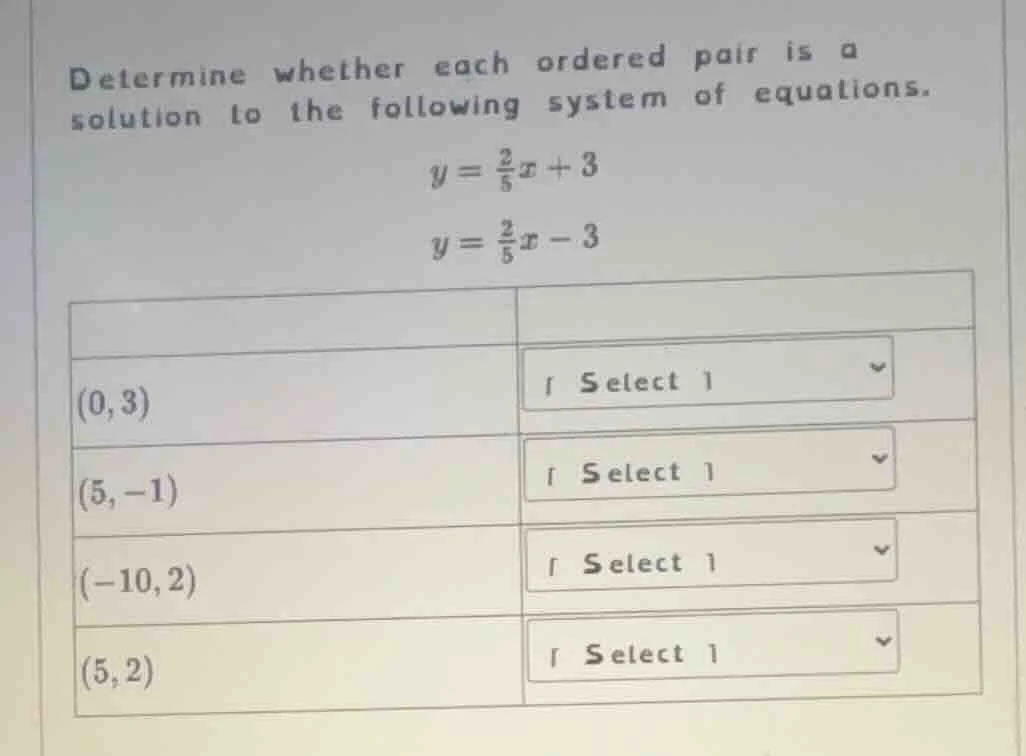
determine whether each ordered pair is a solution to the following system of equations.
$y = \frac{2}{5}x + 3$
$y = \frac{2}{5}x - 3$
| $(5, -1)$ | select 1 |
| $(-10, 2)$ | select 1 |
| $(5, 2)$ | select 1 |
To determine if an ordered pair \((x, y)\) is a solution to the system of equations, we substitute the \(x\)- and \(y\)-values into both equations and check if they satisfy both. The system is:
\[
\]
For \((0, 3)\):
- Substitute \(x = 0\) and \(y = 3\) into the first equation:
\(3 = \frac{2}{5}(0) + 3\)
\(3 = 0 + 3\)
\(3 = 3\) (True).
- Substitute \(x = 0\) and \(y = 3\) into the second equation:
\(3 = \frac{2}{5}(0) - 3\)
\(3 = 0 - 3\)
\(3 = -3\) (False).
Since \((0, 3)\) does not satisfy the second equation, it is not a solution to the system.
For \((5, -1)\):
- Substitute \(x = 5\) and \(y = -1\) into the first equation:
\(-1 = \frac{2}{5}(5) + 3\)
\(-1 = 2 + 3\)
\(-1 = 5\) (False).
- Substitute \(x = 5\) and \(y = -1\) into the second equation:
\(-1 = \frac{2}{5}(5) - 3\)
\(-1 = 2 - 3\)
\(-1 = -1\) (True).
Since \((5, -1)\) does not satisfy the first equation, it is not a solution to the system.
For \((-10, 2)\):
- Substitute \(x = -10\) and \(y = 2\) into the first equation:
\(2 = \frac{2}{5}(-10) + 3\)
\(2 = -4 + 3\)
\(2 = -1\) (False).
- Substitute \(x = -10\) and \(y = 2\) into the second equation:
\(2 = \frac{2}{5}(-10) - 3\)
\(2 = -4 - 3\)
\(2 = -7\) (False).
Since \((-10, 2)\) satisfies neither equation, it is not a solution to the system.
For \((5, 2)\):
- Substitute \(x = 5\) and \(y = 2\) into the first equation:
\(2 = \frac{2}{5}(5) + 3\)
\(2 = 2 + 3\)
\(2 = 5\) (False).
- Substitute \(x = 5\) and \(y = 2\) into the second equation:
\(2 = \frac{2}{5}(5) - 3\)
\(2 = 2 - 3\)
\(2 = -1\) (False).
Since \((5, 2)\) satisfies neither equation, it is not a solution to the system.
Final Answers:
- \((0, 3)\): Not a solution
- \((5, -1)\): Not a solution
- \((-10, 2)\): Not a solution
- \((5, 2)\): Not a solution
(Note: The two lines \(y = \frac{2}{5}x + 3\) and \(y = \frac{2}{5}x - 3\) are parallel (same slope, different y-intercepts), so they never intersect. Thus, there are no solutions to this system.)

Snap & solve any problem in the app
Get step-by-step solutions on Sovi AI
Photo-based solutions with guided steps
Explore more problems and detailed explanations
To determine if an ordered pair \((x, y)\) is a solution to the system of equations, we substitute the \(x\)- and \(y\)-values into both equations and check if they satisfy both. The system is:
\[
\]
For \((0, 3)\):
- Substitute \(x = 0\) and \(y = 3\) into the first equation:
\(3 = \frac{2}{5}(0) + 3\)
\(3 = 0 + 3\)
\(3 = 3\) (True).
- Substitute \(x = 0\) and \(y = 3\) into the second equation:
\(3 = \frac{2}{5}(0) - 3\)
\(3 = 0 - 3\)
\(3 = -3\) (False).
Since \((0, 3)\) does not satisfy the second equation, it is not a solution to the system.
For \((5, -1)\):
- Substitute \(x = 5\) and \(y = -1\) into the first equation:
\(-1 = \frac{2}{5}(5) + 3\)
\(-1 = 2 + 3\)
\(-1 = 5\) (False).
- Substitute \(x = 5\) and \(y = -1\) into the second equation:
\(-1 = \frac{2}{5}(5) - 3\)
\(-1 = 2 - 3\)
\(-1 = -1\) (True).
Since \((5, -1)\) does not satisfy the first equation, it is not a solution to the system.
For \((-10, 2)\):
- Substitute \(x = -10\) and \(y = 2\) into the first equation:
\(2 = \frac{2}{5}(-10) + 3\)
\(2 = -4 + 3\)
\(2 = -1\) (False).
- Substitute \(x = -10\) and \(y = 2\) into the second equation:
\(2 = \frac{2}{5}(-10) - 3\)
\(2 = -4 - 3\)
\(2 = -7\) (False).
Since \((-10, 2)\) satisfies neither equation, it is not a solution to the system.
For \((5, 2)\):
- Substitute \(x = 5\) and \(y = 2\) into the first equation:
\(2 = \frac{2}{5}(5) + 3\)
\(2 = 2 + 3\)
\(2 = 5\) (False).
- Substitute \(x = 5\) and \(y = 2\) into the second equation:
\(2 = \frac{2}{5}(5) - 3\)
\(2 = 2 - 3\)
\(2 = -1\) (False).
Since \((5, 2)\) satisfies neither equation, it is not a solution to the system.
Final Answers:
- \((0, 3)\): Not a solution
- \((5, -1)\): Not a solution
- \((-10, 2)\): Not a solution
- \((5, 2)\): Not a solution
(Note: The two lines \(y = \frac{2}{5}x + 3\) and \(y = \frac{2}{5}x - 3\) are parallel (same slope, different y-intercepts), so they never intersect. Thus, there are no solutions to this system.)