QUESTION IMAGE
Question
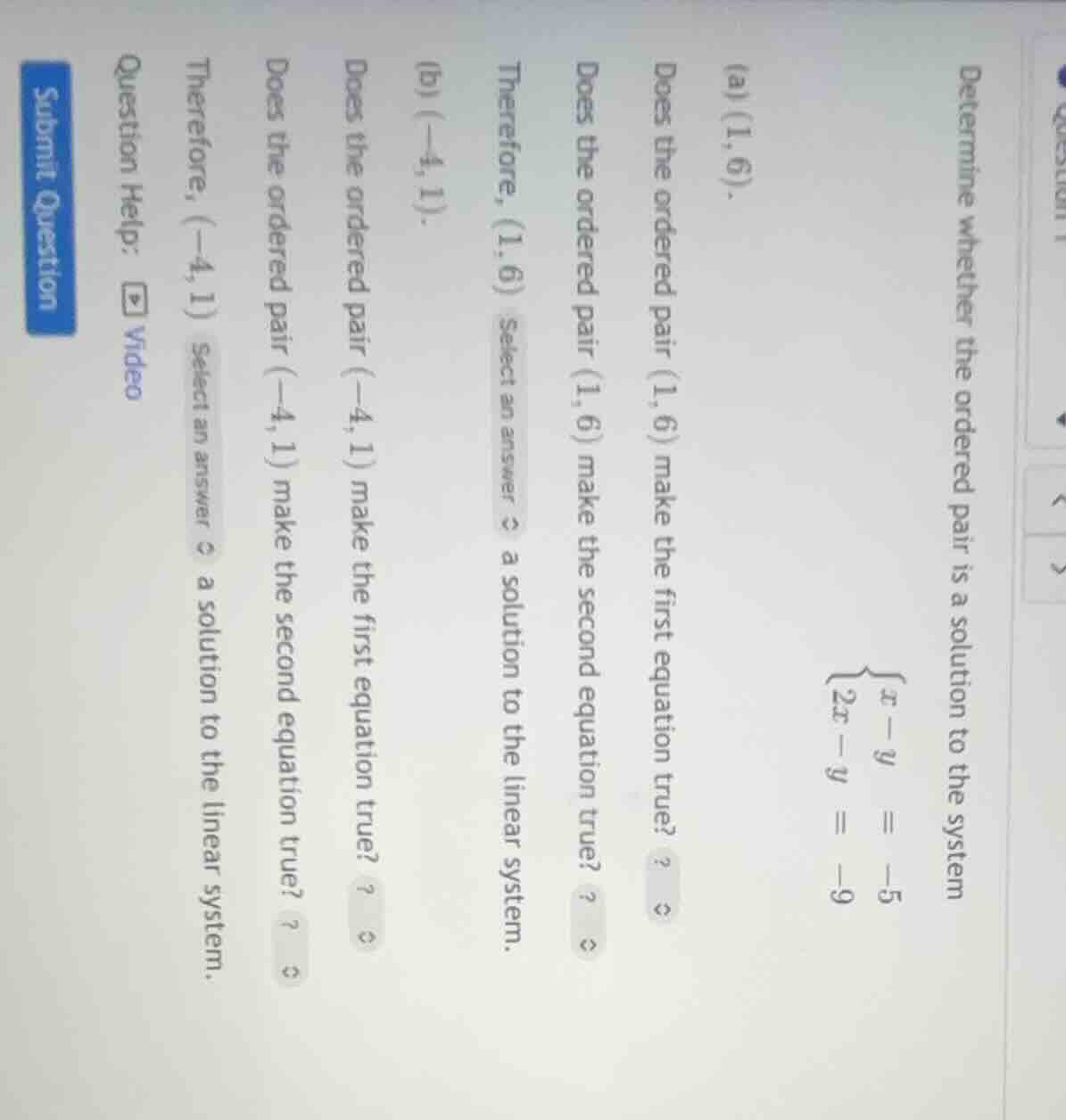
determine whether the ordered pair is a solution to the system
(a) $(1,6)$.
does the ordered pair $(1,6)$ make the first equation true? ?
does the ordered pair $(1,6)$ make the second equation true? ?
therefore, $(1,6)$ select an answer a solution to the linear system.
(b) $(-4,1)$.
does the ordered pair $(-4,1)$ make the first equation true? ?
does the ordered pair $(-4,1)$ make the second equation true? ?
therefore, $(-4,1)$ select an answer a solution to the linear system.
question help: video
submit question
Step1: Test (1,6) in first equation
Substitute $x=1$, $y=6$ into $x-y=-5$:
$1 - 6 = -5$
$-5 = -5$ (True)
Step2: Test (1,6) in second equation
Substitute $x=1$, $y=6$ into $2x-y=-9$:
$2(1) - 6 = 2 - 6 = -4$
$-4
eq -9$ (False)
Step3: Test (-4,1) in first equation
Substitute $x=-4$, $y=1$ into $x-y=-5$:
$-4 - 1 = -5$
$-5 = -5$ (True)
Step4: Test (-4,1) in second equation
Substitute $x=-4$, $y=1$ into $2x-y=-9$:
$2(-4) - 1 = -8 - 1 = -9$
$-9 = -9$ (True)

Snap & solve any problem in the app
Get step-by-step solutions on Sovi AI
Photo-based solutions with guided steps
Explore more problems and detailed explanations
For (1,6):
- Does the ordered pair make the first equation true? Yes
- Does the ordered pair make the second equation true? No
- Therefore, (1,6) is not a solution to the linear system.
For (-4,1):
- Does the ordered pair make the first equation true? Yes
- Does the ordered pair make the second equation true? Yes
- Therefore, (-4,1) is a solution to the linear system.