QUESTION IMAGE
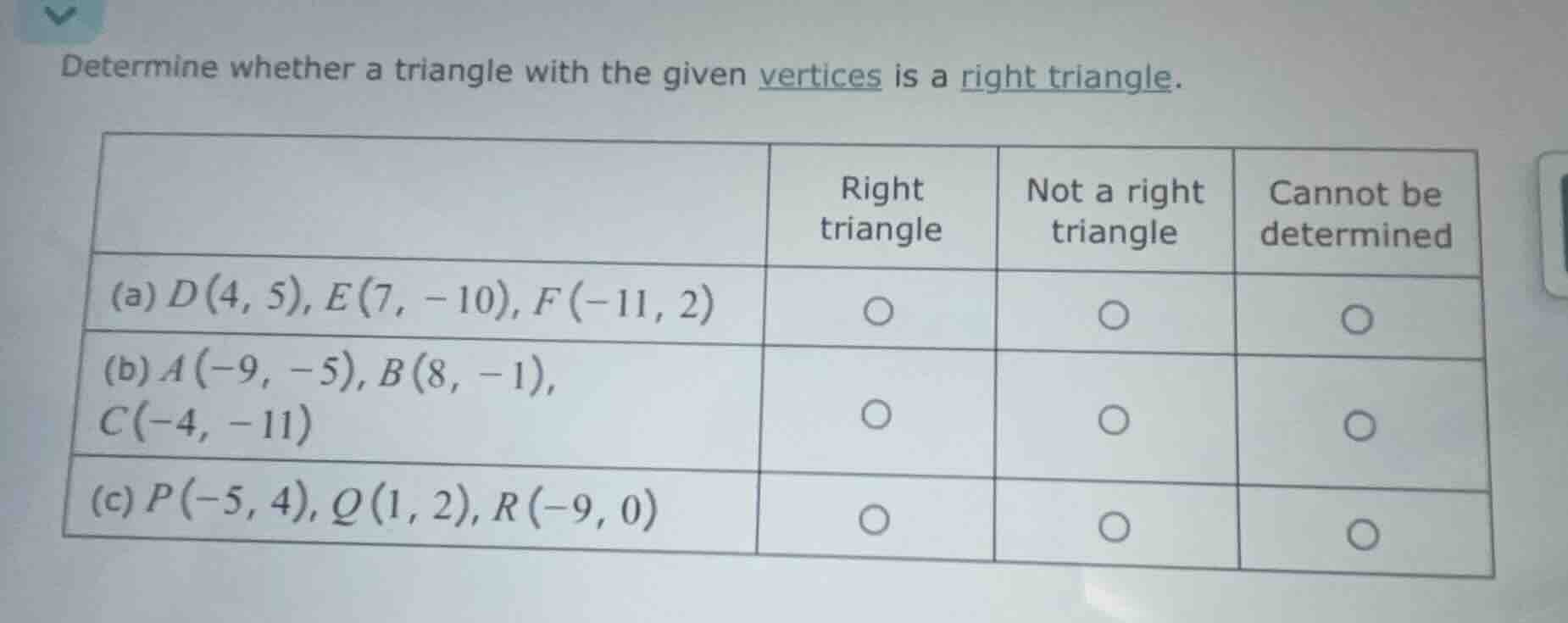
Question
determine whether a triangle with the given vertices is a right triangle.
(a) $d(4, 5), e(7, -10), f(-11, 2)$
(b) $a(-9, -5), b(8, -1), c(-4, -11)$
(c) $p(-5, 4), q(1, 2), r(-9, 0)$
options for each:
right triangle
not a right triangle
cannot be determined
Part (a): Vertices $D(4, 5), E(7, -10), F(-11, 2)$
Step1: Calculate $DE^2$
Use distance formula squared: $DE^2=(x_2-x_1)^2+(y_2-y_1)^2$
$DE^2=(7-4)^2+(-10-5)^2=3^2+(-15)^2=9+225=234$
Step2: Calculate $EF^2$
Apply distance formula squared
$EF^2=(-11-7)^2+(2-(-10))^2=(-18)^2+12^2=324+144=468$
Step3: Calculate $FD^2$
Apply distance formula squared
$FD^2=(4-(-11))^2+(5-2)^2=15^2+3^2=225+9=234$
Step4: Check Pythagorean theorem
Verify if $a^2+b^2=c^2$: $234+234=468$, so $DE^2+FD^2=EF^2$
---
Part (b): Vertices $A(-9, -5), B(8, -1), C(-4, -11)$
Step1: Calculate $AB^2$
Use distance formula squared
$AB^2=(8-(-9))^2+(-1-(-5))^2=17^2+4^2=289+16=305$
Step2: Calculate $BC^2$
Apply distance formula squared
$BC^2=(-4-8)^2+(-11-(-1))^2=(-12)^2+(-10)^2=144+100=244$
Step3: Calculate $CA^2$
Apply distance formula squared
$CA^2=(-9-(-4))^2+(-5-(-11))^2=(-5)^2+6^2=25+36=61$
Step4: Check Pythagorean theorem
Verify if $a^2+b^2=c^2$: $244+61=305$, so $BC^2+CA^2=AB^2$
---
Part (c): Vertices $P(-5, 4), Q(1, 2), R(-9, 0)$
Step1: Calculate $PQ^2$
Use distance formula squared
$PQ^2=(1-(-5))^2+(2-4)^2=6^2+(-2)^2=36+4=40$
Step2: Calculate $QR^2$
Apply distance formula squared
$QR^2=(-9-1)^2+(0-2)^2=(-10)^2+(-2)^2=100+4=104$
Step3: Calculate $RP^2$
Apply distance formula squared
$RP^2=(-5-(-9))^2+(4-0)^2=4^2+4^2=16+16=32$
Step4: Check Pythagorean theorem
Verify if $a^2+b^2=c^2$: $40+32=72
eq104$, $40+104=144
eq32$, $32+104=136
eq40$

Snap & solve any problem in the app
Get step-by-step solutions on Sovi AI
Photo-based solutions with guided steps
Explore more problems and detailed explanations
(a) Right triangle
(b) Right triangle
(c) Not a right triangle