QUESTION IMAGE
Question
determining when to use the law of cosines
which of these triangles can you use the law of cosines to solve for a missing side?
75° 8
38°
x
138° 8
x
12
y
35°
60°
x
60° 60°
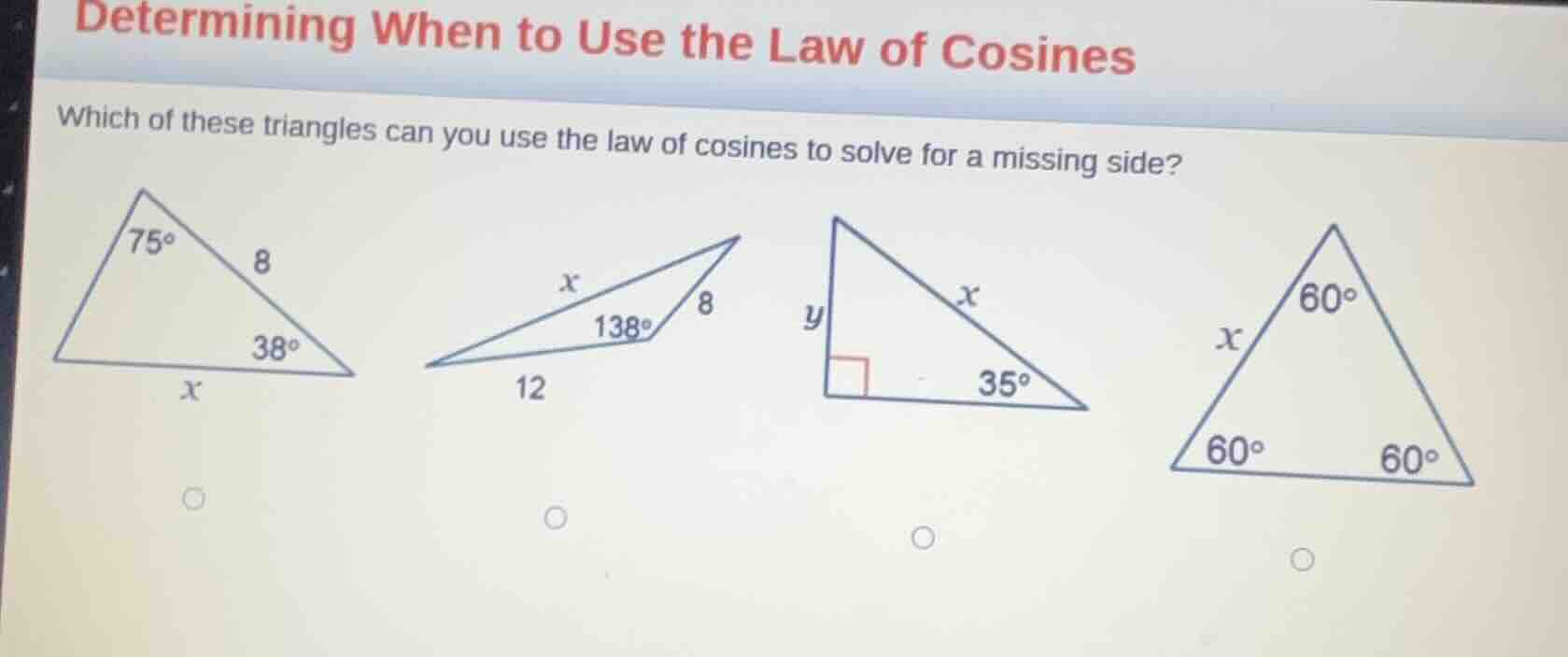
The Law of Cosines is used when we know two sides and the included angle (SAS) or all three sides (SSS) of a triangle to find a missing side or angle. Let's analyze each triangle:
Step 1: Analyze the first triangle
We know two angles (\(75^\circ\) and \(38^\circ\)) and one side (length 8). This is the AAS (Angle - Angle - Side) case, and we would use the Law of Sines, not the Law of Cosines.
Step 2: Analyze the second triangle
We know two sides (lengths 12 and 8) and the included angle (\(138^\circ\)). This is the SAS (Side - Angle - Side) case, which is a valid case for using the Law of Cosines. The Law of Cosines formula for a triangle with sides \(a\), \(b\) and included angle \(C\) is \(c^{2}=a^{2}+b^{2}-2ab\cos(C)\). Here, if we want to find the side \(x\), and we know sides \(a = 12\), \(b=8\) and included angle \(C = 138^\circ\), we can use the Law of Cosines.
Step 3: Analyze the third triangle
This is a right - triangle (we can see the right - angle symbol). For right - triangles, we use the Pythagorean theorem (\(a^{2}+b^{2}=c^{2}\)) and trigonometric ratios (sine, cosine, tangent), not the Law of Cosines.
Step 4: Analyze the fourth triangle
This is an equilateral triangle (all angles are \(60^\circ\)). In an equilateral triangle, all sides are equal. If we know the measure of the angles, we can use the properties of equilateral triangles (all sides equal) rather than the Law of Cosines.

Snap & solve any problem in the app
Get step-by-step solutions on Sovi AI
Photo-based solutions with guided steps
Explore more problems and detailed explanations
The triangle with sides 12, 8 and included angle \(138^\circ\) (the second triangle)