QUESTION IMAGE
Question
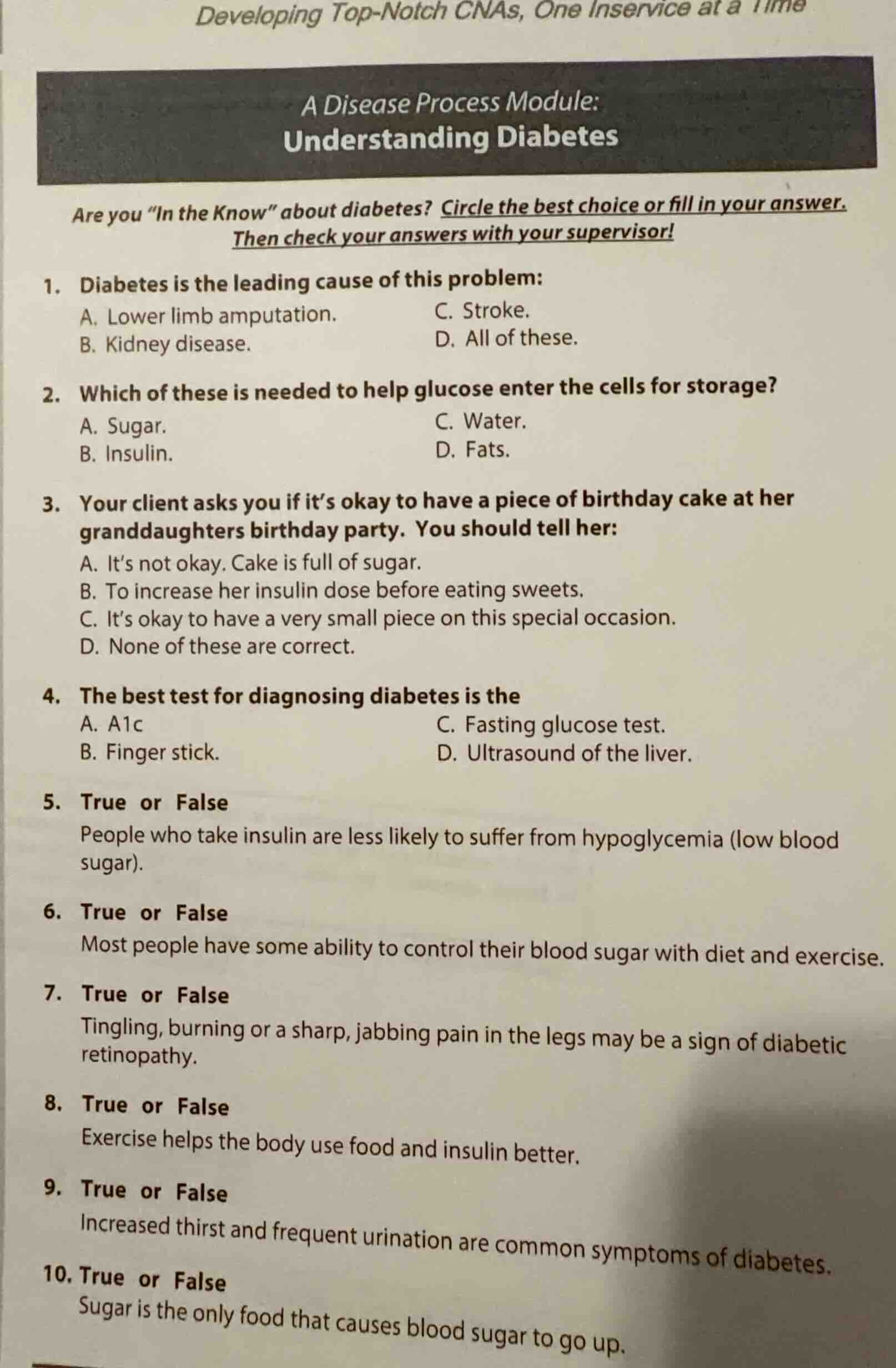
developing top-notch cnas, one inservice at a time
a disease process module:
understanding diabetes
are you \in the know\ about diabetes? circle the best choice or fill in your answer.
then check your answers with your supervisor!
- diabetes is the leading cause of this problem:
a. lower limb amputation. c. stroke.
b. kidney disease. d. all of these.
- which of these is needed to help glucose enter the cells for storage?
a. sugar. c. water.
b. insulin. d. fats.
- your client asks you if it’s okay to have a piece of birthday cake at her granddaughters birthday party. you should tell her:
a. it’s not okay. cake is full of sugar.
b. to increase her insulin dose before eating sweets.
c. it’s okay to have a very small piece on this special occasion.
d. none of these are correct.
- the best test for diagnosing diabetes is the
a. a1c c. fasting glucose test.
b. finger stick. d. ultrasound of the liver.
- true or false
people who take insulin are less likely to suffer from hypoglycemia (low blood sugar).
- true or false
most people have some ability to control their blood sugar with diet and exercise.
- true or false
tingling, burning or a sharp, jabbing pain in the legs may be a sign of diabetic retinopathy.
- true or false
exercise helps the body use food and insulin better.
- true or false
increased thirst and frequent urination are common symptoms of diabetes.
- true or false
sugar is the only food that causes blood sugar to go up.
Question 1
Diabetes can lead to lower limb amputation (due to poor circulation and nerve damage), kidney disease (diabetic nephropathy), and stroke (due to cardiovascular complications). So all these problems are linked to diabetes as a leading cause.
Insulin is a hormone that acts as a key to allow glucose to enter cells for storage or energy use. Sugar, water, and fats do not have this role in facilitating glucose entry into cells.
For a diabetic patient, completely avoiding sweets is too restrictive, and adjusting insulin dose should be done with medical guidance, not on one's own. Having a very small piece on a special occasion, while still being mindful of overall blood sugar control, is a balanced approach.

Snap & solve any problem in the app
Get step-by-step solutions on Sovi AI
Photo-based solutions with guided steps
Explore more problems and detailed explanations
D. All of these.