QUESTION IMAGE
Question
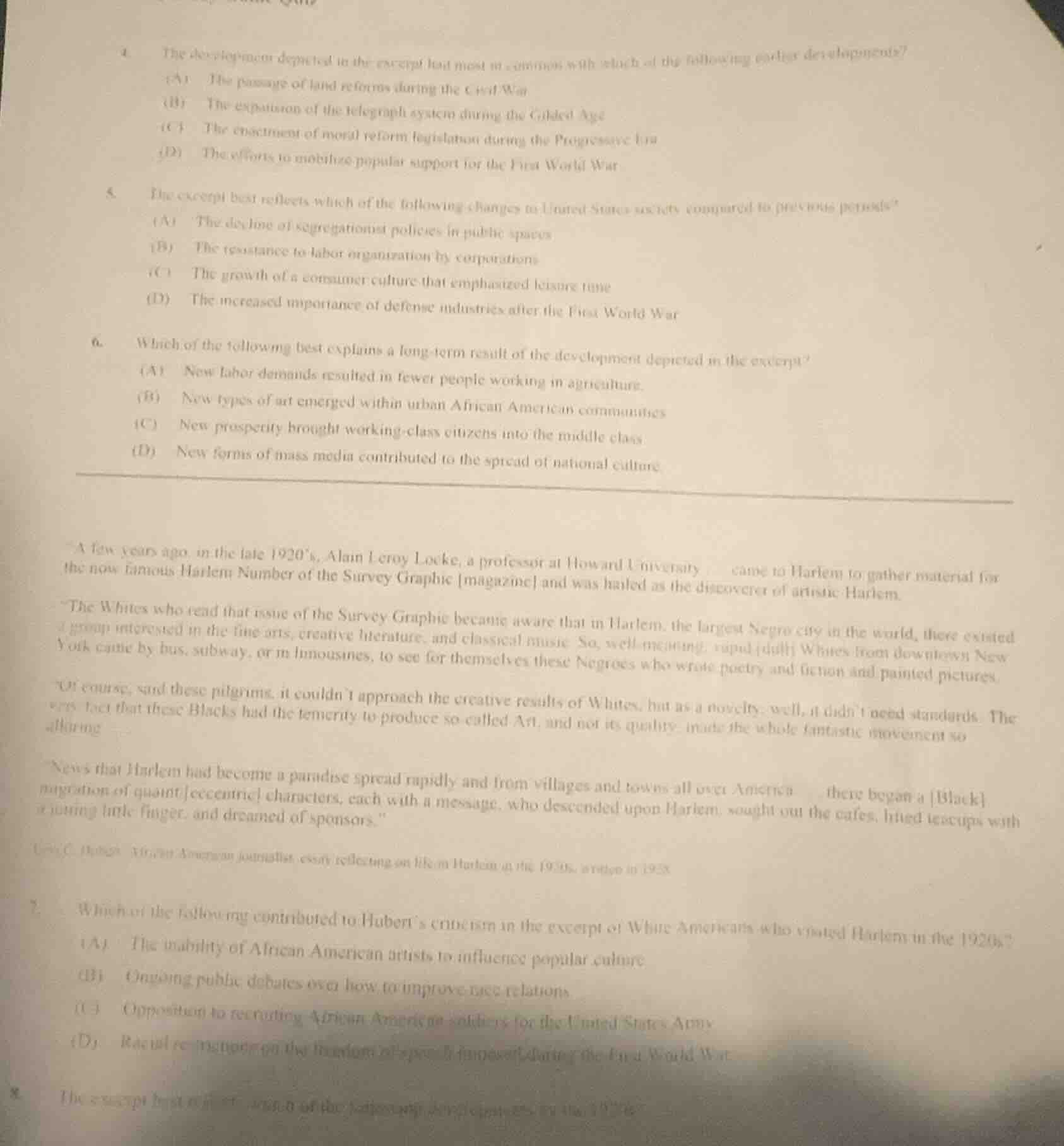
- the development depicted in the excerpt had most in common with which of the following earlier developments?
(a) the passage of land reforms during the civil war
(b) the expansion of the telegraph system during the gilded age
(c) the enactment of moral reform legislation during the progressive era
(d) the efforts to mobilize popular support for the first world war
- the excerpt best reflects which of the following changes in united states society compared to previous periods?
(a) the decline of segregationist policies in public spaces
(b) the resistance to labor organization by corporations
(c) the growth of a consumer culture that emphasized leisure time
(d) the increased importance of defense industries after the first world war
- which of the following best explains a long - term result of the development depicted in the excerpt?
(a) new labor demands resulted in fewer people working in agriculture.
(b) new types of art emerged within urban african american communities
(c) new prosperity brought working - class citizens into the middle class.
(d) new forms of mass media contributed to the spread of national culture.
\a few years ago, in the late 1920s, alain leroy locke, a professor at howard university, came to harlem to gather material for the now famous harlem number of the survey graphic magazine and was hailed as the discoverer of artistic harlem.
\the whites who read that issue of the survey graphic became aware that in harlem, the largest negro city in the world, there existed a group interested in the fine arts, creative literature, and classical music. so, well - meaning, stupid dull whites from downtown new york came by bus, subway, or in limousines, to see for themselves these negroes who wrote poetry and fiction and painted pictures.
\of course, said these pilgrims, it couldnt approach the creative results of whites, but as a novelty, well, it didnt need standards. the very fact that these blacks had the temerity to produce so - called art, and not its quality, made the whole fantastic movement so alluring...
ews that harlem had become a paradise spread rapidly, and from villages and towns all over america, there began a black migration of quaint eccentric characters, each with a message, who descended upon harlem, sought out the cafes, hired teacups with a turning little finger, and dreamed of sponsors.\
(langston hughes, african american journalist, essay reflecting on life in harlem in the 1920s, written in 1933)
- which of the following contributed to hughess criticism in the excerpt of white americans who visited harlem in the 1920s?
(a) the inability of african american artists to influence popular culture
(b) ongoing public debates over how to improve race relations
(c) opposition to recruiting african american soldiers for the united states army
(d) racial prejudice on the part of white americans during the first world war
- the excerpt best represents which of the following developments of the 1920s?
Question 4
The excerpt relates to the Harlem Renaissance (1920s). The effort to mobilize support for WWI (D) involved promoting national unity and cultural expressions, similar to how the Harlem Renaissance gained attention (via media like Survey Graphic). Land reforms (A), telegraph expansion (B), and moral reform (C) don't align with the cultural discovery of Harlem.
The 1920s saw growth of consumer culture with leisure (C). Segregation (A) was still strong, corporate resistance to labor (B) is not the focus, and defense industries post - WWI (D) is incorrect as the 1920s had disarmament. The excerpt shows cultural consumption (Whites visiting Harlem for art), reflecting leisure - focused consumer culture.
The Harlem Renaissance's art was spread via media (Survey Graphic), leading to national culture spread (D). Fewer in agriculture (A) is about labor shifts, new art in urban Black communities (B) is about creation not spread, and middle - class rise (C) is not the long - term result of this cultural spread.

Snap & solve any problem in the app
Get step-by-step solutions on Sovi AI
Photo-based solutions with guided steps
Explore more problems and detailed explanations
D. The efforts to mobilize popular support for the First World War