QUESTION IMAGE
Question
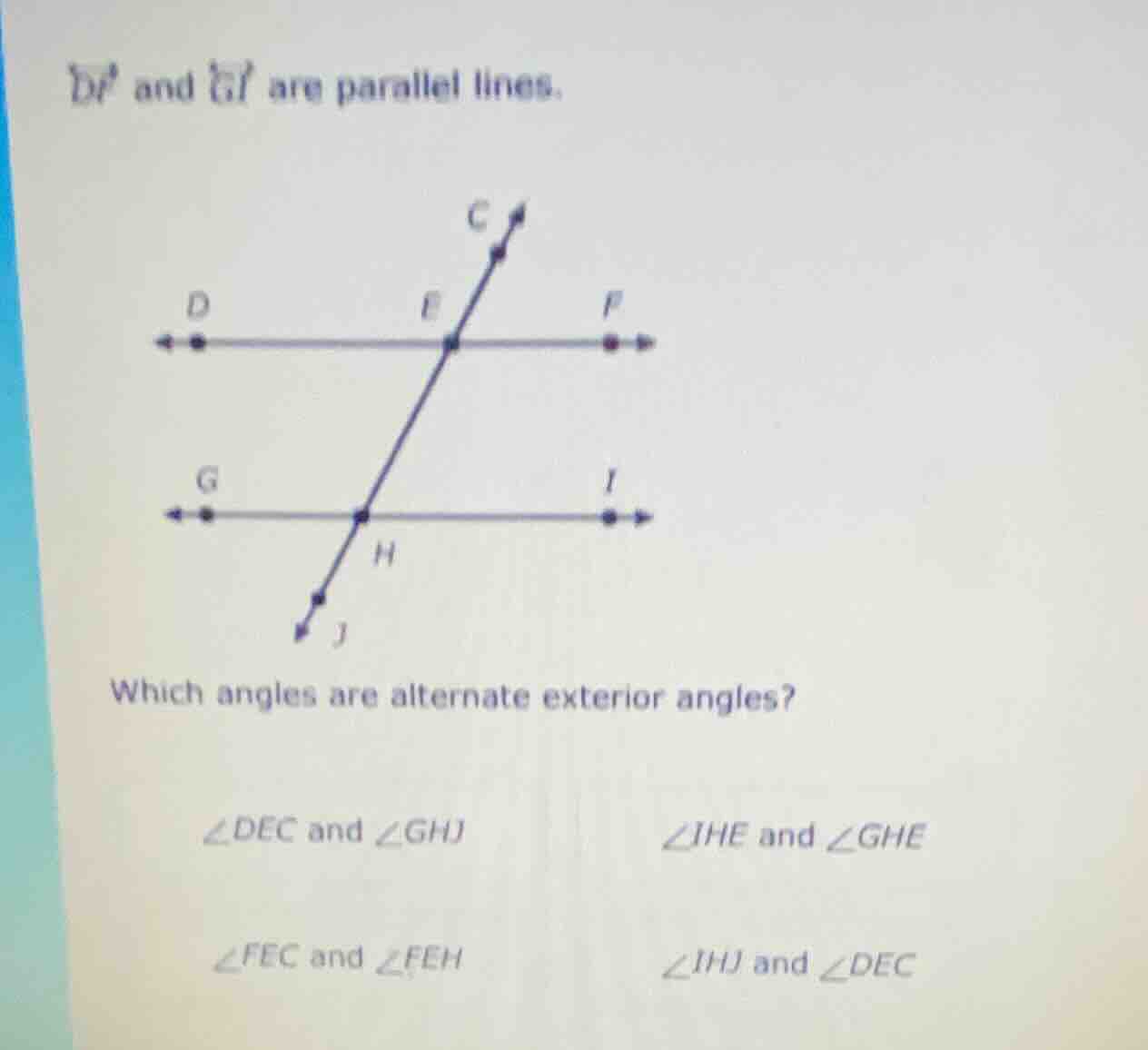
df and gi are parallel lines.
which angles are alternate exterior angles?
∠dec and ∠ghj ∠ihe and ∠ghe
∠fec and ∠feh ∠ihj and ∠dec
Step1: Recall alternate exterior angles definition
Alternate exterior angles are formed when a transversal crosses two parallel lines. They lie outside the two parallel lines and on opposite sides of the transversal.
Step2: Analyze each option
- Option 1: $\angle DEC$ and $\angle GHJ$: $\angle DEC$ is above line $DF$ and left of transversal $CJ$, $\angle GHJ$ is below line $GI$ and left of transversal $CJ$. Wait, no, let's re - check. Wait, $DF\parallel GI$, transversal is $CJ$. $\angle DEC$: outside $DF$ and $GI$? Wait, $DF$ and $GI$ are parallel. $\angle DEC$: line $DF$ is upper parallel, $\angle GHJ$: line $GI$ is lower parallel. $\angle DEC$ is on the outer side of $DF$ (left side of transversal, above $DF$), $\angle GHJ$ is on the outer side of $GI$ (left side of transversal, below $GI$)? No, maybe I made a mistake. Wait, let's check the other options.
- Option 2: $\angle IHE$ and $\angle GHE$: These are adjacent angles, not alternate exterior.
- Option 3: $\angle FEC$ and $\angle FEH$: These are adjacent angles, not alternate exterior.
- Option 4: $\angle IHJ$ and $\angle DEC$: $\angle IHJ$ is outside line $GI$ (right side of transversal, below $GI$) and $\angle DEC$ is outside line $DF$ (left side of transversal, above $DF$)? Wait, no. Wait, correct analysis: For two parallel lines $DF$ and $GI$ cut by transversal $CJ$. Alternate exterior angles should be on opposite sides of the transversal and outside the two parallel lines. $\angle DEC$: above $DF$, left of transversal. $\angle IHJ$: below $GI$, right of transversal? No, wait, maybe the first option. Wait, let's re - define: Alternate exterior angles are two angles that lie outside the two parallel lines, on opposite sides of the transversal. So for $DF\parallel GI$, transversal $CJ$. $\angle DEC$: outside $DF$ (since $DF$ is between the two intersection points $E$ and $H$), and $\angle GHJ$: outside $GI$ (since $GI$ is between $E$ and $H$). And they are on opposite sides of the transversal? Wait, no. Wait, maybe the correct pair is $\angle DEC$ and $\angle GHJ$. Wait, let's check the positions again. Line $DF$ (points $D, E, F$) and line $GI$ (points $G, H, I$) are parallel. Transversal is $CJ$ (points $C, E, H, J$). $\angle DEC$: at $E$, between $D - E - F$ and $C - E - J$. $\angle GHJ$: at $H$, between $G - H - I$ and $C - H - J$. $\angle DEC$ is above $DF$ (outside the region between $DF$ and $GI$) and $\angle GHJ$ is below $GI$ (outside the region between $DF$ and $GI$), and they are on opposite sides of the transversal? Wait, no, maybe I messed up. Wait, the other options: $\angle IHJ$ and $\angle DEC$: $\angle IHJ$ is at $H$, below $GI$, right of transversal. $\angle DEC$ is at $E$, above $DF$, left of transversal. These are outside the two parallel lines and on opposite sides of the transversal. Wait, maybe I made a mistake in the first analysis. Let's re - check the definition. Alternate exterior angles: non - adjacent, outside the two parallel lines, on opposite sides of the transversal. So for $DF\parallel GI$, transversal $CJ$. Angles outside $DF$ and $GI$: $\angle DEC$ (outside $DF$, left of transversal), $\angle IHJ$ (outside $GI$, right of transversal) – no, that's same side? Wait, no. Wait, $\angle DEC$: when we look at transversal $CJ$, $\angle DEC$ is on the left side of $CJ$, above $DF$. $\angle GHJ$: on the left side of $CJ$, below $GI$. No, that's same side. Wait, maybe the correct answer is $\angle DEC$ and $\angle GHJ$? Wait, no, let's check the options again. Wait, the first option is $\angle DEC$ and $\angle GHJ$. Let's see: $DF\parallel GI$,…

Snap & solve any problem in the app
Get step-by-step solutions on Sovi AI
Photo-based solutions with guided steps
Explore more problems and detailed explanations
$\angle IHJ$ and $\angle DEC$ (the fourth option: $\boldsymbol{\angle IHJ}$ and $\boldsymbol{\angle DEC}$)