QUESTION IMAGE
Question
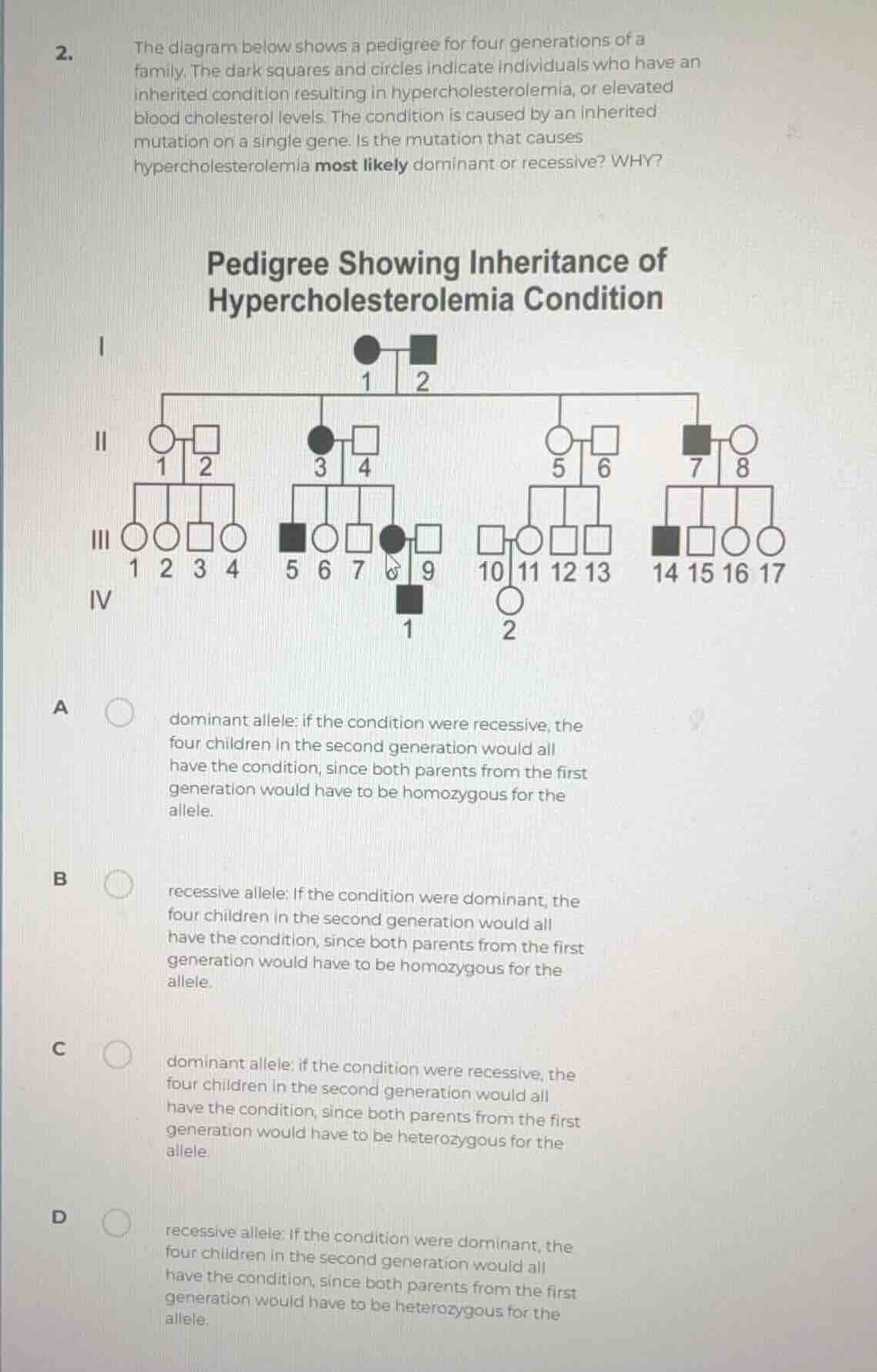
- the diagram below shows a pedigree for four generations of a family. the dark squares and circles indicate individuals who have an inherited condition resulting in hypercholesterolemia, or elevated blood cholesterol levels. the condition is caused by an inherited mutation on a single gene. is the mutation that causes hypercholesterolemia most likely dominant or recessive? why?
pedigree showing inheritance of hypercholesterolemia condition
a dominant allele: if the condition were recessive, the four children in the second generation would all have the condition, since both parents from the first generation would have to be homozygous for the allele.
b recessive allele: if the condition were dominant, the four children in the second generation would all have the condition, since both parents from the first generation would have to be homozygous for the allele.
c dominant allele: if the condition were recessive, the four children in the second generation would all have the condition, since both parents from the first generation would have to be heterozygous for the allele.
d recessive allele: if the condition were dominant, the four children in the second generation would all have the condition, since both parents from the first generation would have to be heterozygous for the allele.
- First, analyze the first generation: both parents (I-1 and I-2) have the condition, but not all of their children (II-1, II-2, II-5, II-6) inherit it.
- For a recessive trait, two homozygous recessive parents would only produce offspring with the recessive trait. Since this is not the case here, the trait cannot be recessive.
- For a dominant trait, if both parents are heterozygous (which is necessary to have unaffected offspring), the cross $Aa \times Aa$ produces offspring with a 3:1 ratio of affected to unaffected, matching the pedigree (2 affected, 2 unaffected children in generation II from I-1 and I-2).
- Match this logic to the options: Option A correctly identifies the trait as dominant and explains that recessive homozygous parents would have all affected children, which does not occur here.

Snap & solve any problem in the app
Get step-by-step solutions on Sovi AI
Photo-based solutions with guided steps
Explore more problems and detailed explanations
A. dominant allele: if the condition were recessive, the four children in the second generation would all have the condition, since both parents from the first generation would have to be homozygous for the allele.