QUESTION IMAGE
Question
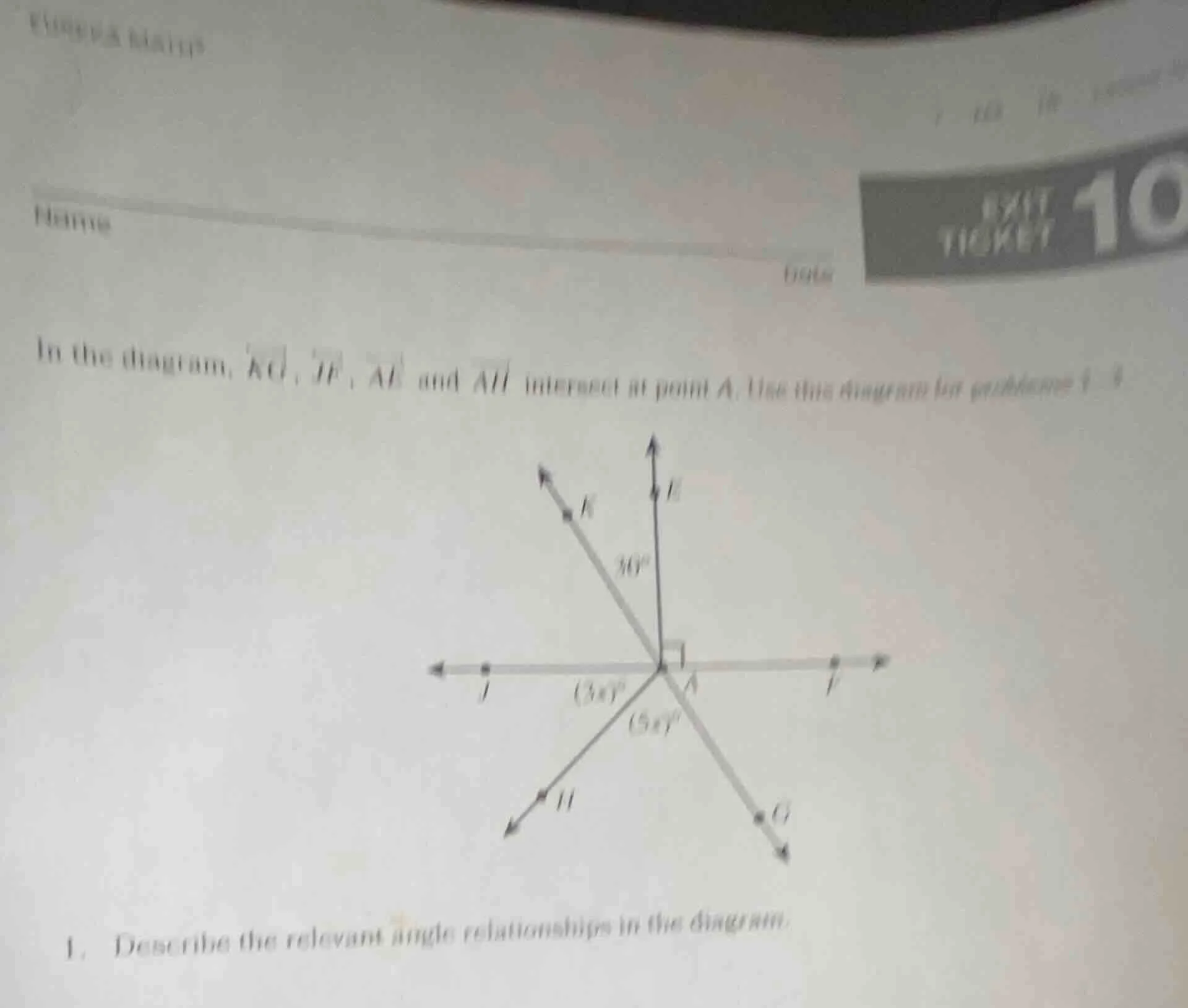
in the diagram, \\( \overleftrightarrow{kj} \\), \\( \overleftrightarrow{jf} \\), \\( \overleftrightarrow{ae} \\) and \\( \overleftrightarrow{ah} \\) intersect at point a. use this diagram for problems 1 - 4
- describe the relevant angle relationships in the diagram.
Brief Explanations
- $\angle EAK$ and $\angle JAH$ are vertical angles, so they are congruent.
- $\angle JAH$ (=$3x^\circ$) and $\angle HAG$ (=$5x^\circ$) are complementary angles, since $\angle JAE$ is a right angle ($90^\circ$), so their sum is $90^\circ$.
- $\angle EAK$ ($30^\circ$) and $\angle KAJ$ are complementary angles, as their sum equals the right angle $\angle JAE$.
- $\angle JAH$ and $\angle HAF$ are supplementary angles, as their sum is a straight angle ($180^\circ$).
- $\angle EAF$ is a right angle (marked with a square symbol), so it measures $90^\circ$.
- $\angle JAF$ is a straight angle, so it measures $180^\circ$.

Snap & solve any problem in the app
Get step-by-step solutions on Sovi AI
Photo-based solutions with guided steps
Explore more problems and detailed explanations
- Vertical angles: $\angle EAK \cong \angle JAH$
- Complementary angles: $\angle JAH + \angle HAG = 90^\circ$, $\angle EAK + \angle KAJ = 90^\circ$
- Supplementary angles: $\angle JAH + \angle HAF = 180^\circ$, $\angle KAJ + \angle KAF = 180^\circ$
- Right angle: $\angle EAF = 90^\circ$
- Straight angle: $\angle JAF = 180^\circ$