QUESTION IMAGE
Question
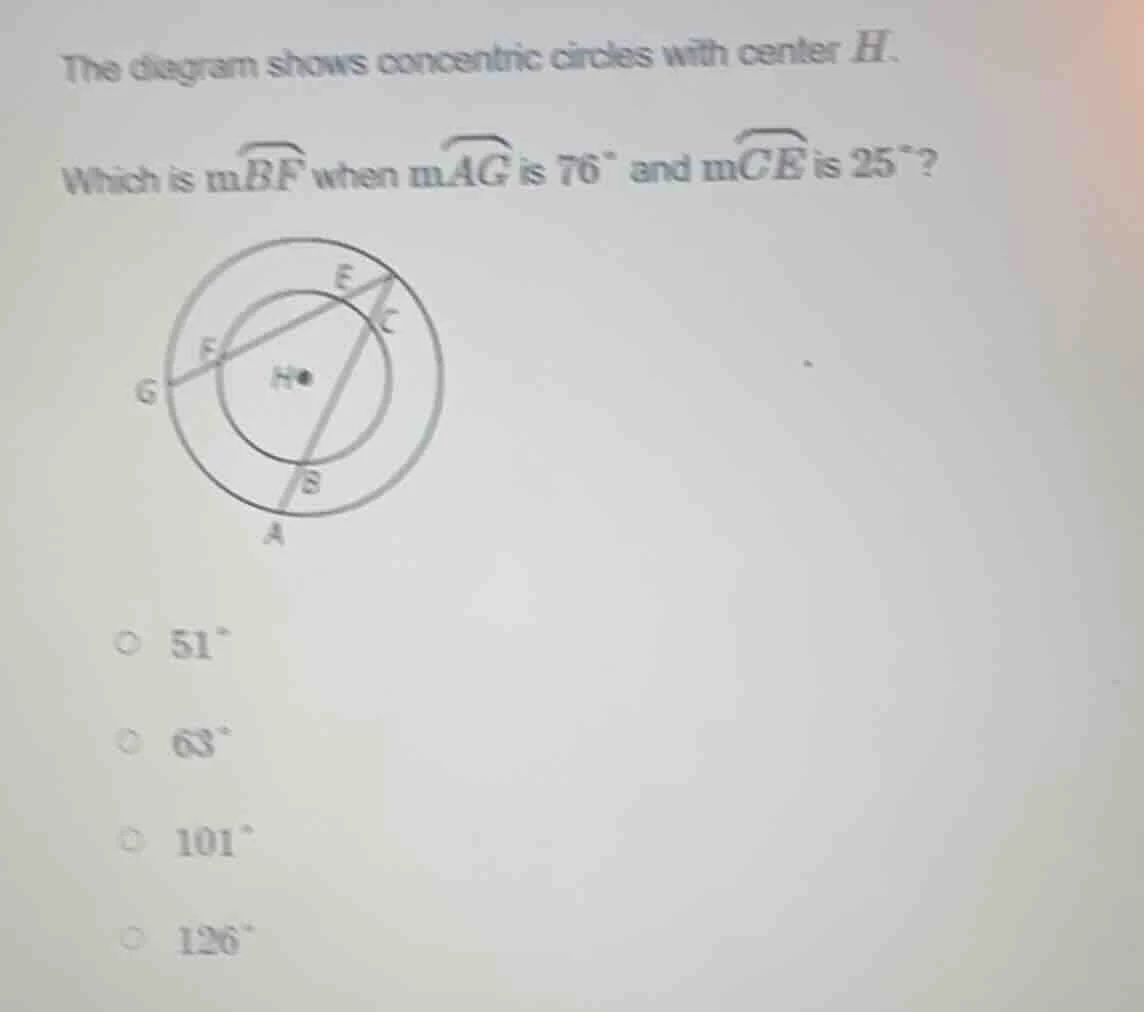
the diagram shows concentric circles with center h. which is ( moverarc{bf} ) when ( moverarc{ag} ) is ( 76^circ ) and ( moverarc{ce} ) is ( 25^circ )?
Step1: Recall concentric circles property
Concentric circles have the same center, so central angles subtended by arcs between two radii are related. The measure of arc \( \widehat{AG} \) and \( \widehat{BF} \) with the angle \( \widehat{CE} \) (which is equal to the angle between the radii for the smaller arcs) can be related. Wait, actually, since \( \widehat{AG} \) and \( \widehat{BF} \) are arcs of concentric circles, and the angle between the lines (the central angle) for \( \widehat{CE} \) is \( 25^\circ \), but actually, the key is that the measure of \( \widehat{BF} \) can be found by considering the relationship between the arcs. Wait, no, let's think again. The arc \( \widehat{AG} \) is \( 76^\circ \), and the arc \( \widehat{CE} \) is \( 25^\circ \). But since the circles are concentric, the central angle for \( \widehat{AG} \) and the central angle for \( \widehat{BF} \) plus twice the angle of \( \widehat{CE} \)? Wait, no, maybe the correct approach is that the measure of \( \widehat{BF} \) is \( \text{m}\widehat{AG} - 2\times \text{m}\widehat{CE} \)? Wait, no, let's look at the diagram. The lines are two secants, one passing through \( G, F, E, C \) and another through \( A, B, C, E \)? Wait, no, the center is \( H \), so \( HA, HB \) are radii of the middle circle, \( HC, HE \) are radii of the smallest circle, and \( HG, HF \) are radii of the largest circle? Wait, no, the diagram shows two concentric circles (center \( H \)) and two lines: one from \( G \) through \( F \) to \( E \) and \( C \), and another from \( A \) through \( B \) to \( C \) and \( E \). So \( \widehat{AG} \) is an arc of the largest circle, \( \widehat{BF} \) is an arc of the middle circle, and \( \widehat{CE} \) is an arc of the smallest circle. Since the circles are concentric, the central angles for these arcs are related. The central angle for \( \widehat{AG} \) is equal to the central angle for \( \widehat{BF} \) plus twice the central angle for \( \widehat{CE} \)? Wait, no, maybe the angle between the two lines (the angle at \( C \) or \( E \)) is the same, but since they are concentric, the measure of \( \widehat{BF} \) can be found by \( \text{m}\widehat{AG} - 2\times \text{m}\widehat{CE} \)? Wait, let's calculate: \( 76^\circ - 2\times 25^\circ = 76 - 50 = 26 \)? No, that's not one of the options. Wait, maybe the other way: \( \text{m}\widehat{BF} = \text{m}\widehat{AG} - \text{m}\widehat{CE} \)? \( 76 - 25 = 51 \), which is one of the options (51°). Wait, that makes sense. Because the arc \( \widehat{AG} \) is composed of \( \widehat{BF} \) and the two arcs \( \widehat{CE} \) (but no, maybe the central angle for \( \widehat{AG} \) is equal to the central angle for \( \widehat{BF} \) plus the central angle for \( \widehat{CE} \)? No, wait, the diagram: the two lines intersect at a point outside? No, the center is \( H \), so the lines are passing through the center? Wait, no, the center is \( H \), so \( HA, HB, HC, HE, HF, HG \) are all radii. So \( HA = HB \) (middle circle), \( HC = HE \) (smallest circle), \( HG = HF \) (largest circle). So the line from \( A \) through \( B \) to \( C \) and \( E \) is a straight line through the center? Wait, if \( H \) is the center, then \( A, B, H, C, E \) are colinear? Similarly, \( G, F, H, E, C \) are colinear? Wait, that would make sense. So \( A, B, H, C, E \) are on a straight line, and \( G, F, H, E, C \) are on another straight line. Then \( \widehat{AG} \) is an arc of the largest circle, with central angle \( \angle AHG \), \( \widehat{BF} \) is an arc of the middle circle with ce…

Snap & solve any problem in the app
Get step-by-step solutions on Sovi AI
Photo-based solutions with guided steps
Explore more problems and detailed explanations
\( 51^\circ \) (corresponding to the option with 51°)