QUESTION IMAGE
Question
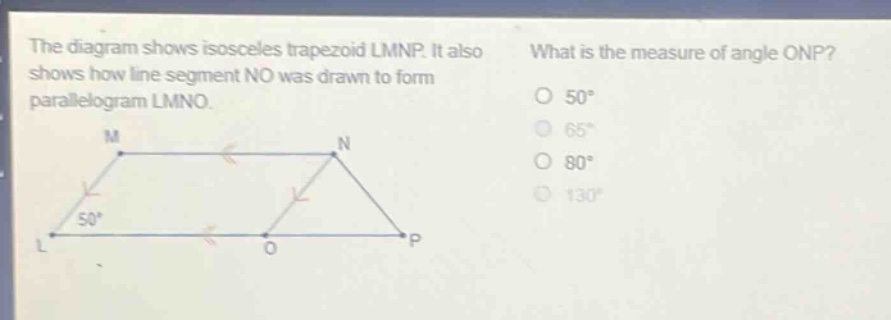
the diagram shows isosceles trapezoid lmnp. it also shows how line segment no was drawn to form parallelogram lmno. what is the measure of angle onp? 50° 65° 80° 130°
Step1: Recall properties of parallelograms
In parallelogram \( LMNO \), \( \angle L = \angle MNO = 50^\circ \) (opposite angles of a parallelogram are equal) and \( LM \parallel ON \), \( LN \parallel MO \). Also, in isosceles trapezoid \( LMNP \), \( LM \parallel NP \), so \( ON \parallel NP \)? Wait, no, \( LM \parallel NP \) (bases of isosceles trapezoid) and \( LM \parallel ON \) (sides of parallelogram), so \( ON \parallel LM \parallel NP \)? Wait, actually, \( LMNP \) is isosceles trapezoid, so \( \angle L \) and \( \angle P \) are related? Wait, no, let's correct. In isosceles trapezoid \( LMNP \), \( LM \parallel NP \), and \( \angle L + \angle M = 180^\circ \), \( \angle L = \angle P \)? Wait, no, in isosceles trapezoid, base angles are equal. So \( \angle L = \angle P \)? Wait, no, \( \angle L \) and \( \angle M \) are adjacent angles on base \( LM \), so they are supplementary. Wait, maybe better to use the parallelogram first.
In parallelogram \( LMNO \), \( \angle L = 50^\circ \), so \( \angle MON \)? Wait, no, \( \angle L = 50^\circ \), and \( LM \parallel ON \), so \( \angle L + \angle LON = 180^\circ \)? No, \( LM \parallel ON \), so \( \angle L \) and \( \angle LON \) are same - side interior angles? Wait, no, \( L \) is a vertex, \( LM \) and \( LN \) are sides. Wait, maybe \( \triangle ONP \) is isosceles? Because \( ON = LM \) (opposite sides of parallelogram), and in isosceles trapezoid \( LMNP \), \( LM = PN \)? Wait, no, in isosceles trapezoid, the non - parallel sides are equal, so \( LN = MP \). Wait, maybe \( ON = PN \), so \( \triangle ONP \) is isosceles with \( ON = PN \).
Since \( LMNO \) is a parallelogram, \( ON = LM \). In isosceles trapezoid \( LMNP \), \( LM = PN \) (wait, no, the legs are equal, but the bases: \( LM \) and \( NP \) are the bases? Wait, no, in trapezoid \( LMNP \), the bases are \( LM \) and \( NP \), and the legs are \( LN \) and \( MP \). Wait, maybe I made a mistake. Let's start over.
- In parallelogram \( LMNO \): \( \angle L = 50^\circ \), so \( \angle MNO = 50^\circ \) (opposite angles of parallelogram). Also, \( LM \parallel ON \), so \( \angle L + \angle LON = 180^\circ \)? No, \( LM \parallel ON \), and \( LN \) is a transversal? Wait, \( L \), \( O \), \( P \) are colinear? Yes, from the diagram, \( L - O - P \) is a straight line. So \( LO \) is a segment, \( OP \) is another segment, so \( LOP \) is a straight line, so \( \angle LON + \angle NOP = 180^\circ \), but maybe not. Wait, in isosceles trapezoid \( LMNP \), \( LM \parallel NP \), and \( LMNO \) is a parallelogram, so \( LM \parallel ON \), hence \( ON \parallel NP \)? No, \( ON \parallel LM \) and \( LM \parallel NP \), so \( ON \parallel NP \), which would mean \( O \), \( N \), \( P \) are colinear, but that's not possible. Wait, no, \( LMNP \) is a trapezoid, so \( LM \) and \( NP \) are the two bases (parallel sides), and \( LN \) and \( MP \) are the legs. Then \( LMNO \) is a parallelogram, so \( LM \parallel ON \) and \( LM = ON \), so \( ON \parallel LM \parallel NP \), so \( ON \) is parallel to \( NP \), which would imply \( O \), \( N \), \( P \) are colinear, but that's not the case. Wait, the diagram shows \( L - O - P \) on the base, so \( LO \) and \( OP \) are parts of the base \( LP \). So \( LMNO \) has sides \( LM \), \( MN \), \( NO \), \( OL \). So \( LM \parallel NO \) and \( MN \parallel OL \). So \( \angle L = 50^\circ \), so \( \angle NO L = 50^\circ \)? No, in parallelogram, opposite angles are equal, so \( \angle L = \angle MNO = 50^\circ \), and \( \angle OLM = \angle ONM \)? W…

Snap & solve any problem in the app
Get step-by-step solutions on Sovi AI
Photo-based solutions with guided steps
Explore more problems and detailed explanations
\( 80^\circ \)