QUESTION IMAGE
Question
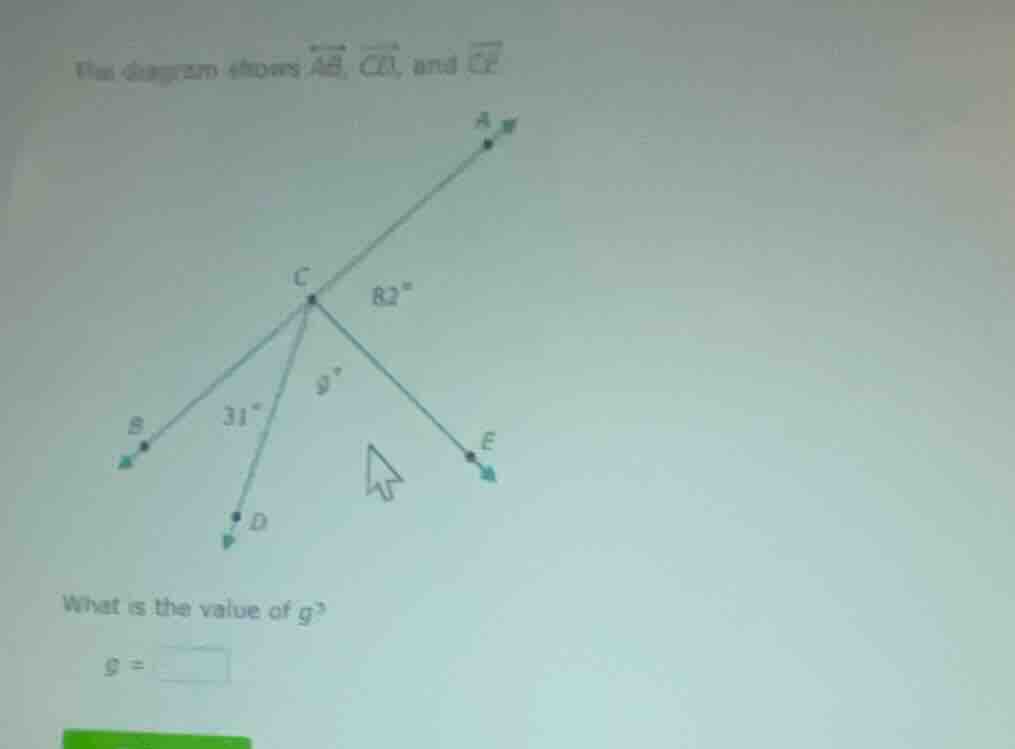
the diagram shows \\(\overrightarrow{ab}\\), \\(\overrightarrow{cd}\\), and \\(\overrightarrow{ce}\\)
what is the value of \\(g\\)?
\\(g = \square\\)
Step1: Identify straight line angle
A straight line forms a \(180^\circ\) angle. So, the sum of \(\angle BCD\), \(\angle DCE\) (which is \(g^\circ\)), and \(\angle ECA\) should be \(180^\circ\).
Step2: Sum the known angles and solve for \(g\)
We know \(\angle BCD = 31^\circ\) and \(\angle ECA = 82^\circ\). Let's denote \(\angle DCE = g^\circ\). Then:
\[
31^\circ + g^\circ + 82^\circ = 180^\circ
\]
First, add the known angles: \(31 + 82 = 113\). So the equation becomes:
\[
g + 113 = 180
\]
Subtract 113 from both sides: \(g = 180 - 113\)
\[
g = 67
\]

Snap & solve any problem in the app
Get step-by-step solutions on Sovi AI
Photo-based solutions with guided steps
Explore more problems and detailed explanations
\(67\)