QUESTION IMAGE
Question
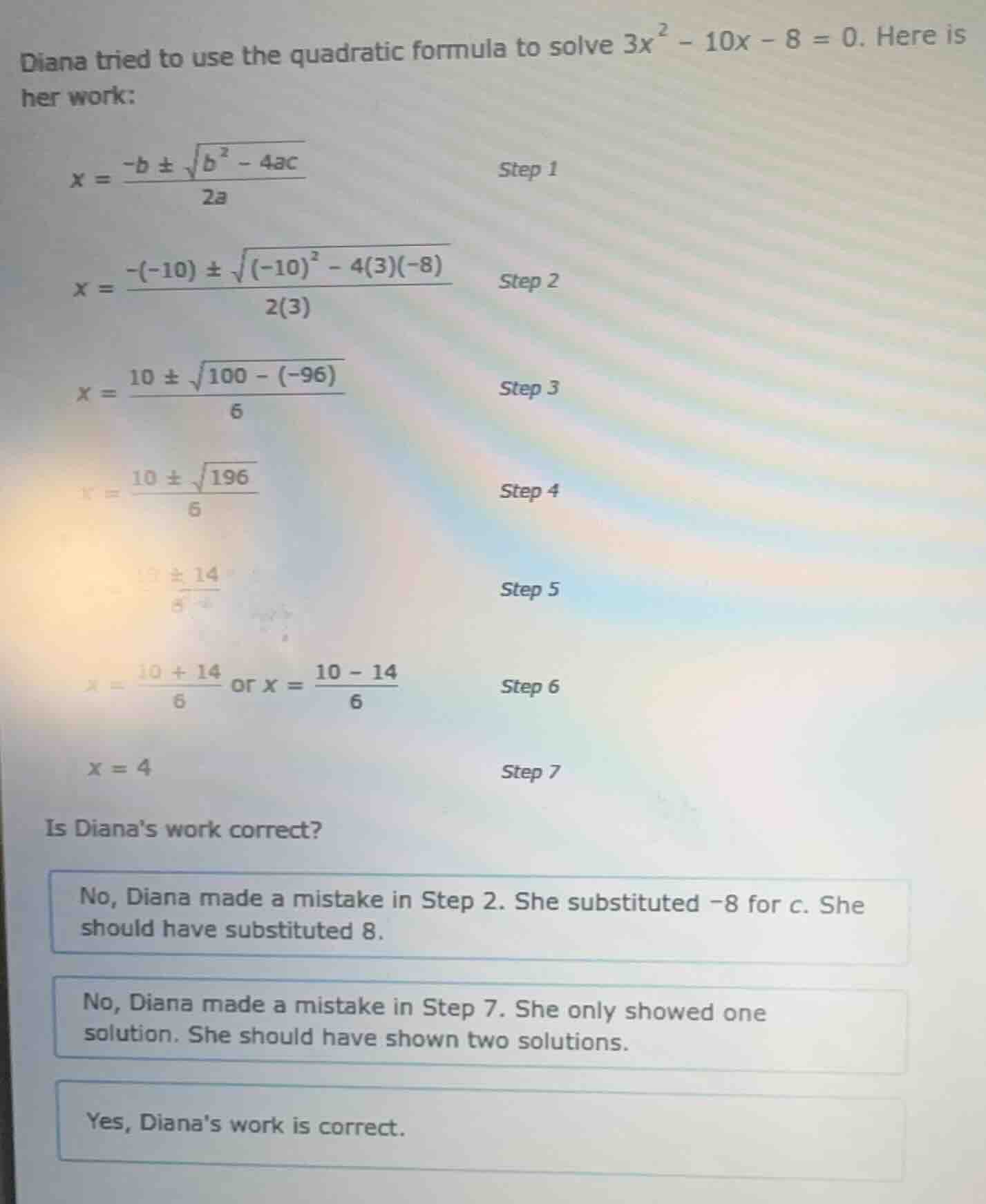
diana tried to use the quadratic formula to solve $3x^{2}-10x - 8 = 0$. here is her work:
$x = \frac{-b \pm \sqrt{b^{2}-4ac}}{2a}$ step 1
$x = \frac{-(-10) \pm \sqrt{(-10)^{2}-4(3)(-8)}}{2(3)}$ step 2
$x = \frac{10 \pm \sqrt{100 - (-96)}}{6}$ step 3
$x = \frac{10 \pm \sqrt{196}}{6}$ step 4
$x = \frac{10 \pm 14}{6}$ step 5
$x = \frac{10 + 14}{6}$ or $x = \frac{10 - 14}{6}$ step 6
$x = 4$ step 7
is dianas work correct?
no, diana made a mistake in step 2. she substituted -8 for c. she should have substituted 8.
no, diana made a mistake in step 7. she only showed one solution. she should have shown two solutions.
yes, dianas work is correct.
Step1: Analyze Step 2
In the quadratic formula \(x=\frac{-b\pm\sqrt{b^{2}-4ac}}{2a}\), for the equation \(3x^{2}-10x - 8 = 0\), \(a = 3\), \(b=- 10\), \(c=-8\). Diana substituted \(a = 3\), \(b=-10\) (so \(-b = 10\)), \(c=-8\) correctly in Step 2 as \(x=\frac{-(-10)\pm\sqrt{(-10)^{2}-4(3)(-8)}}{2(3)}\).
Step2: Analyze Step 3
Calculate the discriminant: \(b^{2}-4ac=(-10)^{2}-4\times3\times(-8)=100 + 96=196\) (since \(-4\times3\times(-8)=96\), so \(100-(-96)=100 + 96\)). So Step 3 is correct.
Step3: Analyze Step 4
\(\sqrt{196} = 14\), so Step 4 is correct.
Step4: Analyze Step 5 - Step 6
In Step 5, the denominator should be \(6\) (since \(2a=2\times3 = 6\)), and in Step 6, we split the \(\pm\) into two cases: \(x=\frac{10 + 14}{6}\) and \(x=\frac{10-14}{6}\).
Step5: Analyze Step 7
Calculate the two solutions:
For \(x=\frac{10 + 14}{6}=\frac{24}{6}=4\)
For \(x=\frac{10-14}{6}=\frac{-4}{6}=-\frac{2}{3}\)
Diana only showed \(x = 4\) and missed the second solution \(x=-\frac{2}{3}\). So she made a mistake in Step 7.

Snap & solve any problem in the app
Get step-by-step solutions on Sovi AI
Photo-based solutions with guided steps
Explore more problems and detailed explanations
No, Diana made a mistake in Step 7. She only showed one solution. She should have shown two solutions.