QUESTION IMAGE
Question
dicals as needed.)
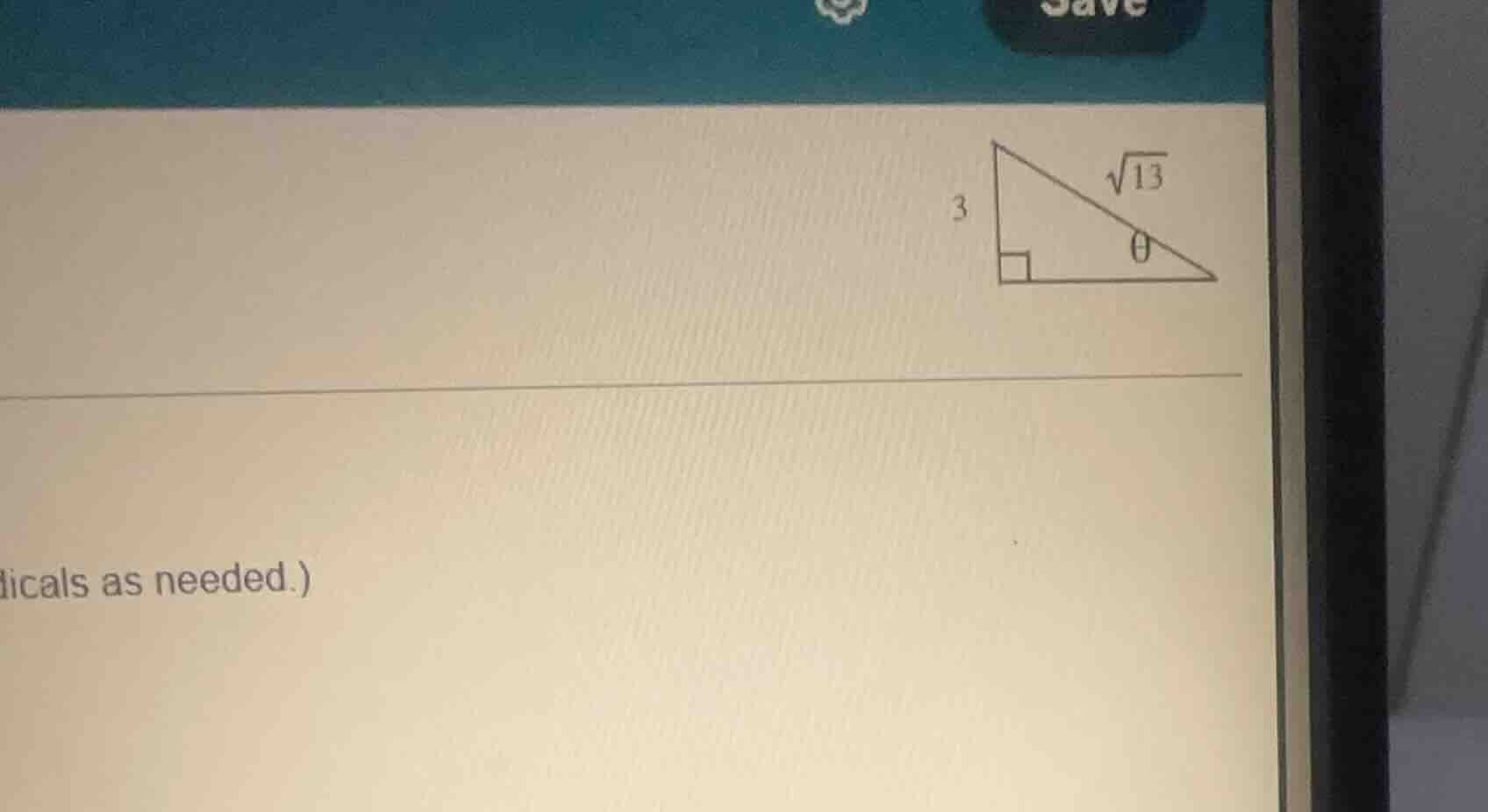
Assuming we need to find the length of the adjacent side to angle \(\theta\) or trigonometric ratios, let's first find the adjacent side.
Step 1: Use Pythagorean theorem
In a right triangle, \(a^2 + b^2 = c^2\), where \(c\) is the hypotenuse, and \(a,b\) are the legs. Let the vertical leg \(a = 3\), hypotenuse \(c=\sqrt{13}\), and horizontal leg (adjacent to \(\theta\)) be \(b\). Then:
\[
b^2 + 3^2=(\sqrt{13})^2
\]
\[
b^2 + 9 = 13
\]
\[
b^2=13 - 9=4
\]
\[
b = 2 \quad (\text{since length is positive})
\]
If we want to find \(\sin\theta\), \(\cos\theta\), or \(\tan\theta\), for example, \(\sin\theta=\frac{\text{opposite}}{\text{hypotenuse}}=\frac{3}{\sqrt{13}}=\frac{3\sqrt{13}}{13}\), \(\cos\theta=\frac{\text{adjacent}}{\text{hypotenuse}}=\frac{2}{\sqrt{13}}=\frac{2\sqrt{13}}{13}\), \(\tan\theta=\frac{\text{opposite}}{\text{adjacent}}=\frac{3}{2}\).
Since the problem statement was cut off, but assuming we needed to find the adjacent side (length 2) or trigonometric ratios, here's the solution for the adjacent side:

Snap & solve any problem in the app
Get step-by-step solutions on Sovi AI
Photo-based solutions with guided steps
Explore more problems and detailed explanations
The length of the adjacent side to \(\theta\) is \(2\). (If you needed a trigonometric ratio, adjust accordingly, e.g., \(\tan\theta=\frac{3}{2}\), \(\sin\theta=\frac{3\sqrt{13}}{13}\), \(\cos\theta=\frac{2\sqrt{13}}{13}\))