QUESTION IMAGE
Question
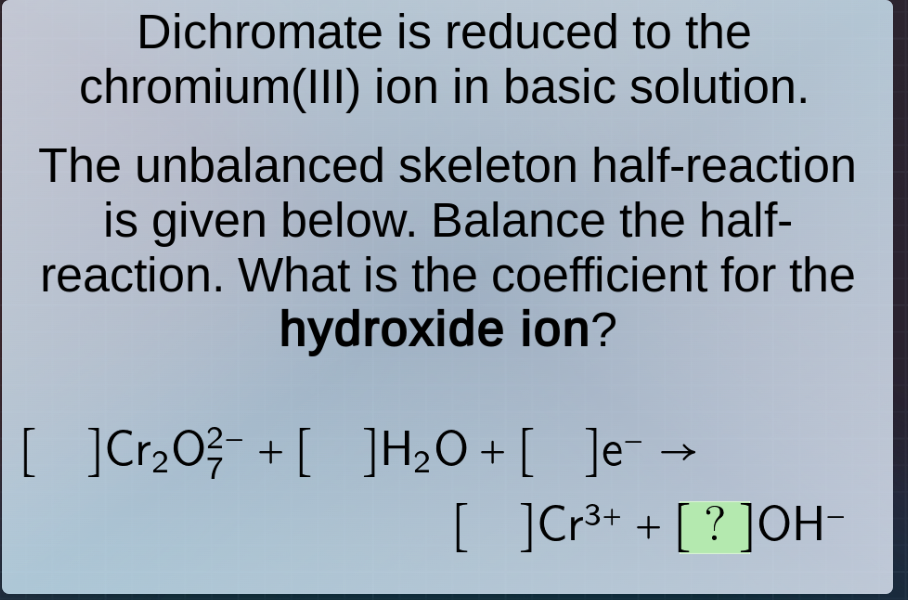
dichromate is reduced to the chromium(iii) ion in basic solution. the unbalanced skeleton half-reaction is given below. balance the half-reaction. what is the coefficient for the hydroxide ion? cr₂o₇²⁻ + h₂o + e⁻ → cr³⁺ + ?oh⁻
Step1: Balance Cr atoms
In \( \text{Cr}_2\text{O}_7^{2-} \), there are 2 Cr atoms, so we put a coefficient of 2 in front of \( \text{Cr}^{3+} \).
\( \text{Cr}_2\text{O}_7^{2-}
ightarrow 2\text{Cr}^{3+} \)
Step2: Balance O atoms by adding \( \text{H}_2\text{O} \)
There are 7 O atoms in \( \text{Cr}_2\text{O}_7^{2-} \), so we add 7 \( \text{H}_2\text{O} \) on the right side.
\( \text{Cr}_2\text{O}_7^{2-}
ightarrow 2\text{Cr}^{3+} + 7\text{H}_2\text{O} \)
Step3: Balance H atoms by adding \( \text{H}^+ \) (but since it's basic, we'll convert later)
There are 14 H atoms in \( 7\text{H}_2\text{O} \), so we add 14 \( \text{H}^+ \) on the left side.
\( 14\text{H}^+ + \text{Cr}_2\text{O}_7^{2-}
ightarrow 2\text{Cr}^{3+} + 7\text{H}_2\text{O} \)
Step4: Convert to basic solution by adding \( \text{OH}^- \) to both sides
Add 14 \( \text{OH}^- \) to both sides to neutralize \( \text{H}^+ \) (forms \( \text{H}_2\text{O} \)).
\( 14\text{OH}^- + 14\text{H}^+ + \text{Cr}_2\text{O}_7^{2-}
ightarrow 2\text{Cr}^{3+} + 7\text{H}_2\text{O} + 14\text{OH}^- \)
Simplify \( \text{H}^+ \) and \( \text{OH}^- \) to \( \text{H}_2\text{O} \):
\( 7\text{H}_2\text{O} + \text{Cr}_2\text{O}_7^{2-}
ightarrow 2\text{Cr}^{3+} + 7\text{H}_2\text{O} + 14\text{OH}^- \) (Wait, no, correction: When adding \( \text{OH}^- \) to \( \text{H}^+ \), they form \( \text{H}_2\text{O} \). So the left side \( 14\text{H}^+ + 14\text{OH}^- = 14\text{H}_2\text{O} \), and the right side has 7 \( \text{H}_2\text{O} \). So subtract 7 \( \text{H}_2\text{O} \) from both sides:
\( 7\text{H}_2\text{O} + \text{Cr}_2\text{O}_7^{2-}
ightarrow 2\text{Cr}^{3+} + 14\text{OH}^- \) (No, wait, let's do the electron balance first. Wait, I missed the electron balance. Let's redo with electron balance.
Step1: Balance Cr (2 Cr in \( \text{Cr}_2\text{O}_7^{2-} \), so 2 \( \text{Cr}^{3+} \))
\( \text{Cr}_2\text{O}_7^{2-}
ightarrow 2\text{Cr}^{3+} \)
Step2: Balance O: 7 O, so 7 \( \text{H}_2\text{O} \) on right
\( \text{Cr}_2\text{O}_7^{2-}
ightarrow 2\text{Cr}^{3+} + 7\text{H}_2\text{O} \)
Step3: Balance H: 14 H on right (from \( 7\text{H}_2\text{O} \)), so add 14 \( \text{H}^+ \) on left
\( 14\text{H}^+ + \text{Cr}_2\text{O}_7^{2-}
ightarrow 2\text{Cr}^{3+} + 7\text{H}_2\text{O} \)
Step4: Balance charge (oxidation state or electrons)
Left side charge: \( 14(+1) + (-2) = +12 \)
Right side charge: \( 2(+3) + 0 = +6 \)
The difference in charge is \( +6 - (+12) = -6 \), so we need to add 6 electrons (since it's reduction, electrons are gained) on the left side (because charge is more positive on left, so gain electrons to reduce the charge).
\( 6\text{e}^- + 14\text{H}^+ + \text{Cr}_2\text{O}_7^{2-}
ightarrow 2\text{Cr}^{3+} + 7\text{H}_2\text{O} \)
Now, convert to basic solution: Add 14 \( \text{OH}^- \) to both sides.
Left side: \( 14\text{OH}^- + 6\text{e}^- + 14\text{H}^+ + \text{Cr}_2\text{O}_7^{2-} \)
Right side: \( 2\text{Cr}^{3+} + 7\text{H}_2\text{O} + 14\text{OH}^- \)
Simplify \( \text{H}^+ \) and \( \text{OH}^- \) to \( \text{H}_2\text{O} \):
Left side: \( 6\text{e}^- + 14\text{H}_2\text{O} + \text{Cr}_2\text{O}_7^{2-} \)
Right side: \( 2\text{Cr}^{3+} + 7\text{H}_2\text{O} + 14\text{OH}^- \)
Subtract 7 \( \text{H}_2\text{O} \) from both sides:
\( 6\text{e}^- + 7\text{H}_2\text{O} + \text{Cr}_2\text{O}_7^{2-}
ightarrow 2\text{Cr}^{3+} + 14\text{OH}^- \)
Now, let's check the original skeleton reaction: \( [\ ]\text{Cr}_2\text{O}_7^{2-} + [\ ]\text{H}_2\text{O} + [\ ]\text{e}^-
ightarrow [\ ]\text{Cr}^{3+} + [?]\text{OH}^- \)
From our balanced equation:
- Coefficient of…

Snap & solve any problem in the app
Get step-by-step solutions on Sovi AI
Photo-based solutions with guided steps
Explore more problems and detailed explanations
14