QUESTION IMAGE
Question
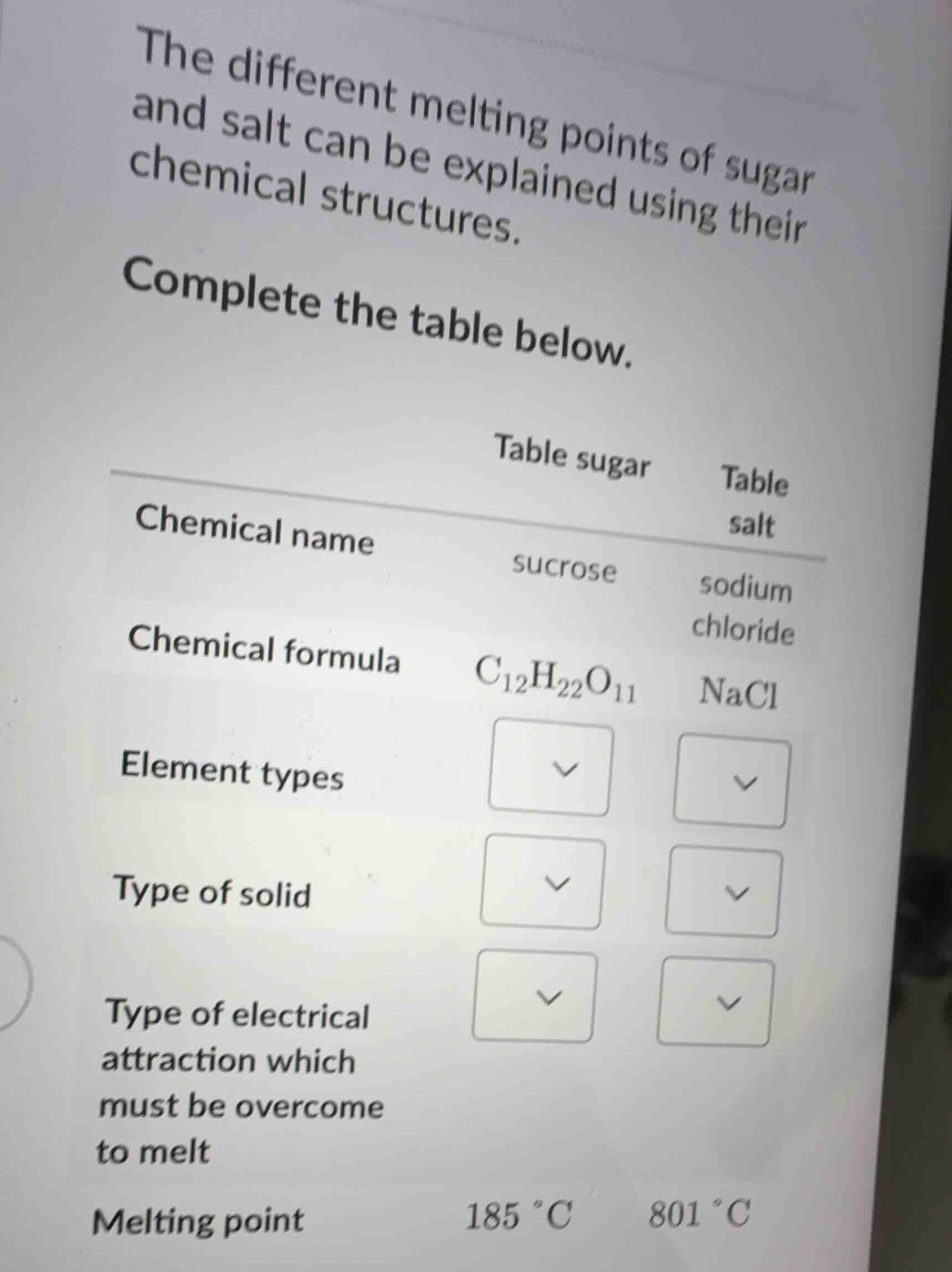
the different melting points of sugar and salt can be explained using their chemical structures. complete the table below. table sugar table salt chemical name sucrose sodium chloride chemical formula $ce{c_{12}h_{22}o_{11}}$ $ce{nacl}$ element types $\boldsymbol{downarrow}$ $\boldsymbol{downarrow}$ type of solid $\boldsymbol{downarrow}$ $\boldsymbol{downarrow}$ type of electrical attraction which must be overcome to melt $\boldsymbol{downarrow}$ $\boldsymbol{downarrow}$ melting point $185 ^{circ}\text{c}$ $801 ^{circ}\text{c}$
Step1: Analyze Table Sugar (Sucrose, $\boldsymbol{C_{12}H_{22}O_{11}}$)
- Element types: Sucrose is composed of carbon (C), hydrogen (H), and oxygen (O). All these are non - metals. So the element types for sucrose are non - metals.
- Type of solid: Sucrose is a molecular solid. Molecular solids are formed by molecules held together by intermolecular forces (like van der Waals forces, hydrogen bonding in some cases). In sucrose, the $C_{12}H_{22}O_{11}$ molecules are held together by intermolecular forces.
- Type of electrical attraction to overcome: For molecular solids, the intermolecular forces (like dipole - dipole, London dispersion forces, and hydrogen bonding between the - OH groups in sucrose) need to be overcome to melt the solid.
Step2: Analyze Table Salt (Sodium Chloride, $\boldsymbol{NaCl}$)
- Element types: Sodium (Na) is a metal and chlorine (Cl) is a non - metal. So the element types for sodium chloride are metal and non - metal.
- Type of solid: Sodium chloride is an ionic solid. Ionic solids are composed of ions ( $Na^+$ and $Cl^-$ ) held together by ionic bonds.
- Type of electrical attraction to overcome: For ionic solids, the ionic bonds (electrostatic attraction between positive and negative ions) need to be overcome to melt the solid.

Snap & solve any problem in the app
Get step-by-step solutions on Sovi AI
Photo-based solutions with guided steps
Explore more problems and detailed explanations
| Chemical name | Table sugar (sucrose) | Table salt (sodium chloride) |
|---|---|---|
| Element types | Non - metals (C, H, O) | Metal (Na) and Non - metal (Cl) |
| Type of solid | Molecular solid | Ionic solid |
| Type of electrical attraction to overcome | Intermolecular forces | Ionic bonds (electrostatic attraction) |
| Melting point | $185^{\circ}C$ | $801^{\circ}C$ |