QUESTION IMAGE
Question
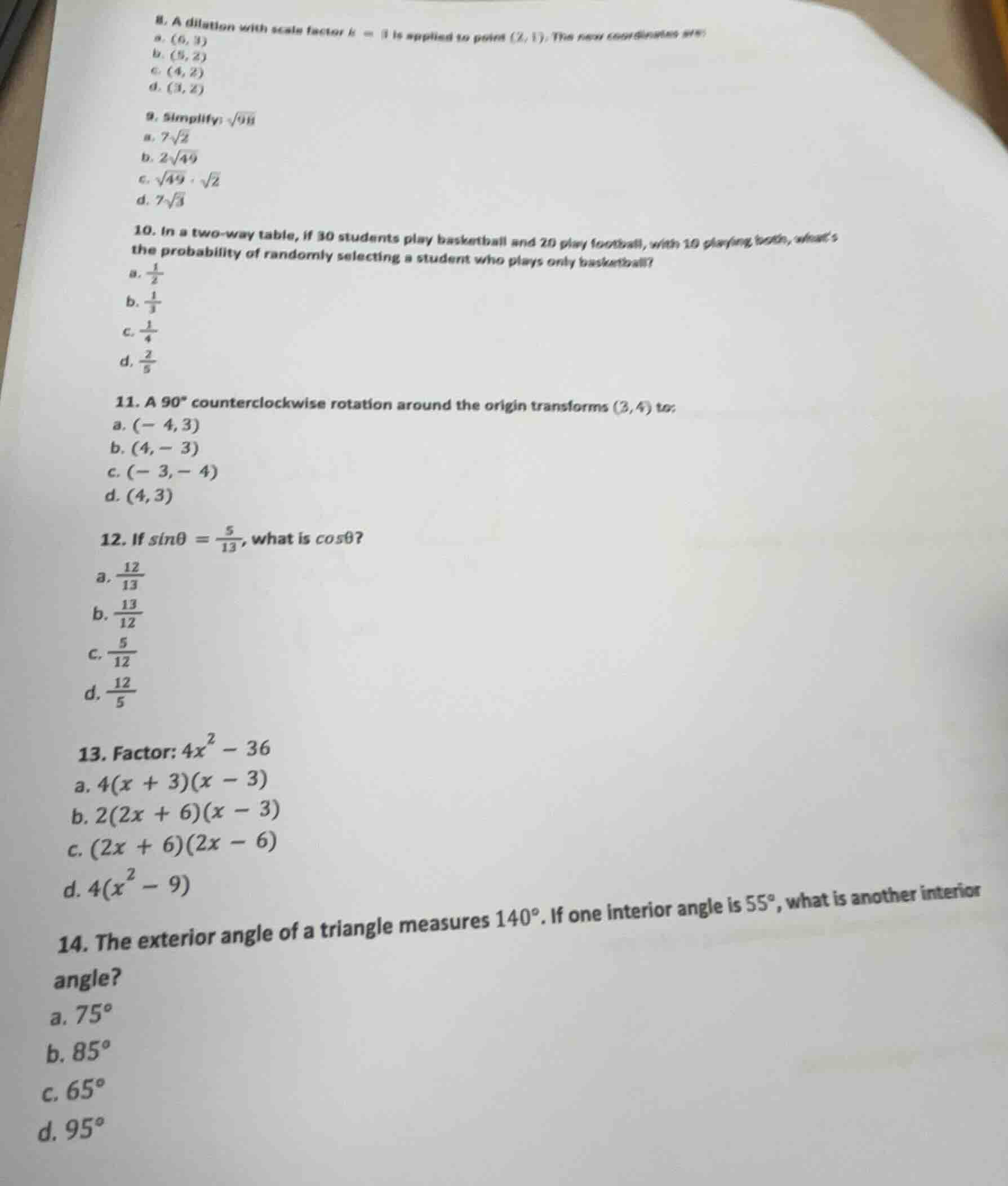
- a dilation with scale factor ( k = 3 ) is applied to point ( (2, 1) ). the new coordinates are:
a. ( (6, 3) )
b. ( (5, 2) )
c. ( (4, 2) )
d. ( (3, 2) )
- simplify ( sqrt{98} )
a. ( 7sqrt{2} )
b. ( 2sqrt{49} )
c. ( sqrt{49} cdot sqrt{2} )
d. ( 7sqrt{3} )
- in a two - way table, if 30 students play basketball and 20 play football, with 10 playing both, whats the probability of randomly selecting a student who plays only basketball?
a. ( \frac{1}{2} )
b. ( \frac{1}{3} )
c. ( \frac{1}{4} )
d. ( \frac{2}{5} )
- a ( 90^{circ} ) counterclockwise rotation around the origin transforms ( (3, 4) ) to:
a. ( (-4, 3) )
b. ( (4, -3) )
c. ( (-3, -4) )
d. ( (4, 3) )
- if ( sin\theta=\frac{5}{13} ), what is ( cos\theta )?
a. ( \frac{12}{13} )
b. ( \frac{13}{12} )
c. ( \frac{5}{12} )
d. ( \frac{12}{5} )
- factor: ( 4x^{2}-36 )
a. ( 4(x + 3)(x - 3) )
b. ( 2(2x + 6)(x - 3) )
c. ( (2x + 6)(2x - 6) )
d. ( 4(x^{2}-9) )
- the exterior angle of a triangle measures ( 140^{circ} ). if one interior angle is ( 55^{circ} ), what is another interior angle?
a. ( 75^{circ} )
b. ( 85^{circ} )
c. ( 65^{circ} )
d. ( 95^{circ} )
Question 8
Step1: Recall dilation formula
For a dilation with scale factor \( k \), the new coordinates \((x', y')\) of a point \((x, y)\) are given by \( x' = kx \) and \( y' = ky \).
Step2: Apply scale factor \( k = 3 \) to \((2, 1)\)
\( x' = 3\times2 = 6 \), \( y' = 3\times1 = 3 \). So the new coordinates are \((6, 3)\).
Step1: Factor 98
We know that \( 98 = 49\times2 \), where 49 is a perfect square.
Step2: Simplify the square root
Using the property \( \sqrt{ab}=\sqrt{a}\cdot\sqrt{b} \) (\( a\geq0, b\geq0 \)), we have \( \sqrt{98}=\sqrt{49\times2}=\sqrt{49}\cdot\sqrt{2} = 7\sqrt{2} \).
Step1: Find number of only basketball players
Total basketball players = 30, both basketball and football = 10. So only basketball players = \( 30 - 10 = 20 \).
Step2: Find total number of players
Using the principle of inclusion - exclusion, total players = basketball + football - both = \( 30 + 20 - 10 = 40 \).
Step3: Calculate probability
Probability of only basketball = \( \frac{\text{only basketball}}{\text{total}}=\frac{20}{40}=\frac{1}{2} \)? Wait, no, wait: Wait, 30 play basketball, 10 play both, so only basketball is \( 30 - 10 = 20 \). Total students: basketball (30) + football (20) - both (10) = 40. Wait, but the options: Wait, maybe I made a mistake. Wait, 30 play basketball, 10 play both, so only basketball is \( 30 - 10 = 20 \). Football only is \( 20 - 10 = 10 \). Total students: \( 20 + 10 + 10 = 40 \)? Wait, no, the two - way table: the formula for total is \( n(B\cup F)=n(B)+n(F)-n(B\cap F)=30 + 20 - 10 = 40 \). The number of only basketball is \( n(B)-n(B\cap F)=30 - 10 = 20 \). So probability is \( \frac{20}{40}=\frac{1}{2} \)? But let's check the options. Option a is \( \frac{1}{2} \). Wait, but let's re - check. Wait, 30 play basketball, 10 play both, so only basketball is 20. Total students: 30 (basketball) + 20 (football) - 10 (both) = 40. So probability is \( \frac{20}{40}=\frac{1}{2} \).

Snap & solve any problem in the app
Get step-by-step solutions on Sovi AI
Photo-based solutions with guided steps
Explore more problems and detailed explanations
a. \((6, 3)\)