QUESTION IMAGE
Question
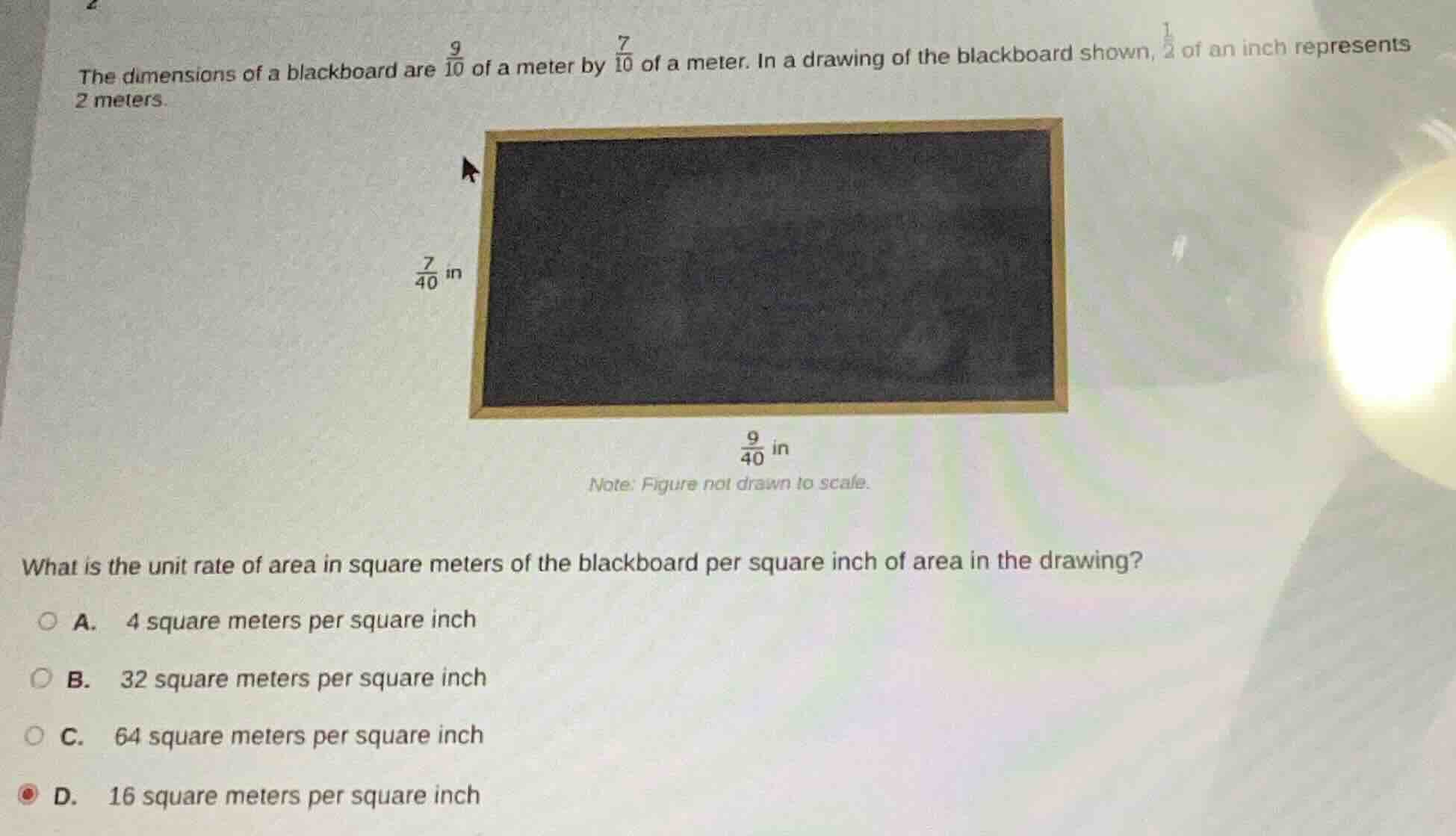
the dimensions of a blackboard are \\(\frac{9}{10}\\) of a meter by \\(\frac{7}{10}\\) of a meter. in a drawing of the blackboard shown, \\(\frac{1}{2}\\) of an inch represents 2 meters.
image of a rectangle (blackboard drawing) with \\(\frac{7}{40}\\) in on the side and \\(\frac{9}{40}\\) in at the bottom. note: figure not drawn to scale.
what is the unit rate of area in square meters of the blackboard per square inch of area in the drawing?
\\(\circ\\) a. 4 square meters per square inch
\\(\circ\\) b. 32 square meters per square inch
\\(\circ\\) c. 64 square meters per square inch
\\(\circ\\) d. 16 square meters per square inch
Step1: Find the scale factor for length
We know that $\frac{1}{2}$ inch represents 2 meters. So the scale factor (meters per inch) is calculated by dividing the number of meters by the number of inches.
The scale factor $k$ (length) is $k=\frac{2}{\frac{1}{2}} = 2\times2=4$ meters per inch. But for area, the scale factor is the square of the length scale factor. So the area scale factor $K=k^{2}=4^{2} = 16$? Wait, no, wait. Wait, let's do it step by step.
Wait, first, let's find the actual area of the blackboard and the area of the drawing, then find the ratio.
Actual dimensions: length $l=\frac{9}{10}$ m, width $w=\frac{7}{10}$ m. So actual area $A_{actual}=l\times w=\frac{9}{10}\times\frac{7}{10}=\frac{63}{100}$ m²? Wait, no, that's not right. Wait, no, the scale is $\frac{1}{2}$ inch represents 2 meters. So first, let's find the scale factor for length: 2 meters is represented by $\frac{1}{2}$ inch. So 1 inch represents $2\div\frac{1}{2}=4$ meters. So 1 inch (drawing) = 4 meters (actual). Therefore, the scale factor for length is 4 meters per inch. Then, for area, since area is length × width, the scale factor for area is (4 meters per inch)² = 16 square meters per square inch? Wait, but let's check with the given drawing dimensions.
Drawing dimensions: length $l_{drawing}=\frac{9}{40}$ inch, width $w_{drawing}=\frac{7}{40}$ inch. So drawing area $A_{drawing}=l_{drawing}\times w_{drawing}=\frac{9}{40}\times\frac{7}{40}=\frac{63}{1600}$ square inches.
Actual area: $A_{actual}=\frac{9}{10}\times\frac{7}{10}=\frac{63}{100}$ square meters.
Now, the unit rate is $\frac{A_{actual}}{A_{drawing}}=\frac{\frac{63}{100}}{\frac{63}{1600}}$. The 63 cancels out, and we have $\frac{1600}{100}=16$? Wait, that's 16. But wait, let's check the scale factor again.
Wait, the scale is $\frac{1}{2}$ inch = 2 meters. So 1 inch = 4 meters (since $\frac{1}{2}$ inch is 2 meters, so 1 inch is 2×2=4 meters). So the length scale factor is 4 meters per inch. Therefore, area scale factor is (4 meters per inch)² = 16 square meters per square inch. So the unit rate (actual area per drawing area) is 16 square meters per square inch. Let's verify with the areas.
Drawing area: $\frac{9}{40}\times\frac{7}{40}=\frac{63}{1600}$ in².
Actual area: $\frac{9}{10}\times\frac{7}{10}=\frac{63}{100}$ m².
Then $\frac{63/100}{63/1600}=\frac{1600}{100}=16$. So the unit rate is 16 square meters per square inch.
Step2: Verify using scale factor for area
Since the length scale factor (meters per inch) is $k = \frac{2}{\frac{1}{2}}=4$ meters per inch. Then the area scale factor (square meters per square inch) is $k^{2}=4^{2}=16$. So the unit rate is 16 square meters per square inch.

Snap & solve any problem in the app
Get step-by-step solutions on Sovi AI
Photo-based solutions with guided steps
Explore more problems and detailed explanations
D. 16 square meters per square inch