QUESTION IMAGE
Question
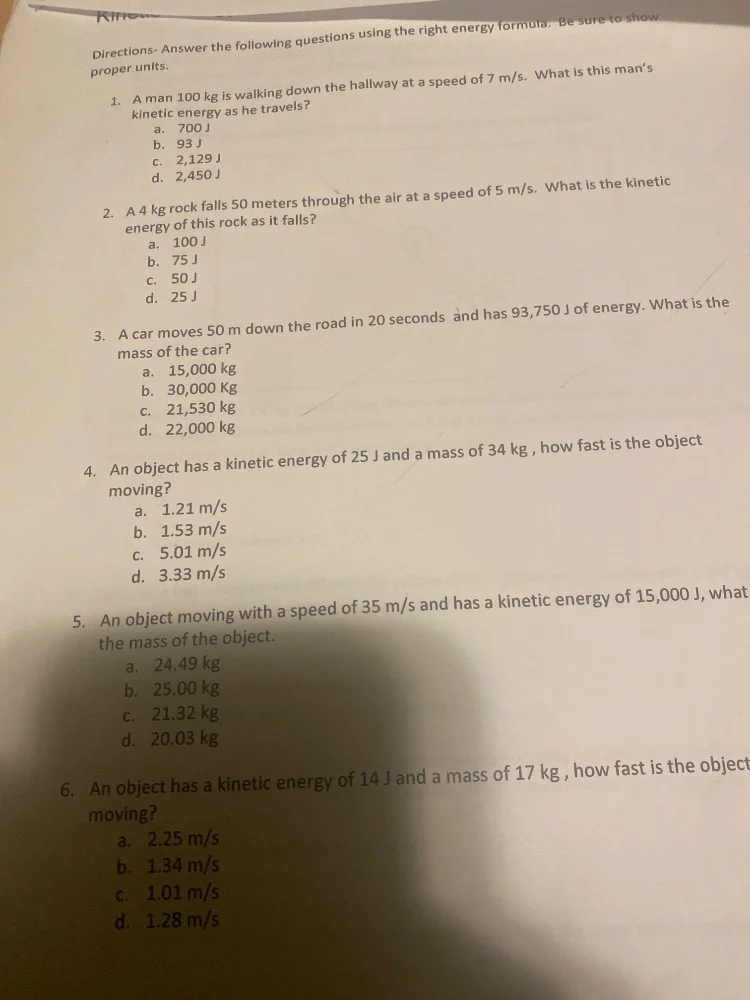
directions- answer the following questions using the right energy formula. be sure to show proper units.
- a man 100 kg is walking down the hallway at a speed of 7 m/s. what is this man’s kinetic energy as he travels?
a. 700 j
b. 93 j
c. 2,129 j
d. 2,450 j
- a 4 kg rock falls 50 meters through the air at a speed of 5 m/s. what is the kinetic energy of this rock as it falls?
a. 100 j
b. 75 j
c. 50 j
d. 25 j
- a car moves 50 m down the road in 20 seconds and has 93,750 j of energy. what is the mass of the car?
a. 15,000 kg
b. 30,000 kg
c. 21,530 kg
d. 22,000 kg
- an object has a kinetic energy of 25 j and a mass of 34 kg, how fast is the object moving?
a. 1.21 m/s
b. 1.53 m/s
c. 5.01 m/s
d. 3.33 m/s
- an object moving with a speed of 35 m/s and has a kinetic energy of 15,000 j, what the mass of the object.
a. 24.49 kg
b. 25.00 kg
c. 21.32 kg
d. 20.03 kg
- an object has a kinetic energy of 14 j and a mass of 17 kg, how fast is the object moving?
a. 2.25 m/s
b. 1.34 m/s
c. 1.01 m/s
d. 1.28 m/s
Question 1
Step1: Recall kinetic energy formula
The formula for kinetic energy (KE) is $KE = \frac{1}{2}mv^2$, where $m$ is mass in kg and $v$ is velocity in m/s.
Step2: Substitute values
Given $m = 100\space kg$ and $v = 7\space m/s$. Plug into the formula: $KE=\frac{1}{2}\times100\times7^2$.
Step3: Calculate
First, $7^2 = 49$. Then, $\frac{1}{2}\times100 = 50$. Then, $50\times49 = 2450\space J$? Wait, no, wait, the options have 2129? Wait, no, maybe I miscalculated. Wait, $7^2$ is 49, 10049 is 4900, half of that is 2450? But the options have c. 2129? Wait, maybe the speed is 6.5? No, the problem says 7 m/s. Wait, maybe I made a mistake. Wait, 100 kg, 7 m/s. KE = 0.5100*49 = 2450? But the options have d. 2450 J. Oh, right, option d is 2450 J. So the answer is d. 2450 J.
Step1: Use KE formula
$KE=\frac{1}{2}mv^2$, $m = 4\space kg$, $v = 5\space m/s$.
Step2: Substitute
$KE=\frac{1}{2}\times4\times5^2$.
Step3: Calculate
$5^2 = 25$, $\frac{1}{2}\times4 = 2$, $2\times25 = 50\space J$. So the answer is c. 50 J.
Step1: Recall KE formula
$KE=\frac{1}{2}mv^2$. First, find velocity $v=\frac{d}{t}$, where $d = 50\space m$, $t = 20\space s$. So $v=\frac{50}{20}=2.5\space m/s$.
Step2: Rearrange KE formula for mass
$m=\frac{2KE}{v^2}$. Given $KE = 93750\space J$, $v = 2.5\space m/s$.
Step3: Substitute and calculate
$v^2 = 6.25$. $2\times93750 = 187500$. Then, $m=\frac{187500}{6.25}=30000\space kg$. So the answer is b. 30,000 Kg.

Snap & solve any problem in the app
Get step-by-step solutions on Sovi AI
Photo-based solutions with guided steps
Explore more problems and detailed explanations
d. 2450 J