QUESTION IMAGE
Question
directions: answer each of the following regents multiple c
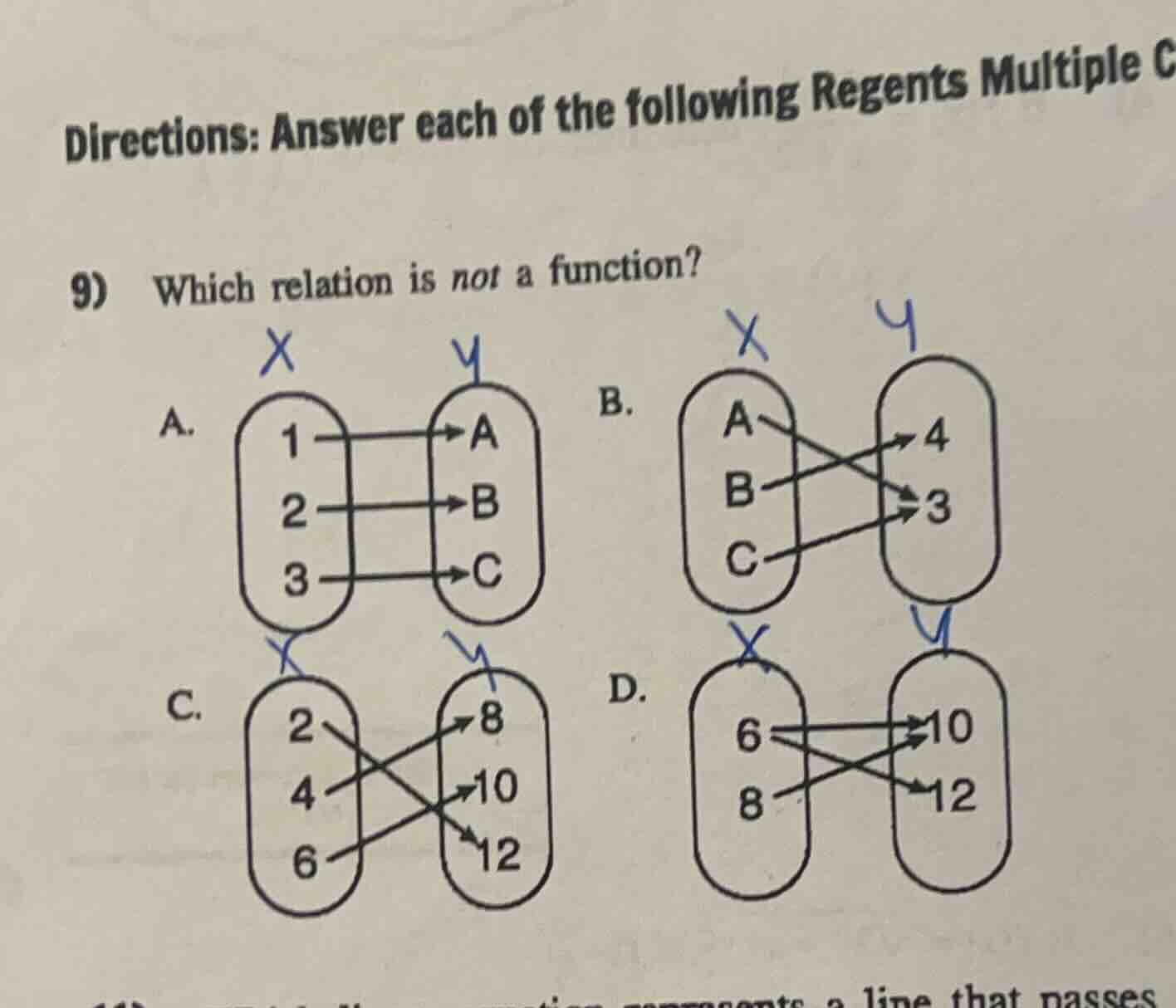
- which relation is not a function?
a.
x: 1, 2, 3
y: a, b, c
1→a, 2→b, 3→c
b.
x: a, b, c
y: 4, 3
a→4, a→3, b→4, b→3, c→3
c.
x: 2, 4, 6
y: 8, 10, 12
2→8, 2→10, 4→8, 4→12, 6→10, 6→12
d.
x: 6, 8
y: 10, 12
6→10, 6→12, 8→10, 8→12
Step1: Recall the definition of a function
A function is a relation where each input (element in the domain, the \( x \)-set) has exactly one output (element in the codomain, the \( y \)-set). So we need to check each option to see if any input has more than one output.
Step2: Analyze Option A
In Option A, the domain elements are \( 1 \), \( 2 \), \( 3 \). Each domain element maps to exactly one codomain element (\( 1 \to A \), \( 2 \to B \), \( 3 \to C \)). So this is a function.
Step3: Analyze Option B
In Option B, the domain elements are \( A \), \( B \), \( C \). Each domain element maps to exactly one codomain element (\( A \to 4 \), \( B \to 3 \), \( C \to 3 \)). Note that multiple domain elements can map to the same codomain element (that's allowed in a function, it's just not allowed for a single domain element to map to multiple codomain elements). So this is a function.
Step4: Analyze Option C
In Option C, the domain elements are \( 2 \), \( 4 \), \( 6 \). Each domain element maps to exactly one codomain element (\( 2 \to 8 \), \( 4 \to 10 \), \( 6 \to 12 \))? Wait, no, looking at the diagram, actually \( 2 \) maps to \( 8 \) and \( 12 \)? Wait, no, let's re - check. Wait, the diagram for C: \( 2 \) has an arrow to \( 8 \) and \( 12 \)? Wait, no, maybe I misread. Wait, no, let's check Option D.
Step5: Analyze Option D
In Option D, the domain element \( 6 \) has arrows to both \( 10 \) and \( 12 \). So the input \( 6 \) (in the domain, the \( x \)-set) has more than one output (it maps to both \( 10 \) and \( 12 \) in the codomain, the \( y \)-set). By the definition of a function, each input must have exactly one output. So this relation is not a function.

Snap & solve any problem in the app
Get step-by-step solutions on Sovi AI
Photo-based solutions with guided steps
Explore more problems and detailed explanations
D. The relation in option D is not a function because the domain element 6 maps to two different codomain elements (10 and 12), violating the definition of a function where each input must have exactly one output.