QUESTION IMAGE
Question
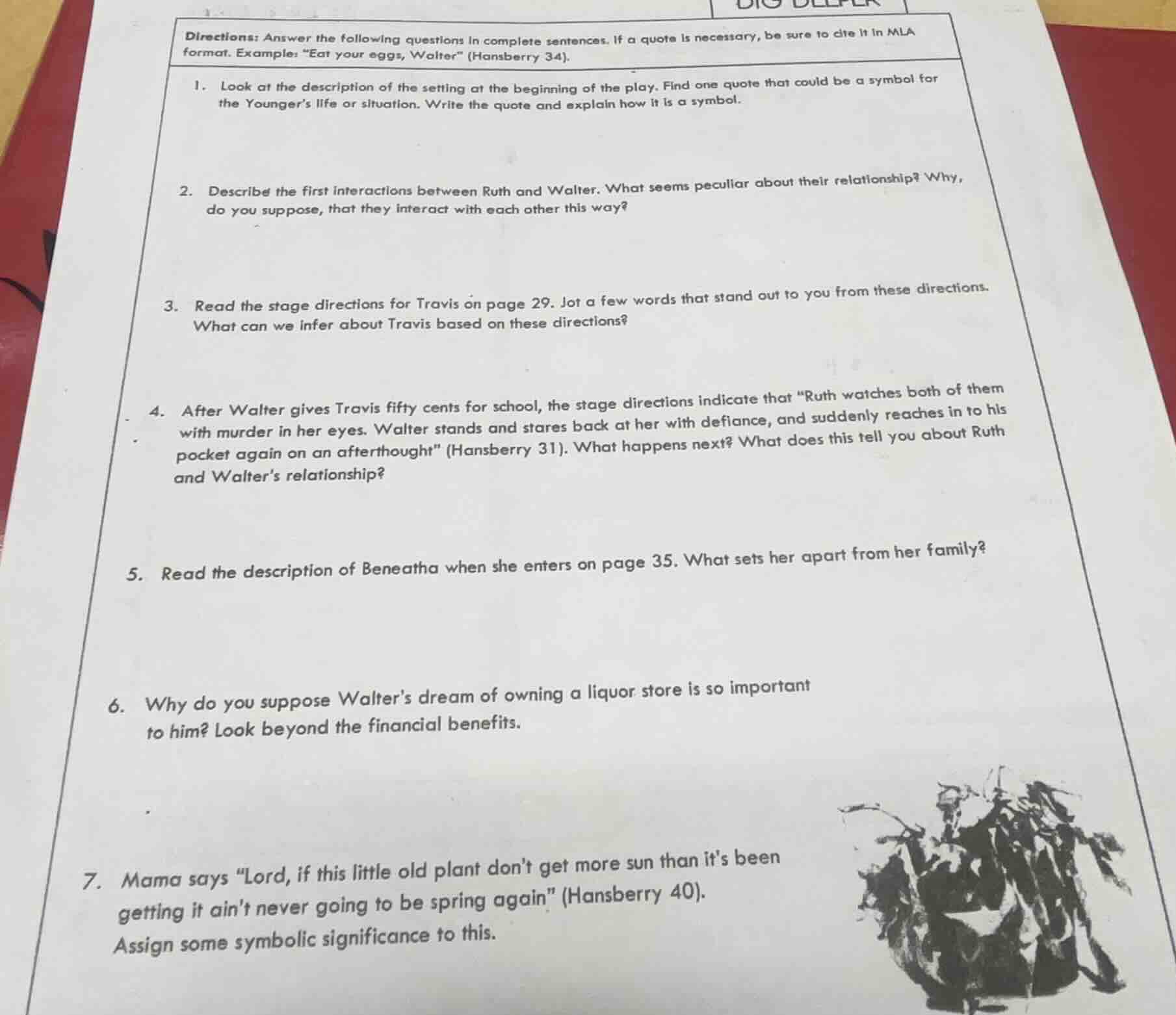
directions: answer the following questions in complete sentences. if a quote is necessary, be sure to cite it in mla format. example: \eat your eggs, walter\ (hansberry 34).
- look at the description of the setting at the beginning of the play. find one quote that could be a symbol for the youngers life or situation. write the quote and explain how it is a symbol.
- describe the first interactions between ruth and walter. what seems peculiar about their relationship? why, do you suppose, that they interact with each other this way?
- read the stage directions for travis on page 29. jot a few words that stand out to you from these directions. what can we infer about travis based on these directions?
- after walter gives travis fifty cents for school, the stage directions indicate that
uth watches both of them with murder in her eyes. walter stands and stares back at her with defiance, and suddenly reaches in to his pocket again on an afterthought\ (hansberry 31). what happens next? what does this tell you about ruth and walters relationship?
- read the description of beneatha when she enters on page 35. what sets her apart from her family?
- why do you suppose walters dream of owning a liquor store is so important to him? look beyond the financial benefits.
- mama says \lord, if this little old plant dont get more sun than its been getting it aint never going to be spring again\ (hansberry 40). assign some symbolic significance to this.
Brief Explanations
- Question 1: The opening stage direction "a living room tired of being a living room" (Hansberry 23) symbolizes the Youngers' stagnant, unfulfilled lives. The worn, overused space mirrors how the family has outgrown their cramped apartment and their dreams have been put on hold by financial hardship.
- Question 2: Ruth and Walter's first interactions are tense, short, and focused on practical, mundane tasks like breakfast. What is peculiar is their lack of warmth; Ruth is dismissive of Walter's dreams, and Walter is frustrated by her indifference. This stems from financial stress wearing down their connection, and Walter feeling unheard in the marriage.
- Question 3: Key words from Travis's page 29 stage directions include "scampering," "energetic," and "ravenous." These details infer that Travis is a playful, active young boy who is well-loved but growing up in a space with limited resources, as his ravenousness hints at financial strain affecting meals.
- Question 4: Next, Walter gives Travis an extra fifty cents, going against Ruth's wishes. This shows their relationship is marked by conflict over money and parenting: Ruth is pragmatic and focused on budgeting, while Walter acts impulsively, wanting to give his son small joys he never had, even if it strains their finances.
- Question 5: When Beneatha enters on page 35, she is described wearing "a bright-colored flannel nightie" and listening to African records, which sets her apart. Unlike her more practical, family-focused mother and sister-in-law, Beneatha is interested in her African heritage, intellectual pursuits, and defies traditional gender roles, making her feel like an outsider in her own home.
- Question 6: Walter's dream of owning a liquor store is important beyond money because it represents his desire for power, respect, and agency. As a Black man working as a chauffeur, he feels powerless and emasculated; owning his own business would let him provide for his family on his own terms and prove his worth to himself and others.
- Question 7: Mama's plant symbolizes the Younger family. Like the plant, the family is surviving in harsh, cramped conditions with limited "sun" (opportunity, hope, financial stability). Mama's care for the plant mirrors her care for her family, and her line suggests that without more opportunity, the family will never thrive or reach their full potential (their "spring").

Snap & solve any problem in the app
Get step-by-step solutions on Sovi AI
Photo-based solutions with guided steps
Explore more problems and detailed explanations
- Quote: "a living room tired of being a living room" (Hansberry 23). This quote symbolizes the Youngers' stagnant, unfulfilled lives, as their worn apartment mirrors their put-on-hold dreams and cramped, unchanging circumstances.
- Ruth and Walter's first interactions are tense, short, and focused on mundane tasks, with little warmth. Their peculiar, distant dynamic stems from financial stress that has eroded their emotional connection, leaving Walter feeling unheard and Ruth focused solely on practical survival.
- Standout words: "scampering," "energetic," "ravenous." We can infer Travis is a playful, active young boy who is growing up in a resource-strapped household, as his ravenousness hints at financial limits on food access.
- Walter gives Travis an extra fifty cents, ignoring Ruth's unspoken protest. This shows their relationship is defined by conflict over money and parenting: Ruth is pragmatic and budget-focused, while Walter acts impulsively to give his son small, joyful freedoms he never had, even at the cost of financial sense.
- Beneatha is set apart by her interest in her African heritage (shown by listening to African records) and her rejection of traditional gender and domestic roles, unlike her more family-focused, practical mother and sister-in-law.
- Walter's liquor store dream is important because it represents his desire for power, respect, and agency. As a Black man working a demeaning chauffeur job, owning a business would let him take control of his life, provide for his family on his own terms, and prove his self-worth.
- Mama's plant symbolizes the Younger family. The plant survives in cramped, low-light conditions, just as the family survives financial hardship and limited opportunity. Mama's line means that without more hope and opportunity ("sun"), the family will never thrive or reach their full potential.