QUESTION IMAGE
Question
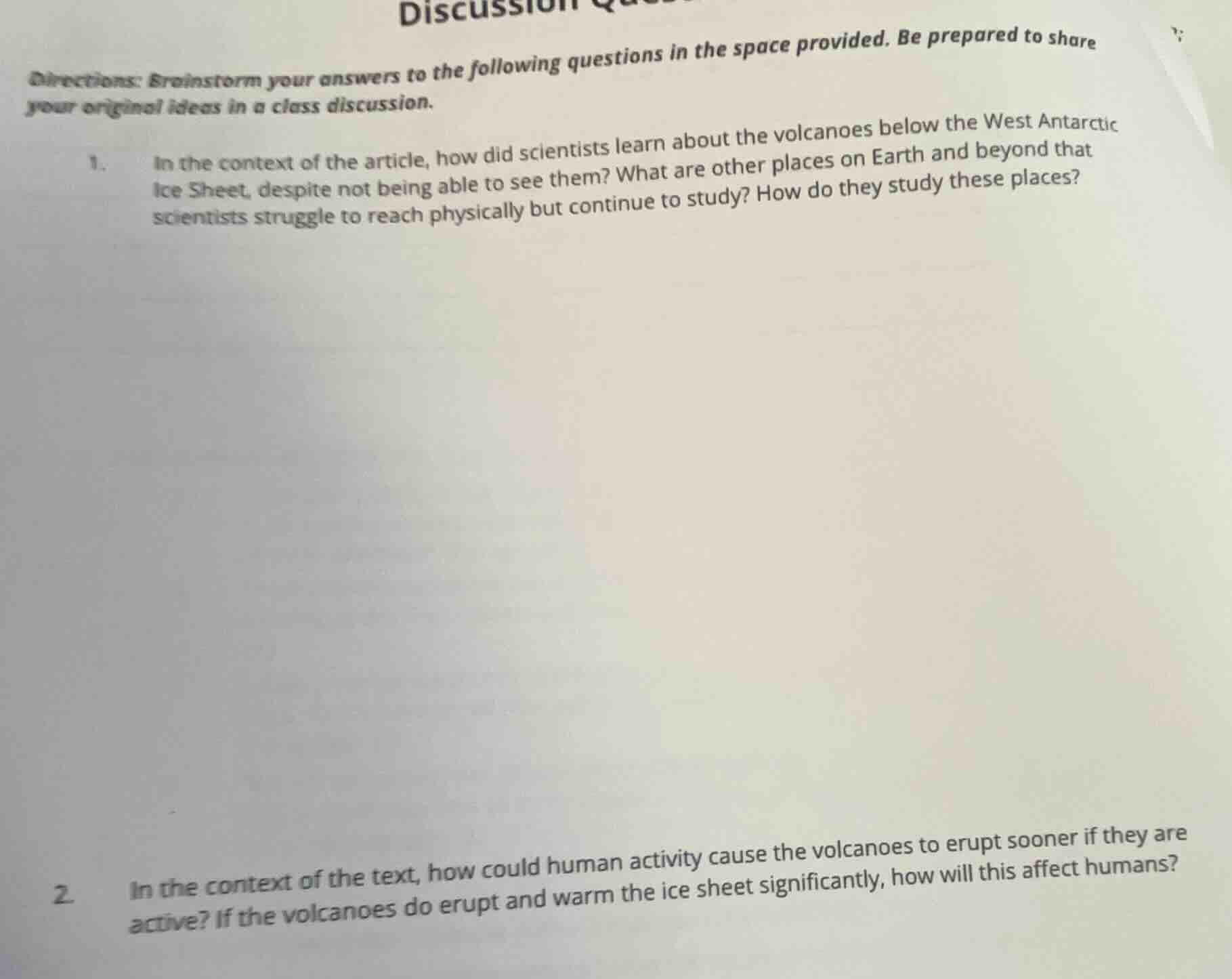
directions: brainstorm your answers to the following questions in the space provided. be prepared to share your original ideas in a class discussion. 1. in the context of the article, how did scientists learn about the volcanoes below the west antarctic ice sheet, despite not being able to see them? what are other places on earth and beyond that scientists struggle to reach physically but continue to study? how do they study these places? 2. in the context of the text, how could human activity cause the volcanoes to erupt sooner if they are active? if the volcanoes do erupt and warm the ice sheet significantly, how will this affect humans?
For Question 1:
- West Antarctic Ice Sheet Volcanoes: Scientists use airborne radar and seismic surveys. Radar penetrates ice to map the bedrock, identifying volcanic landforms. Seismic sensors detect underground activity that signals magma movement.
- Hard-to-Reach Locations:
- Submarine Trenches (Earth): Remote-operated vehicles (ROVs) and autonomous underwater vehicles (AUVs) with cameras and sampling tools explore these deep, high-pressure areas.
- Mars (Beyond Earth): Orbiting satellites use spectrometers to analyze surface composition, and rovers collect rock/soil samples to study geology and potential habitability.
- Study Methods: All these rely on remote sensing tools (radar, satellites, seismic equipment) and unmanned vehicles to gather data without direct human presence.
For Question 2:
- Human Activity and Eruption Risk: Human-caused climate change warms the atmosphere, which in turn warms the edges of the Antarctic ice sheet. This warming can thin the ice, reducing the pressure on underlying volcanoes. Reduced pressure can lower the melting point of magma, making it easier for magma to rise and potentially triggering earlier eruptions.
- Impacts of Eruption and Ice Warming:
- Sea Level Rise: Warming from volcanic activity will speed up ice sheet melting, causing global sea levels to rise. This threatens coastal cities, island nations, and low-lying areas with flooding, erosion, and saltwater intrusion into freshwater supplies.
- Climate Disruption: Volcanic eruptions release ash and greenhouse gases like sulfur dioxide. Ash can block sunlight, temporarily cooling the atmosphere, while greenhouse gases can contribute to long-term warming, creating unpredictable shifts in global weather patterns.
- Ecosystem Disruption: Melting ice will alter Antarctic ecosystems, affecting species like penguins and krill. Changes in ocean circulation from freshwater input can also disrupt marine ecosystems worldwide.

Snap & solve any problem in the app
Get step-by-step solutions on Sovi AI
Photo-based solutions with guided steps
Explore more problems and detailed explanations
Question 1:
- Scientists studied West Antarctic sub-ice volcanoes using airborne radar (to map ice-bedrock interfaces) and seismic surveys (to detect magma movement).
- Other hard-to-reach places:
- Earth: Deep ocean trenches, remote polar interior regions
- Beyond Earth: Mars, icy moons like Europa
- Study methods: Remote sensing (satellites, radar), unmanned vehicles (ROVs, rovers), and seismic/geophysical monitoring.
Question 2:
- Human-driven climate change warms and thins the West Antarctic Ice Sheet, reducing pressure on underlying volcanoes; this can lower magma's melting point, potentially triggering earlier eruptions.
- Impacts of eruption and significant ice sheet warming:
- Accelerated global sea level rise, threatening coastal communities.
- Volcanic ash and gas release causing short-term atmospheric cooling and long-term greenhouse warming, disrupting weather patterns.
- Disruption of Antarctic and global marine ecosystems from ice melt and altered ocean conditions.