QUESTION IMAGE
Question
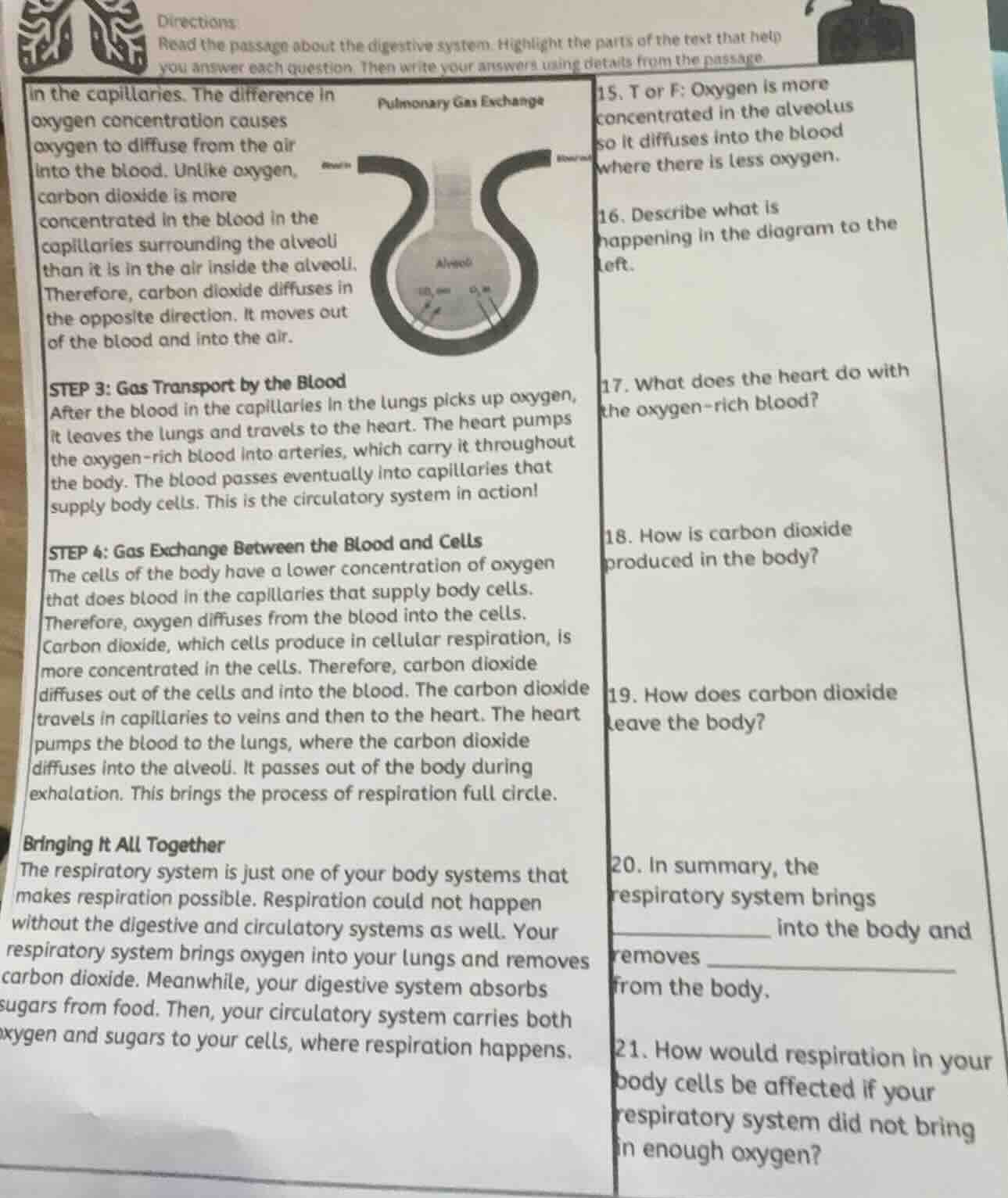
directions: read the passage about the digestive system. highlight the parts of the text that help you answer each question. then write your answers using details from the passage. in the capillaries. the difference in oxygen concentration causes oxygen to diffuse from the air into the blood. unlike oxygen, carbon dioxide is more concentrated in the blood in the capillaries surrounding the alveoli than it is in the air inside the alveoli. therefore, carbon dioxide diffuses in the opposite direction. it moves out of the blood and into the air. step 3: gas transport by the blood after the blood in the capillaries in the lungs picks up oxygen, it leaves the lungs and travels to the heart. the heart pumps the oxygen - rich blood into arteries, which carry it throughout the body. the blood passes eventually into capillaries that supply body cells. this is the circulatory system in action! step 4: gas exchange between the blood and cells the cells of the body have a lower concentration of oxygen that does blood in the capillaries that supply body cells. therefore, oxygen diffuses from the blood into the cells. carbon dioxide, which cells produce in cellular respiration, is more concentrated in the cells. therefore, carbon dioxide diffuses out of the cells and into the blood. the carbon dioxide travels in capillaries to veins and then to the heart. the heart pumps the blood to the lungs, where the carbon dioxide diffuses into the alveoli. it passes out of the body during exhalation. this brings the process of respiration full circle. bringing it all together the respiratory system is just one of your body systems that makes respiration possible. respiration could not happen without the digestive and circulatory systems as well. your respiratory system brings oxygen into your lungs and removes carbon dioxide. meanwhile, your digestive system absorbs sugars from food. then, your circulatory system carries both oxygen and sugars to your cells, where respiration happens. 15. t or f: oxygen is more concentrated in the alveolus so it diffuses into the blood where there is less oxygen. 16. describe what is happening in the diagram to the left. 17. what does the heart do with the oxygen - rich blood? 18. how is carbon dioxide produced in the body? 19. how does carbon dioxide leave the body? 20. in summary, the respiratory system brings ________ into the body and removes ________ from the body. 21. how would respiration in your body cells be affected if your respiratory system did not bring in enough oxygen?
- The passage states oxygen diffuses from alveolus (higher concentration) to blood (lower concentration).
- The left arrow in the diagram shows oxygen moving from the alveolus into the surrounding capillary blood, as explained in the pulmonary gas exchange text.
- Step 3 of the passage details the heart's role with oxygen-rich blood.
- Step 4 explicitly notes the source of carbon dioxide in the body.
- Step 4 outlines the full path of carbon dioxide leaving the body.
- The final "Bringing It All Together" section summarizes the respiratory system's core function.
- Since cellular respiration relies on oxygen, insufficient oxygen would limit this process.

Snap & solve any problem in the app
Get step-by-step solutions on Sovi AI
Photo-based solutions with guided steps
Explore more problems and detailed explanations
- T (True)
- Oxygen is diffusing from the alveolus (air sac) into the blood in the surrounding capillary, moving from an area of higher oxygen concentration to lower concentration.
- The heart pumps the oxygen-rich blood into arteries, which carry it throughout the body to supply body cells.
- Carbon dioxide is produced by body cells during cellular respiration.
- Carbon dioxide diffuses out of body cells into the blood, travels via capillaries to veins, then to the heart. The heart pumps this blood to the lungs, where carbon dioxide diffuses into alveoli, and it is removed from the body during exhalation.
- oxygen; carbon dioxide
- Respiration in body cells would be limited or unable to function properly, because cellular respiration requires oxygen to produce energy for the cells. Without enough oxygen, cells cannot carry out this process effectively.