QUESTION IMAGE
Question
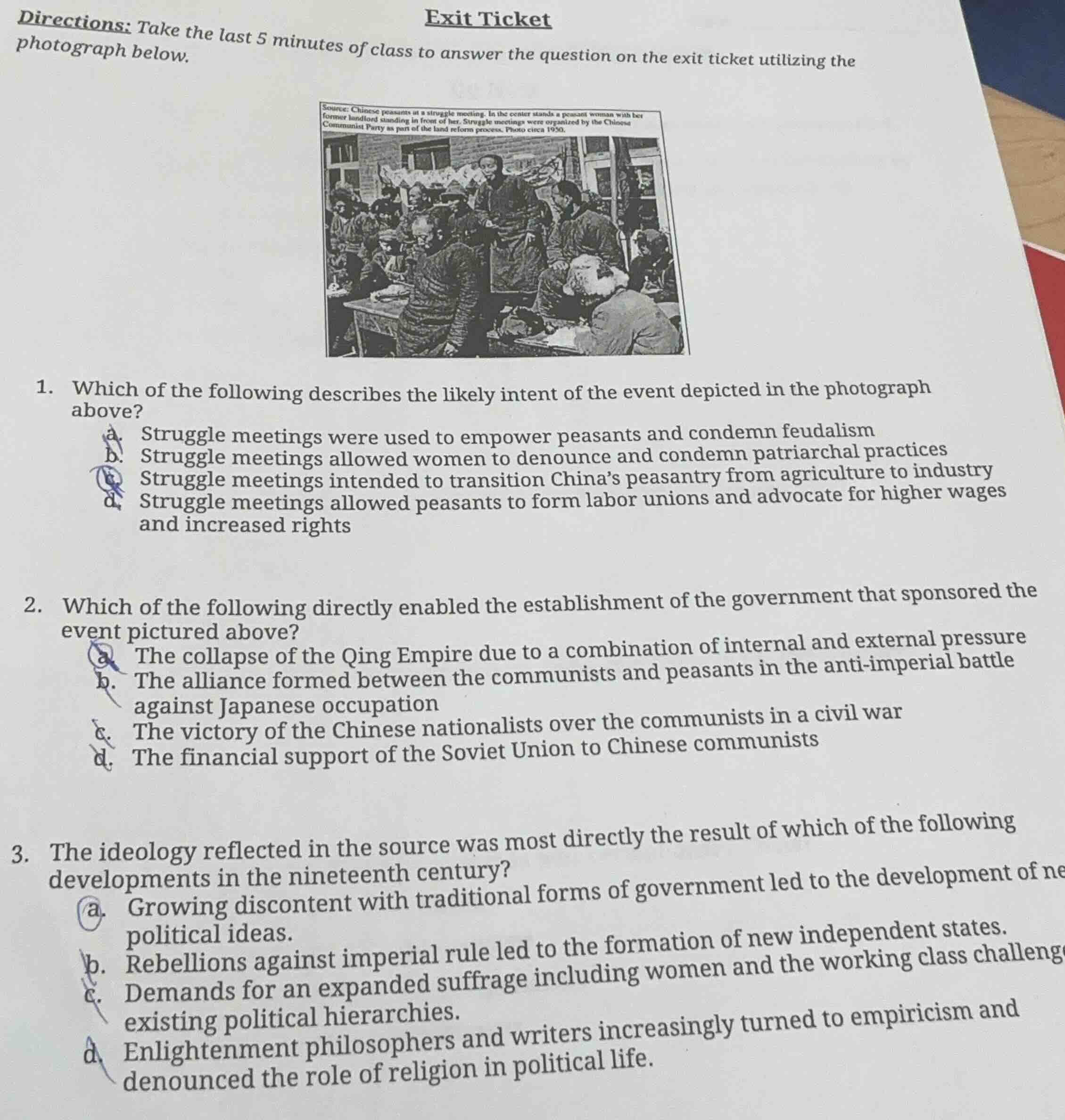
directions: take the last 5 minutes of class to answer the question on the exit ticket utilizing the photograph below.
exit ticket
- which of the following describes the likely intent of the event depicted in the photograph above?
a. struggle meetings were used to empower peasants and condemn feudalism
b. struggle meetings allowed women to denounce and condemn patriarchal practices
c. struggle meetings intended to transition china’s peasantry from agriculture to industry
d. struggle meetings allowed peasants to form labor unions and advocate for higher wages and increased rights
- which of the following directly enabled the establishment of the government that sponsored the event pictured above?
a. the collapse of the qing empire due to a combination of internal and external pressure
b. the alliance formed between the communists and peasants in the anti - imperial battle against japanese occupation
c. the victory of the chinese nationalists over the communists in a civil war
d. the financial support of the soviet union to chinese communists
- the ideology reflected in the source was most directly the result of which of the following developments in the nineteenth century?
a. growing discontent with traditional forms of government led to the development of new political ideas.
b. rebellions against imperial rule led to the formation of new independent states.
c. demands for an expanded suffrage including women and the working class challenged existing political hierarchies.
d. enlightenment philosophers and writers increasingly turned to empiricism and denounced the role of religion in political life.
Question 1
The photograph shows a Chinese peasant struggle meeting (c.1950) organized by the Communist Party for land reform. Feudal landownership (landlords) oppressed peasants. Struggle meetings empowered peasants by denouncing feudalism (landlords) to redistribute land. Option b focuses on patriarchy (not the main intent here), c on agriculture - to - industry (not land reform), d on labor unions/wages (unrelated to land reform). So a is correct.
The event is sponsored by the Chinese Communist government. The CCP's rise was enabled by the anti - Japanese alliance (uniting with peasants) during the war, which strengthened their base. The Qing collapse (a) was earlier, nationalists lost the civil war (c is wrong), Soviet support (d) was less direct than the peasant - communist alliance in anti - Japanese war. So b is correct.
The ideology is communism (from CCP). In the 19th century, discontent with traditional governments (like Qing, imperialist - dominated) led to new political ideas (like communism, socialism). Option b is about new states (not ideology), c about suffrage (not main), d about Enlightenment/religion (unrelated to communist ideology's 19th - century roots). So a is correct.

Snap & solve any problem in the app
Get step-by-step solutions on Sovi AI
Photo-based solutions with guided steps
Explore more problems and detailed explanations
a. Struggle meetings were used to empower peasants and condemn feudalism