QUESTION IMAGE
Question
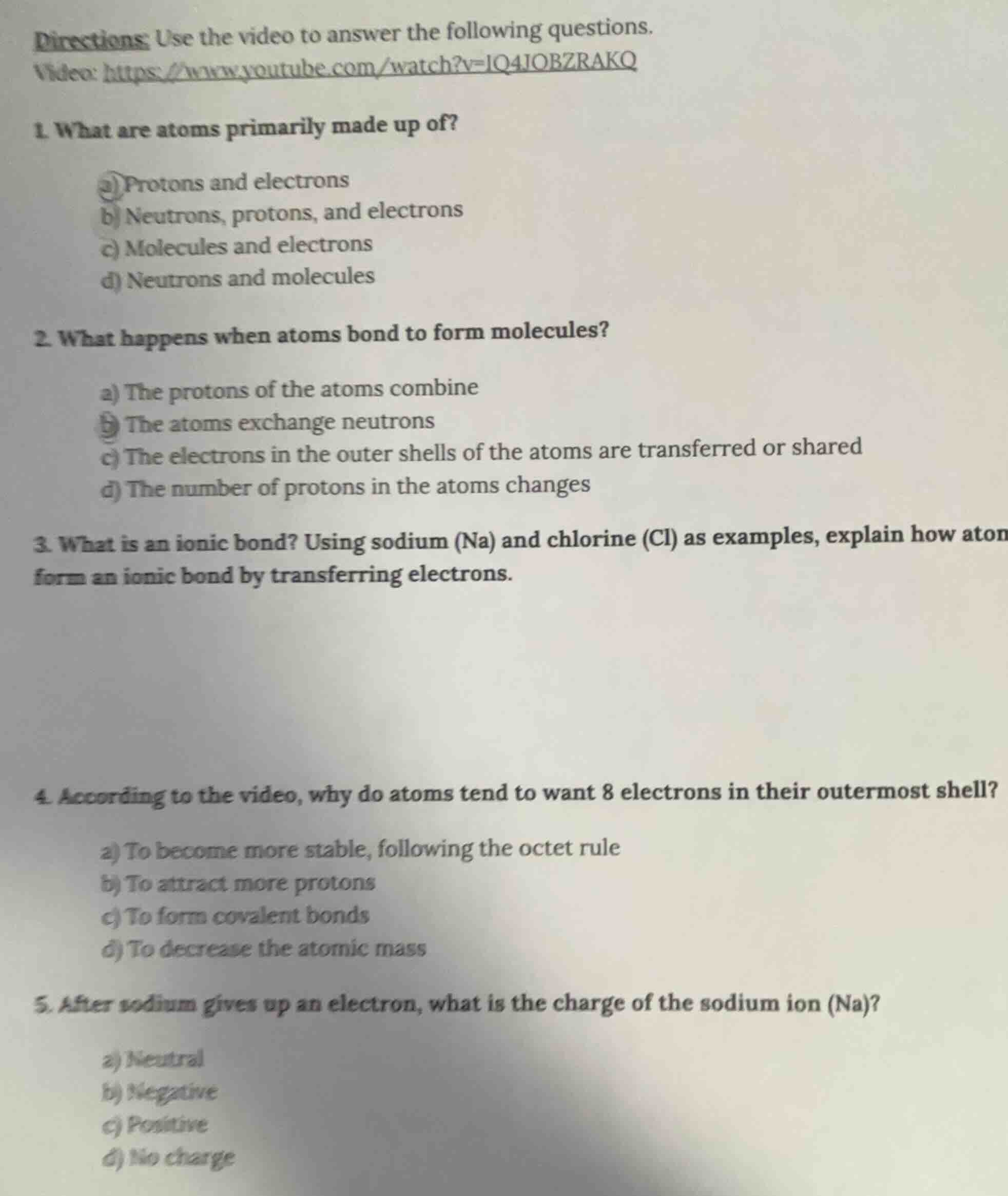
directions: use the video to answer the following questions.
video: https://www.youtube.com/watch?v=iq4iobzrakq
- what are atoms primarily made up of?
a) protons and electrons
b) neutrons, protons, and electrons
c) molecules and electrons
d) neutrons and molecules
- what happens when atoms bond to form molecules?
a) the protons of the atoms combine
b) the atoms exchange neutrons
c) the electrons in the outer shells of the atoms are transferred or shared
d) the number of protons in the atoms changes
- what is an ionic bond? using sodium (na) and chlorine (cl) as examples, explain how atoms form an ionic bond by transferring electrons.
- according to the video, why do atoms tend to want 8 electrons in their outermost shell?
a) to become more stable, following the octet rule
b) to attract more protons
c) to form covalent bonds
d) to decrease the atomic mass
- after sodium gives up an electron, what is the charge of the sodium ion (na)?
a) neutral
b) negative
c) positive
d) no charge
Question 1
Atoms are composed of a nucleus (containing protons and neutrons) and electrons surrounding the nucleus. So the correct components are neutrons, protons, and electrons.
When atoms bond to form molecules, it is the electrons in the outer shells (valence electrons) that are involved in transfer (ionic bonding) or sharing (covalent bonding). Protons don't combine, neutrons aren't exchanged, and proton number doesn't change during bonding.
An ionic bond is a chemical bond formed by the transfer of electrons from one atom to another, resulting in the formation of ions (positively and negatively charged) that are attracted to each other.
- Sodium (Na) has 1 valence electron. Chlorine (Cl) has 7 valence electrons.
- To achieve a stable electron configuration (following the octet rule, having 8 electrons in the outer shell), sodium donates its single valence electron to chlorine.
- After losing an electron, sodium becomes a positively charged ion ($\text{Na}^+$) (since it has more protons than electrons).
- Chlorine, after gaining an electron, becomes a negatively charged ion ($\text{Cl}^-$) (since it has more electrons than protons).
- The opposite charges of $\text{Na}^+$ and $\text{Cl}^-$ attract each other, forming an ionic bond, and the compound formed is sodium chloride ($\text{NaCl}$).
Question 4

Snap & solve any problem in the app
Get step-by-step solutions on Sovi AI
Photo-based solutions with guided steps
Explore more problems and detailed explanations
b) Neutrons, protons, and electrons