QUESTION IMAGE
Question
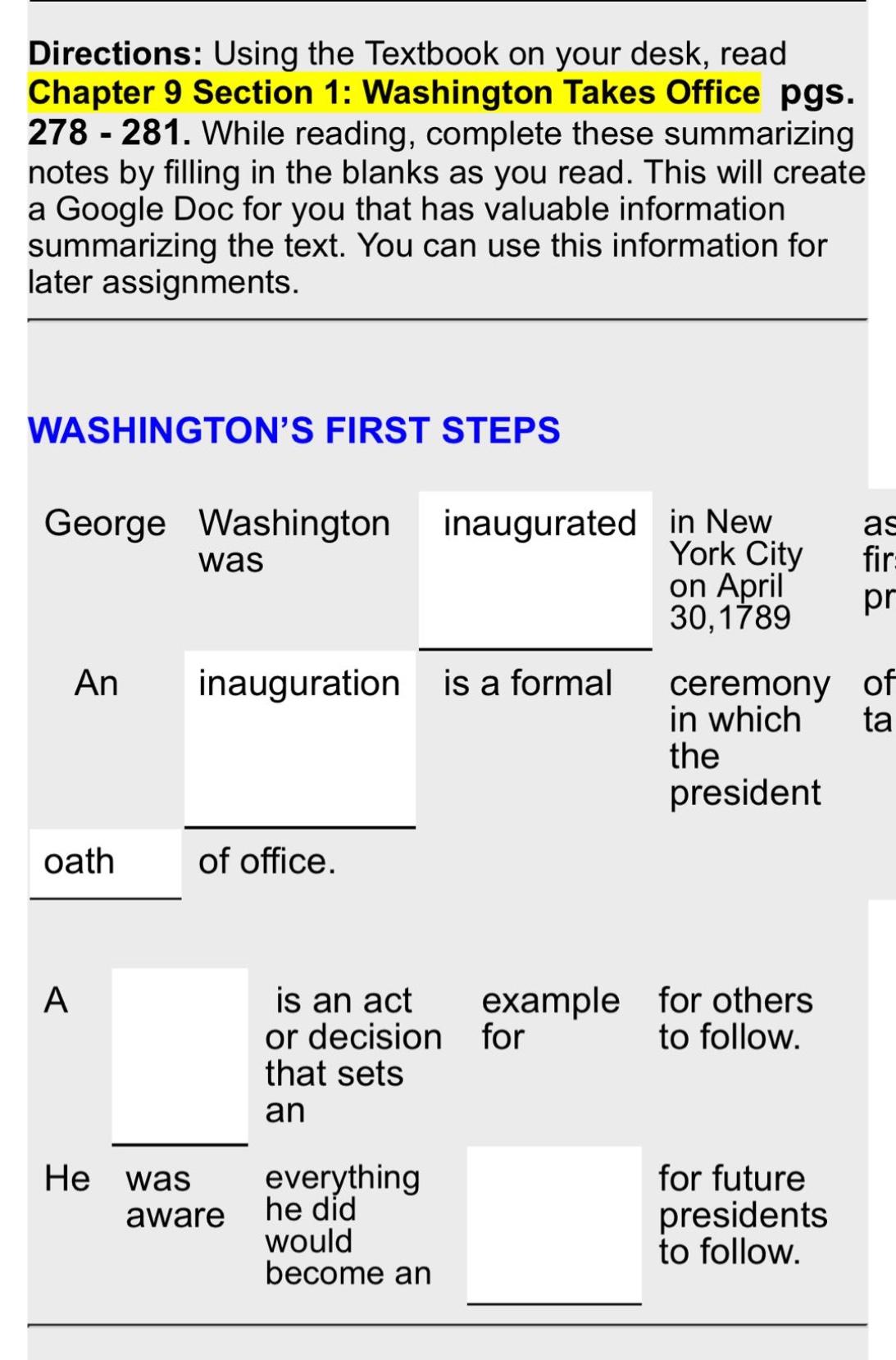
directions: using the textbook on your desk, read chapter 9 section 1: washington takes office pgs. 278 - 281. while reading, complete these summarizing notes by filling in the blanks as you read. this will create a google doc for you that has valuable information summarizing the text. you can use this information for later assignments.
washington’s first steps
george washington was inaugurated in new york city on april 30,1789 as fir pr
an inauguration is a formal ceremony in which the president of ta
oath of office.
a blank is an act or decision that sets an example for others to follow.
he was aware everything he did would become an blank for future presidents to follow.
To solve the blanks, we refer to the context of Washington's inauguration and historical definitions:
First Blank (after "George Washington was"):
The context is about Washington’s inauguration. The word "inaugurated" fits here as it means he was formally sworn in.
Second Blank (after "An"):
The sentence defines an inauguration. The word "inauguration" is the noun form, and the blank is part of defining what an inauguration is (a formal ceremony where the president takes the oath of office). Wait, no—looking at the structure: "An [blank] is a formal ceremony in which the president [takes the oath] of office." Wait, the original has "inauguration" in the box? Wait, no, the first blank under "Washington was" is "inaugurated" (past tense of inaugurate). Then the next blank: "An [blank] is a formal ceremony..." The correct term is "inauguration" (noun) here. Then the next part: "oath of office" is given. Then the next blank: "A [blank] is an act or decision that sets an example..." The term is "precedent" (a precedent is an example to follow). Then the last blank: "He was aware everything he did would become an [blank] for future presidents..." Also "precedent".
Wait, let's re-express:
- George Washington was inaugurated in New York City on April 30, 1789. (Inaugurated: past tense of the verb, meaning sworn into office.)
- An inauguration is a formal ceremony in which the president takes the oath of office. (Inauguration: noun, the ceremony.)
- A precedent is an act or decision that sets an example for others to follow. (Precedent: definition matches "act/decision setting an example".)
- He was aware everything he did would become an precedent for future presidents to follow. (Precedent: what he did set examples (precedents) for later presidents.)
Filling the Blanks:
- First blank (Washington was ____): inaugurated
- Second blank (An ____ is a formal ceremony...): inauguration
- Third blank (A ____ is an act or decision...): precedent
- Fourth blank (would become an ____ for future presidents): precedent
(Note: The original document’s formatting might have the blanks in specific boxes, but based on context and historical knowledge, these are the correct terms.)
Final Answers (for each blank, in order):
- inaugurated
- inauguration
- precedent
- precedent

Snap & solve any problem in the app
Get step-by-step solutions on Sovi AI
Photo-based solutions with guided steps
Explore more problems and detailed explanations
To solve the blanks, we refer to the context of Washington's inauguration and historical definitions:
First Blank (after "George Washington was"):
The context is about Washington’s inauguration. The word "inaugurated" fits here as it means he was formally sworn in.
Second Blank (after "An"):
The sentence defines an inauguration. The word "inauguration" is the noun form, and the blank is part of defining what an inauguration is (a formal ceremony where the president takes the oath of office). Wait, no—looking at the structure: "An [blank] is a formal ceremony in which the president [takes the oath] of office." Wait, the original has "inauguration" in the box? Wait, no, the first blank under "Washington was" is "inaugurated" (past tense of inaugurate). Then the next blank: "An [blank] is a formal ceremony..." The correct term is "inauguration" (noun) here. Then the next part: "oath of office" is given. Then the next blank: "A [blank] is an act or decision that sets an example..." The term is "precedent" (a precedent is an example to follow). Then the last blank: "He was aware everything he did would become an [blank] for future presidents..." Also "precedent".
Wait, let's re-express:
- George Washington was inaugurated in New York City on April 30, 1789. (Inaugurated: past tense of the verb, meaning sworn into office.)
- An inauguration is a formal ceremony in which the president takes the oath of office. (Inauguration: noun, the ceremony.)
- A precedent is an act or decision that sets an example for others to follow. (Precedent: definition matches "act/decision setting an example".)
- He was aware everything he did would become an precedent for future presidents to follow. (Precedent: what he did set examples (precedents) for later presidents.)
Filling the Blanks:
- First blank (Washington was ____): inaugurated
- Second blank (An ____ is a formal ceremony...): inauguration
- Third blank (A ____ is an act or decision...): precedent
- Fourth blank (would become an ____ for future presidents): precedent
(Note: The original document’s formatting might have the blanks in specific boxes, but based on context and historical knowledge, these are the correct terms.)
Final Answers (for each blank, in order):
- inaugurated
- inauguration
- precedent
- precedent