QUESTION IMAGE
Question
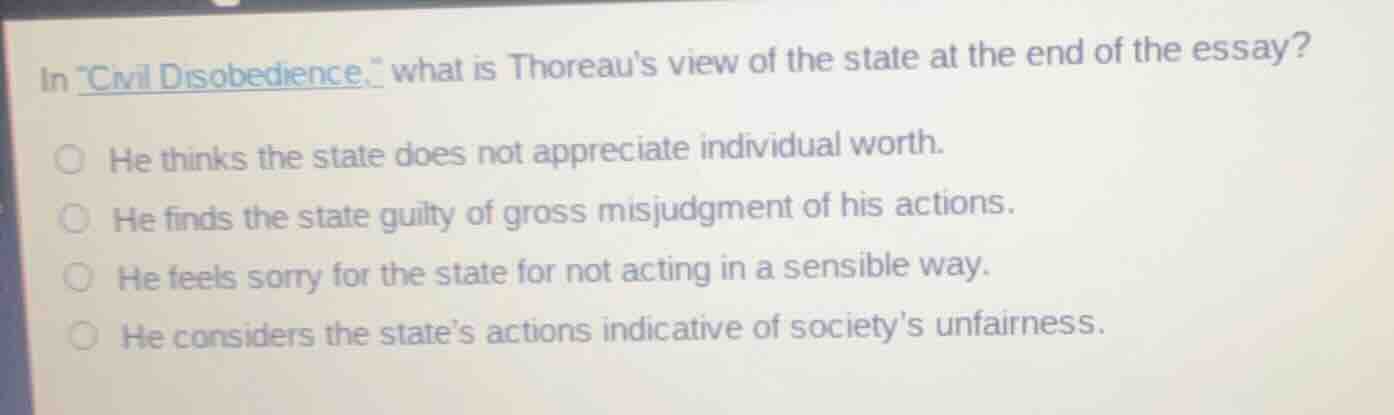
in \civil disobedience,\ what is thoreaus view of the state at the end of the essay?
he thinks the state does not appreciate individual worth.
he finds the state guilty of gross misjudgment of his actions.
he feels sorry for the state for not acting in a sensible way.
he considers the states actions indicative of societys unfairness.
At the end of "Civil Disobedience," Thoreau frames the state as an institution that fails to recognize and value the moral agency and inherent worth of the individual, prioritizing its own authority over the conscience of people. The other options do not align with his concluding perspective: he does not express sympathy for the state, focus on personal misjudgment, or frame the state's actions only as a marker of societal unfairness, but centers on the state's disregard for individual worth.

Snap & solve any problem in the app
Get step-by-step solutions on Sovi AI
Photo-based solutions with guided steps
Explore more problems and detailed explanations
He thinks the state does not appreciate individual worth.